Page Not Found
Page not found. Your pixels are in another canvas.

A list of all the posts and pages found on the site. For you robots out there is an XML version available for digesting as well.
Page not found. Your pixels are in another canvas.
About me
Published:
Published:
Published:
Published:
Published:
Published:
Published:
Published:
Published:
Published:
Published:
Published:
Published:
Published:
Published:
Published:
Published:
Published:
Published:
Published:
Published:
Published:
Published:
Published:
Published:
Published:
Published:
Published:
This is a page not in th emain menu
Published:
Published:
Published:
Published:
Published:
Published:
Published:
Published:
Published:
Published:
Published:
Published:
Published:
Published:
Published:
Published:
Published:
Published:
Published:
Published:
Published:
Published:
Published:
Published:
Published:
Published:
Published:
Published:
Published:
Published:
Published:
Published:
Published:
Published:
Published:
Published:
Published:
Published:
Published:
Published:
Published:
Published:
Published:
Published:
Published:
Published:
Published:
Published:
Published:
Published:
Published:
Published:
Read this to gain some intuition about the difference between supervised and unsupervised learning.
Published:
Read this to gain some intuition on how generative adversarial networks solve problems.
Published:
This book explores the question of why some regions of the world developed and expanded faster than others.
Published:
A book about psychological truths that we tend to pretend don’t exist but are more or less obvious, much like the saying “the elephant in the room”. Hence the title, the elephant in the brain.
Published:
Published:
This book touches on the recent developments in some American universities, and try to identify some of the causal mechanisms that give rise to the “… new problems on campus, [which] have their origins in three terrible ideas that have become increasingly woven into American childhood and education: What doesn’t kill you makes you weaker; always trust your feelings; and life is a battle between good people and evil people. These three Great Untruths contradict basic psychological principles about well-being and ancient wisdom from many cultures. Embracing these untruths—and the resulting culture of safetyism—interferes with young people’s social, emotional, and intellectual development. It makes it harder for them to become autonomous adults who are able to navigate the bumpy road of life.”
Published:
Published:
• Statistical models consistently outperform - and are much more consistent - than experts in low validity environments. Example: for medical school admissions, adding interviews at the end and giving interviewers the final say of who’s accepted injects bias and uncertainties into the process, and the quality of candidates generally suffers as a result
• Questions in an interview should be as objective as possible. It has been shown that scores accumulated from these more objective results can make useful predictions, whereas results based purely on somewhat unstructured interviews aren’t predictive of future success. Objective questions are also better guides for intuitive judgements - which perform on par with the scoring mechanism
Published:
This book sees how religion evolved alongside humans, from hunter gatherer tribes to civilizations. More emphasis on the monotheist Abrahamic religions.
Published:
Published:
This book touches on the recent developments in some American universities, and tries to identify some of the causal mechanisms that give rise to the “… new problems on campus, [which] have their origins in three terrible ideas that have become increasingly woven into American childhood and education: What doesn’t kill you makes you weaker; always trust your feelings; and life is a battle between good people and evil people. These three Great Untruths contradict basic psychological principles about well-being and ancient wisdom from many cultures. Embracing these untruths—and the resulting culture of safetyism—interferes with young people’s social, emotional, and intellectual development. It makes it harder for them to become autonomous adults who are able to navigate the bumpy road of life.”
Published:
A book about psychological truths that we tend to pretend don’t exist but are more or less obvious, much like the saying “the elephant in the room”. Hence the title, the elephant in the brain.
Published:
This book sees how religion evolved alongside humans, from hunter gatherer tribes to civilizations. More emphasis on the monotheist Abrahamic religions.
Published:
Published:
This book explores the question of why some regions of the world developed and expanded faster than others.
Published:
A book about happiness that uses a clever metaphor to describe the conflict between primitive motives and conscious thought.
Published:
Published:
Published:
Published:
Published:
Cosmos, Carl Sagan
Published:
Published:
Published:
When encountered with inevitable “loss” (a loved one, youth, etc.), think of it instead as returned.
It was never yours in the first place; you don’t own what you can’t control.
Be grateful for it while it’s there; accept it when it goes.
Book notes 2022/2023 P1
Published:
Published:
How to create a good habit
The 1st Law: Make It Obvious
1.1: Fill out the Habits Scorecard. Write down your current habits to
become aware of them.
1.2: Use implementation intentions: “I will (BEHAVIOR] at TIME] in
[LOCATION].’
1.3: Use habit stacking: “After [CURRENT HABIT], I will [NEW
HABIT.
1.4: Design your environment. Make the cues of good habits obvious
and visible.
Published:
Published:
Published:
Published:
Published:
The Remains of the Day - Kazuo Ishiguro
Published:
Published:
Published:
Published:
Published:
Published:
Published:
Published:
Published:
Published:
Published:
Published:
Published:
Published:
Published:
Published:
Published:
Published:
Published:
Published:
Published:
Published:
Published:
Published:
Published:
Published:
Published:
Published:
Published:
Published:
Published:
Published:
Published:
Published:
Published:
Published:
Published:
Published:
Published:
Published:
Published:
Published:
Published:
Published:
Published:
Published:
Published:
Published:
Published:
Drunk, Edward Slingerland
Published:
Published:
Published:
Published:
Published:
Published:
Book notes 2024 p3
Published:
Published:
Published:
Published:
Published:
Published:
Published:
Published:
A fundamental postulate of sociology is that a human institution cannot rest upon error and falsehood; if it did, it could not endure. If it had not been grounded in the nature of things, those very things would hinder its perpetuation.
Disagree. Institutions can rest in falsehood, so long as that falsehood provides an adaptive benefit. In the short term, this can work; it’s true, however, that long term those falsehoods will clash with reality. The human condition itself—the biological condition even—is rested on falsehood: each biological agent acts under the inherent assumption that they—or their offspring—are the most important biological agent there is. Otherwise, they would cease to exist.
“Religious conceptions aim above all to express and explain not what is exceptional and abnormal but what is constant and regular.”
This reminds of an analogy Tolstoy made, where what is remembered by history is that which grabs the most attention (the exceptional and abnormal). History is like a forest, and the attention grabbing stuff is what we see on the horizon of the forest’s surface (the leaves and trunks), and to characterize a forest by its leaves is to miss the dense activity that occurs beneath.
Religions do not require belief in spiritual beings. Consider Buddhism, with its four noble truths: 1) the existence of suffering is tied to the perpetual change of things; 2) suffering is caused by desire; 3) the only way to end suffering is to suppress desire; and 4) uprightness, meditation, and wisdom (full knowledge of the doctrine) must be followed to approach nirvana.
Desire implies that there is a time (that is not the present) at which you will be more happy, which means you must be less happy with the present.
A fundamental religious belief is the duality of the sacred and profane. Man creates a chasm between these two, for if they mingle the water is muddied and confusion is introduced in what to strive for or avoid, but they both also need each other, for without the profane there would be no need for the sacred, and the worship of the sacred is what defines religions.
Yin and yang
Animism
One theory for animism involves the idea of souls (that can posses us or others) arising due dreaming. Used as a way to explain dreaming, the theory goes that the soul roams around while the dreamer sleeps. Durkheim refutes this. Our dreams involve others, but if we were to ask others whether their souls saw ours in the dream, the dreams wouldn’t coincide. Also, just because we don’t understand something, doesn’t mean we feel the need to explain it. The Sun was thought to be only several feet in diameter for much of humanity’s history. If the unknown about something does nothing to hinder us, the unknown can remain hidden for all we care.
“While the Australian has quite a strong inclination to represent his totem, he does not do so in order to have a portrait before his eyes that perpetually renews the sensation of it; he does so simply because he feels the need to represent the idea he has by means of an outward physical sign, no matter what that sign may be.”
Early totems were and symboles derived from it were not precise for some Australians like they were in America. Symbols could even change, but the clan members’ attitudes towards it would remain constant.
In early Australian totemism, “cults are juxtaposed but not interpenetrating. The totem of a clan is fully sacred only for that clan…Each of them is imagined as being irreducible to similar groups that are radically discontinuous with it and constitutions what amounts to a distinct realm. Under these conditions, it would occur to no one that these heterogeneous worlds were only different manifestations of one and the same fundamental force.”
Much like the religious landscape of today.
During these congregations, participants often get carried away. Typical taboos , like the intermingling of the sexes (which during normal times remain separate), trading of wives, and the odd engagement in incestuous relations (which are normally strictly forbidden)
Sounds like the typical rave
“When the civilizing hero Mangakunjerkunja gave a personal churinga to each member of the Kangaroo clan, he spoke these words: ‘Here is the body of a kangaroo.’ In this way, the churinga is the body of the ancestor, the actual individual, and the totemic animal, all at once.”
Similar to Christianity, where participants are given the body of Christ. Also similar to the holy trinity, where the ancestor is like the father, the individual the son, and the totemic animal the Holy Spirit. The force connecting the three is God, or, equivalently, the society
“The determinism that reigns in that world of representations is thus far more supple than the determinism that is roots in our flesh-and-blood constitution, and it leaves the agent with a justified impression of greater liberty.”
Religious and profane life do not cohere. To establish authority, the sacred must be established in space—temples or sanctuaries—and in time—holy days. These delineations in space and time make the sacred more tangible; separating the greatness of the group from the feebleness of the individuals. Utility for the group versus utility for individuals.
The delineations can blend into each other. One can perform personal religious rites at home or daily. But these will always be second tier to rites performed in temples or on holy days.
“Cause is force before it has manifested the power that is in it. Effect is the same power, but actualized.”
Potential energy versus kinetic.
The physical efficacy of religious practices ascribed by the faithful is an interpretation that masks their true function: “to remake individually and groups morally.” That is, to sustain and proliferate the identity of the group.
Think religious wears: hijabs or turbans; circumcision; baptism; fasts: ramadan, lent.
Group mythology revitalizes the collective spirit and maintains collective beliefs, generally by recounting stories of past. The further back the story goes and the more formidable the feats, the more inspired one’s faith.
Published:
Published:
Published:
Published:
Published:
Published:
Published:
Part 1 talks about:
Published:
“I have no real friends in all the Worlds.” - Vaishravana (God of material wealth)
“Others have laboured, and you have entered into their labour.”
Published:
“Love that is kindled by virtue, will, in another, find reply, as long as that love’s flame appears without.”
Love flourishes when service is done for others, done for the without
Virgil talks of the first circle of hell from which he resides, referring to it as a “blind prison.” Reminiscent of Plato’s cave.
Published:
“Even the wisest people are roused to rage, which trickles into you sweeter than honey, and inside your body it swells like smoke…” (18.135-139)
Very similar to the Buddha quote: Anger is like a honey-tipped arrow with a poison root.
Published:
Published:
“Essential categories are independent, unitary, and continuous. They exist without any dependence on anything other than themselves for existence. This includes their lack of dependence on perceptions or thoughts, which is why essentialism must entail a metaphysical (i.e., nonempirical) claim.”
The essence of something cannot be confirmed by perceptions, it exists independent of them.
“The object-subject divide, when reified, gives rise to all kind of logical problems, and several practical problems besides. To remove it is to remove potentially unnecessary (and sometimes unhelpful) conceptual baggage. In other words, contingentism invites us to live without certain familiar but dubious assumptions, thus potentially enriching our lives as well as our views of the lives of other beings.”
I agree that removing these dualistic assumptions seems to approach truth, but what kinds of problems will arise from their removal? Could it create more problems than it solves?
Signal transduction: “The [ORGANISM] [SENSES AND RESPONDS] to the [ENVIRONMENT].”
“The search for fundamental particles—conceived of as the ‘building block of atoms’—can be a search for something indivisible. Space-occupying particles can always be decomposed—if not empirically, then rationally—into even smaller parts.”
As per Einstein, matter itself (i.e., some aggregation of mass) is really energy in a more concentrated form.
Just as two magnets of same pole are brought together, and there is a repellent field holding them apart, we could consider their boundaries to actually extend beyond their visible surfaces to include a ‘field’, which is just air. “This is in a crude sense how we might imagine atoms, bounding them as spheres, thought the sphere has no surface but is simply a way of describing how close two nuclei might be able to come to one another. In that sense, the space-filling property of atoms does not describe its own ‘actual volume’ calculated from some bounded surface; rather, volume is relative, in that it is the relation between nuclei.”
The volume of some ‘fundamental’ particle depends on its relation with other particles, which makes it non-fundamental
“[A process such as the establishment of the first law of thermodynamics] does not describe a prior separation from and subsequent revelation of the structure of the universe as it is. Such a process is better described as a full participation in a universe that is rendered explicable, predictable, and understandable by virtue of the participation. It is our very intimacy with and participation in ‘what is’ that gives rise to this very real, regular, and predictable world.”
Is the first law an inherent property of the universe? Or is it just a pattern, a regularity also immersed in the universe which we participate within? Was the first law revealed to us, or did our participation render it so? Doesn’t this imply some causality…?
To preserve the vastness of what is is (existence itself), we try to assert its independence from us. But that ironically constrains the vastness by imposing assumptions upon it (whether it be “a something” or “a nothing”). It also assumes what it means for “what is” to be, like for it to be independent. “Contingentism helps preserve the vastness of what is by questioning these very assumptions.”
Norbert Wiener, the father of cybernetics, wrote in 1948 that “Information is information, not matter or energy.” Information was thus described as its own quantity, with sensing being a kind of information processing.
Deeply wrong
“Energy is associated with the chemical bonds of the atoms in gasoline. So this chemical energy is associated with the relationship of the atoms. But most often you like to say that there is energy in your gallon of gasoline.” - David Jeffrey
So there is a potential of energy—a potential of movement—associated with the chemical structure. That energy is contingent on those chemical bonds—it depends on them (among other things, such as their ignition)
If we see the world as:
“In either case, the confusion is created by thinking of energy and form as separable from one another, when they are not.
Energy and information are not two separate things.
The physical-psychological divide:
What if we could have both?
The contingentist account of sensing describes phenomena not as intrinsically existing, nor as interacting, reactive, or changed or transformed over time. The contingentist contends that phenomena arise anew each instant, and this “arising anew” occurs dependently—“that is, phenomena bring each other newly into being in each instant.”
“What do organisms depend on? They depend on delineations of distinct spatial boundaries and temporal continuity. The organism-as-subject depends on the sense that experiences arise from a locus, whether material or immaterial. Finally, whereas the organism-as-object depends on material and energy flows, the organism-as-subject depends additionally on the experience of the nexus of such flows as a separate, intrinsically existent thing.”
“The world is not an illusion.”
Published:
Published:
Published:
To feel one’s way out of the mystery of consciousness, one must find that the key lies not in “the stuff out of which brains are made, but the patterns that can come to exist inside the stuff of a brain.”
Published:
Published:
“An embodied being can never relinquish actions completely; to relinquish the results of actions is all that can be required.”
One cannot live without acting. But one can live without being attached to outcome and inhabiting earnestly the present
Happiness
Published:
“You live in illusions and the appearance of things. There is a Reality, you are that Reality. When you recognize this you will realize that you are nothing, and being nothing, you are everything. That is all.” - Kalu Rinpoche
Published:
Published:
Published:
Published:
Published:
Published:
Published:
Published:
Published:
Published:
Published:
#The Tao of Physics, Fritjof Capra
Published:
“Though leaves are many, the root is one;
Through all the lying days of my youth
I swayed my leaves and flowers in the sun;
Now I may wither into the truth.”
“And all their helms of silver hovering side by side
And all their eyes still fixed, hoping to find one more,
Being by Cavalry’s turbulence unsatisfied,
The uncontrollable mystery on the bestial floor.”
Those that I fight I do not hate,
That that I guard I do not love,
…
A lonely impulse of delight
Drew me to this tumult of clouds;
…
…
Discovered that my thoughts, not it,
Are but a narrow pound.
…
There’s not a thing but love can make
The world a narrow pound.
‘Though logic-choppers rule the town,
And every man and maid and boy
Has marked a distant object down,
And aimless joy is a pure joy,’
…
‘And wisdom is a butterfly
And not a gloomy bird of prey.
If little planned is little sinned
But little need the grave distress.
What’s dying but a second wind?
…
…
Knowledge he shall unwind
Through victories of the mind,
Till, clambering at the cradle-side,
He dreams himself his mother’s pride,
All knowledge lost in trance
Of sweeter ignorance.
On the grey rock of Cashel I suddenly saw
A Sphinx with woman breast and lion paw,
A Buddha, hand at rest,
Hand lifted up that blest;
And right between these two a girl at play
That, it may be, had danced her life away,
For now being dead it seemed
That she of dancing dreamed.
Although I saw it all in the mind’s eye
There can be nothing solider till I die;
I saw it by the moon’s light
Now at its fifteenth night.
One lashed her tail; her eyes lit by the moon
Gazed upon all things known, all things unknown,
In triumph of intellect
With motionless head erect.
That other’s moonlit eyeballs never moved,
Being fixed on all things loved, all things unloved,
Yet little peace he had,
For all that love are sad.
O little did they care who danced between,
And little she by whom her dance was seen
So she had outdanced thought.
Body perfection brought,
For what but eye and ear silence the mind
With the minute particulars of mankind?
Mind moved yet seemed to stop
As ’twere a spinning-top.
In contemplation had those three so wrought
Upon a moment, and so stretched it out
That they, time overthrown,
Were dead yet flesh and bone
“Consume my heart away; sick with desire
And fastened to a dying animal
It knows not what it is, and gather me
Into the artifice of eternity.”
VII
“[…]
Give place to an indifferent multitude, give place
To brazen hawks. Nor self-delighting reverie,
Nor hate of what’s to come, nor pity for what’s gone,
Nothing but grip of claw, and the eye’s complacency,
The innumerable clanging wings that have put out the moon.”
…
Labour is blossoming or dancing where
The body is not bruised to pleasure soul,
Nor beauty born out of its own despair,
Nor blear-eyed wisdom out of midnight oil.
O chestnut tree, great rooted blossomer,
Are you the leaf, the blossom or the bole?
O body swayed to music, O brightening glance,
How can we know the dancer from the dance?
I could recover if I shrieked
My heart’s agony
To passing bird, but I am dumb
From human dignity
…
Such thought, that in it bound
I need no other thing,
Wound in mind’s wandering
As mummies in the mummy-cloth are wound.
II.
My Self. A living man is blind and drinks his drop.
What matter if the ditches are impure?
What matter if I live it all once more?
Endure that toil of growing up;
The ignominy of boyhood; the distress
Of boyhood changing into man;
The unfinished man and his pain
Brought face to face with his own clumsiness;
The finished man among his enemies?—
How in the name of Heaven can he escape
That defiling and disfigured shape
The mirror of malicious eyes
Casts upon his eyes until at last
He thinks that shape must be his shape?
And what’s the good of an escape
If honour find him in the wintry blast?
I am content to live it all again
And yet again, if it be life to pitch
Into the frog-spawn of a blind man’s ditch,
A blind man battering blind men;
Or into that most fecund ditch of all,
The folly that man does
Or must suffer, if he woos
A proud woman not kindred of his soul.
I am content to follow to its source
Every event in action or in thought;
Measure the lot; forgive myself the lot!
When such as I cast out remorse
So great a sweetness flows into the breast
We must laugh and we must sing,
We are blest by everything,
Everything we look upon is blest.
…
I declare this tower is my symbol; I declare
This winding, gyring, spiring treadmill of a stair is my ancestral stair;
…
We that have done and thought,
That have thought and done,
Must ramble, and thin out,
Like milk spilt on a stone.
…
And half a dozen in formation there,
That seemed to whirl upon a compass-point,
Found certainty upon the dreaming air
…
Published:
His little throat labours with inspiration; every feather
On throat & breast & wings vibrates with the effluence Divine.
All Nature listens silent to him, & the awful Sun
Stands still upon the Mountain looking on this little Bird
With eyes of soft humility & wonder, love & awe.
…
Thou perceivest the Flowers out forth their precious Odours,
And none can tell how from so small a center comes such sweets,
Forgetting that within that Center Eternity expands
To Mercy, Pity, Peace, and Love
All pray in their distress;
And to these virtues of delight
Return their thankfulness.
For Mercy, Pity, Peace, and Love
Is God, our father dear,
And Mercy, Pity, Peace, and Love
Is Man, his child and care.
For Mercy has a human heart,
Pity a human face,
And Love, the human form divine,
And Peace, the human dress.
Then every man, of every clime,
That prays in his distress,
Prays to the human form divine,
Love, Mercy, Pity, Peace.
And all must love the human form,
In heathen, Turk, or Jew;
Where Mercy, Love, and Pity dwell
There God is dwelling too.
When the voices of children are heard on the green,
And laughing is heard on the hill,
My heart is at rest within my breast,
And everything else is still.
‘Then come home, my children, the sun is gone down,
And the dews of night arise;
Come, come, leave off play, and let us away
Till the morning appears in the skies.’
‘No, no, let us play, for it is yet day,
And we cannot go to sleep;
Besides, in the sky the little birds fly,
And the hills are all cover’d with sheep.’
‘Well, well, go and play till the light fades away,
And then go home to bed.’
The little ones leapèd and shoutèd and laugh’d
And all the hills echoèd.
Youth of delight! come hither
And see the opening morn,
Image of Truth new-born.
Doubt is fled, and clouds of reason,
Dark disputes and artful teazing.
Folly is an endless maze;
Tangled roots perplex her ways;
How many have fallen there!
They stumble all night over bones of the dead;
And feel–they know not what but care;
And wish to lead others, when they should be led.
…
From the depths of dark solitude. From
The eternal abode in my holiness,
Hidden set apart in my stern counsels
Reserv’d for the days of futurity,
I have sought for a joy without pain,
For a solid without fluctuation
Why will you die O Eternals?
Why live in unquenchable burnings?
…
Mock on, mock on, Voltaire, Rousseau;
Mock on, mock on; ‘tis all in vain!
You throw the sand against the wind,
And the wind blows it back again.
And every sand becomes a gem
Reflected in the beams divine;
Blown back they blind the mocking eye,
But still in Israel’s paths they shine.
The Atoms of Democritus
And Newton’s Particles of Light
Are sands upon the Red Sea shore,
Where Israel’s tents do shine so bright.
Published:
Published:
Published:
“Randomness is merely the limit case of order, which is the universal norm. Indeed, true randomness is a theoretical construct that does not exist.”
Simplicity is the limit case of complexity, which is the norm, where complexity is cleaved off in an attempt to make the unintelligible intelligible. Simplicity is always a feature of the model, not of the reality modelled
Summary of hemisphere differences
The LH is optimistic, lacking insights to its limitations; the RH is realistic, but tends towards pessimism
###
“The musician does not only manipulate the instrument like a separate object, but lives in it like a limb and inhabits the expressive musical space it opens.” - Behnke
Three phases of creativity:
“[The subliminal self] knows better how to divine than the conscious self, since it succeeds where that has failed. In a word, is not the subliminal self superior to the conscious self?” — Poincaré
“You are a philosopher, Dr Johnson. I have tried too in my time to be a philosopher; but, I don’t know how, cheerfulness was always breaking in.” (Boswel, Life of Johnson)
Three RH functions impacted by schizophrenia (and modern culture): sustained attention, the ability to read faces, and empathy
One schizophrenic patient described by Saas reported that ‘the world consists of tools, and … everything that we glance at has some utilization.’
LH dominated activity leads to a loss of uniqueness (and thus uncertainty) in exchange for increased generality and perceived certainty, where uniqueness is transmuted into abstract categories. People lose their individuality and become typical of a certain class of people.
“Let us, then, understand our condition: we are something and we are not everything. Such being as we have removes us from knowledge of first principles, which arise out of nothingness. And the smallness of our being conceals from us the sight of the infinite.” — Pascal
Truth as a process of revealing itself to us only through our experience. The Greek word for truth, aletheia, literally means ‘un-forgetting’
Example of epigenetics: a fruit fly was stressed during development (the pupae were heat shocked) leading to abnormal wing veins. In 14 generations of consecutive heat shocking, the next generation inherited the abnormality even without heat shocking, meaning the gene had been altered directly by the environment, i.e., not only by random mutation.
In regards to scientific papers, “the heavy acronymic jargon of research papers seems to me to present an almost impenetrable barrier to anyone other than the most highly specialized reader, and even then, if they are to get anything out of the exercise, they must have a huge capacity to tolerate boredom.”
Acts are still important, ‘by their fruits ye shall know them’, but these fruits consistently arise out of the being, and a good intentioned being is more likely to produce fruits over the long run, even if sometimes they don’t
So. Good.
Published:
Published:
“Few are his pleasures: if his eyes have now Been doomed so long to settle upon earth, That not without some effort they behold The countenance of the horizontal sun, Rising or setting, let the light at least Find a free entrance to their languid orbs”
“The mild necessity of use compels
To acts of love; and habit does the work 0
Of reason; yet prepares that after-joy
Which reason cherishes. And thus the soul,
By that sweet taste of pleasure unpursued,
Doth find herself insensibly disposed
To virtue and true goodness.
Some there are,
By their good works exalted, lofty minds
And meditative, authors of delight
And happiness, which to the end of time
Will live, and spread, and kindle”
…
Alas! my journey, rugged and uneven,
Through prickly moors or dusty ways must wind;
But hearing thee, or others of thy kind,
As full of gladness and as free of heaven,
I, with my fate contented, will plod on,
And hope for higher raptures, when life’s day is done
…
Amid yon tuft of hazel trees,
That twinkle to the gusty breeze,
Behold him perched in ecstasies,
Yet seeming still to hover;
There! where the flutter of his wings
Upon his back and body flings
Shadows and sunny glimmerings,
That cover him all over.
My dazzled sight he oft deceives,
A brother of the dancing leaves;
Then flits, and from the cottage-eaves
Pours forth his song in gushes;
As if by that exulting strain
He mocked and treated with disdain
The voiceless Form he chose to feign,
While fluttering in the bushes.
…
Huge trunks!—and each particular trunk a growth
Of intertwisted fibres serpentine
Up-coiling, and inveterately convolved,—
…
I wandered lonely as a cloud
That floats on high o’er vales and hills,
When all at once I saw a crowd,
A host, of golden daffodils;
Beside the lake, beneath the trees,
Fluttering and dancing in the breeze.
Continuous as the stars that shine
And twinkle on the milky way,
They stretched in never-ending line
Along the margin of a bay:
Ten thousand saw I at a glance,
Tossing their heads in sprightly dance.
The waves beside them danced; but they
Out-did the sparkling waves in glee:
A poet could not but be gay,
In such a jocund company:
I gazed—and gazed—but little thought
What wealth the show to me had brought:
For oft, when on my couch I lie
In vacant or in pensive mood,
They flash upon that inward eye
Which is the bliss of solitude;
And then my heart with pleasure fills,
And dances with the daffodils.
There was a roaring in the wind all night;
The rain came heavily and fell in floods;
But now the sun is rising calm and bright;
The birds are singing in the distant woods;
Over his own sweet voice the Stock-dove broods;
The Jay makes answer as the Magpie chatters;
And all the air is filled with pleasant noise of waters.
All things that love the sun are out of doors;
The sky rejoices in the morning’s birth;
The grass is bright with rain-drops;—on the moors
The hare is running races in her mirth;
And with her feet she from the plashy earth
Raises a mist, that, glittering in the sun,
Runs with her all the way, wherever she doth run.
…
Yes, it was the mountain Echo,
Solitary, clear, profound,
Answering to the shouting Cuckoo,
Giving to her sound for sound!
Unsolicited reply
To a babbling wanderer sent;
Like her ordinary cry,
Like—but oh, how different!
Hears not also mortal Life?
Hear not we, unthinking Creatures!
Slaves of folly, love, or strife—
Voices of two different natures?
Have not ‘we’ too?—yes, we have
Answers, and we know not whence;
Echoes from beyond the grave,
Recognised intelligence!
Such rebounds our inward ear
Catches sometimes from afar—
Listen, ponder, hold them dear;
For of God,—of God they are.
Long but good
…
It seems the Eternal Soul is clothed in thee
With purer robes than those of flesh and blood,
And hath bestowed on thee a safer good;
Unwearied joy, and life without its cares.
Why, William, on that old gray stone,
Thus for the length of half a day,
Why, William, sit you thus alone,
And dream your time away?
“Where are your books? — that light bequeathed
To Beings else forlorn and blind!
Up! up! and drink the spirit breathed
From dead men to their kind.
“You look round on your Mother Earth,
As if she for no purpose bore you;
As if you were her first-born birth,
And none had lived before you!”
One morning thus, by Esthwaite lake,
When life was sweet, I knew not why,
To me my good friend Matthew spake,
And thus I made reply:—
“The eye — it cannot choose but see;
We cannot bid the ear be still;
Our bodies feel, where’er they be,
Against or with our will.
“Nor less I deem that there are Powers
Which of themselves our minds impress;
That we can feed this mind of ours
In a wise passiveness.
“Think you, ‘mid all this mighty sum
Of things forever speaking,
That nothing of itself will come
But we must still be seeking?
“Then ask not wherefore, here, alone,
Conversing as I may,
I sit upon this old gray stone,
And dream my time away.”
…
Grave thoughts ruled wide on that sweet day,
Their dignity installing
In gentle bosoms, while sere leaves
Were on the bough, or falling;
But breezes played, and sunshine gleamed-
The forest to embolden;
Reddened the fiery hues, and shot
Transparence through the golden.
For busy thoughts the Stream flowed on
In foamy agitation;
And slept in many a crystal pool
For quiet contemplation:
No public and no private care
The freeborn mind enthralling,
We made a day of happy hours,
Our happy days recalling.
…
…
Sweet is the lore which Nature brings;
Our meddling intellect
Mis-shapes the beauteous forms of things:
We murder to dissect.
Enough of Science and of Art;
Close up those barren leaves;
Come forth, and bring with you a heart
That watches and receives.
…
And yet the wiser mind
Mourns less for what age takes away
Than what it leaves behind
…
…
A Moralist perchance appears;
Led, Heaven knows how! to this poor sod:
And he has neither eyes nor ears;
Himself his world, and his own God;
One to whose smooth-rubbed soul can cling
Nor form, nor feeling, great or small;
A reasoning, self-sufficing thing,
An intellectual All-in-all!
Shut close the door; press down the latch;
Sleep in thy intellectual crust;
Nor lose ten tickings of thy watch
Near this unprofitable dust.
But who is He, with modest looks,
And clad in homely russet brown?
He murmurs near the running brooks
A music sweeter than their own.
He is retired as noontide dew,
Or fountain in a noon-day grove;
And you must love him, ere to you
He will seem worthy of your love.
The outward shows of sky and earth,
Of hill and valley, he has viewed;
And impulses of deeper birth
Have come to him in solitude.
In common things that round us lie
Some random truths he can impart,—
The harvest of a quiet eye
That broods and sleeps on his own heart.
Published:
“There is certainly no purpose in remaining in the dark except long enough to clear from the mind the illusion of having ever been in the light. The fact that you can’t give a reason for wanting her is the best reason for believing that you want her.”
“There was a door and I could not open it. I could not touch the handle. What is hell? Hell is oneself, hell is alone, the other figures in it merely projections. There is nothing to escape from and nothing to escape to. One is always alone.”
“Disillusion can become itself an illusion if we rest in it.”
Published:
“A man is the whole encyclopedia of facts. The creation of a thousand forests is in one acorn, and Egypt, Greece…America, lie folded already in the first man. Epoch after epoch…are merely the application of his manifold spirit to the manifold world.”
“To be great is to be misunderstood.”
“…the luminaries of heaven seem to them hung on the arch their master built. They cannot imagine how you aliens have any right to see—how you can see; ‘It must be somehow that you stole the light from us.”’They do not yet perceive that light, unsystematic, indomitable, will break into any cabin, even into theirs. Let them chirp awhile and call it their own. If they are honest and do well, presently their neat new pinfold will be too strait and low, will crack, will lean, will rot and vanish, and the immortal light, all young and joyful, million-orbed, million-coloured, will beam over the universe as on the first morning.”
“There is less intention in history than we ascribe to it. … [The successes of great men] lay in their parallelism to the course of thought, which found in them an unobstructed channel; and the wonders of which they were the visible conductors seemed to the eye their deed.”
Much like Tolstoy’s prescription of Napoleon
“The walking of man and all animals is a falling forward.”
From our past, we fall into the present towards the future.
“In nature, all is useful, all is beautiful. It is therefore beautiful because it is alive, moving, reproductive; it is therefore useful because it is symmetrical and fair.”
Symmetrical… is it? Striving towards symmetry, thus depending on asymmetry, perhaps? Fair and just as a whole? Self-correcting, self-balancing?
“We fill the hands and nurseries of our children with all manners of dolls, drums, and horses, withdrawing their eyes from the plain face and sufficing object of nature, the sun, and moon, the animals, the water, and storms, which should be their toys.”
“The rounded world is fair to see,
Nine times folded in mystery:
Though baffled seers cannot impart
The secret of its laboring heart,
Throb thine with Nature’s throbbing breast And all is clear from east to west.
Spirit that lurks each form within
Beckons to spirit of its kin;
Self-kindled every atom glows,
And hints the future which it owes.”
Published:
“Ah, whom can we ever turn to in our need? Not angels, not humans, and already knowing animals are aware that we are not really at home in our interpreted world.”
“Yet were, when playing by ourselves, enchanted with what alone endures; and we would stand there in the infinite, blissful space between world and toy… Who shows a child as he really is? Who sets him in his constellation and puts the measuring rod of distance in his hand?”
“Nowhere, Beloved, will world be but within us. Our life passes in transformation. And the external shrinks into less and less. Where once an enduring house was, now a cerebral structure crosses our path, completely belonging to the realm of concepts, as though it still stood in the brain. Our age has built itself vast reservoirs of power, formless as the straining energy that it wrests from the earth. Temples are no longer known. It is we who secretly save up these extravagances of the heart. Where one of them still survives, a Thing that was formerly prayed to, worshipped, knelt before- just as it is, it passes into the invisible world. Many no longer perceive it, yet miss the chance to build it inside themselves now, with pillars and statues: greater.”
“With all its eyes the natural world looks out into the Open. Only our eyes are turned backward, and surround plant, animal, child like traps, as they emerge into their freedom. We know what is really out there only from the animal’s gaze; for we take the very young child and force it around, so that it sees objects—not the Open, which is so deep in animals’ faces. … the free animal has its decline in back of it, forever, and God in front, and when it moves, it moves already in eternity, like a fountain.”
“And we: spectators, always, everywhere, turned toward the world of objects, never outward. It fills us. We arrange it. It breaks down. We rearrange it, then break down ourselves.”
“And we, who have always thought of happiness as rising, would feel the emotion that almost overwhelms us whenever a happy thing falls.”
[X, part 2]
All we have gained the machine threatens, as long as it dares to exist in the mind and not in obedience.
To dim the masterful hand’s more glorious lingering, for the determined structure it more rigidly cuts the stones.
Nowhere does it stay behind; we cannot escape it at last as it rules, self-guided, self-oiled, from its silent factory.
It thinks it is life: thinks it does everything best, though with equal determination it can create or destroy.
But still, existence for us is a miracle; in a hundred places it is still the source. A playing of absolute forces that no one can touch who has not knelt down in
wonder.
Still there are words that can calmly approach the unsayable…
And from the most tremulous stones music, forever new, builds in unusable space her deified temple.
[XII]
He who pours himself out like a stream is acknowledged at last by Knowledge;
and she leads him enchanted through the harmonious country
that finishes often with starting, and with ending begins.
…is a child or grandchild of parting. And the transfigured
as she feels herself become laurel, wants you to change into
wind.
[II]
The New, my friends, is not a matter of
letting machines force out our handiwork.
Don’t be confused by change; soon those who have
praised the “New” will realize their mistake.
For look, the Whole is infinitely newer
than a cable or a high apartment house.
The stars keep blazing with an ancient fire,
and all more recent fires will fade out.
Not even the longest, strongest of transmissions
can turn the wheels of what will be.
Across the moment, aeons speak with aeons.
More than we experienced has gone by.
And the future holds the most remote event in union with what we most deeply want.
[VIII]
…
The water is strange and the water is yours,
from here and from far below.
You are the fountain-stone, unawares,
and all Things are mirrored in you.
…
Your task is to love what you don’t understand.
It grips your most secret emotion, and
rushes away with it. Where?
#
Published:
“Because of the glad nature of its source, the power mingled with a sphere shines forth, as gladness, through the living pupil, shines. From this, and not from matter rare or dense, derive the differences from light to light; this is the forming principle, producing, conforming with its worth, the dark, the bright.”
“…thus you may draw, as consequence, the high worth of a vow, when what is pledged with your consent encounters God’s consent; for when a pact is drawn between a man and God, then through free will, a man gives up what I have called his treasure, his free will.”
Published:
“How can anyone say what happens, even if each of us dips a pen a hundred million times into ink?”
Our descriptions will always fall short of what is.
“This mirror inside me shows… / I can’t say what, but I can’t not know!”
We have a deep familiar sense of who we are, but have a hard time describing it. Again, descriptions will always fall short.
“What the sayer or praise is really praising is himself, by saying implicitly, ‘My eyes are clear.’ // Likewise, someone who criticizes is criticizing himself, saying implicitly, ‘I can’t see very well with my eyes so inflamed.’”
Wonderful. Those who praise praise themselves for recognizing what is praiseworthy. Those who blame blame themselves for being teary-eyed victims of the so-called blameworthy. Both try to pretend that their judgment is not clouded.
“…Remember the rewards you get for being obedient! There are two types on the path. Those who come
against their will, the blindly religious people, and those
who obey out of love. The former have ulterior motives.
They want the midwife near, because she gives them milk.
The others love the beauty of the nurse. The former memorize the prooftexts of conformity,
and repeat them. The latter disappear
into whatever draws them to God. Both are drawn from the source.
Any movings from the mover.
Any love from the beloved.”
A story is like water
that you heat for your bath.
It takes messages between the fire
and your skin. It lets them meet,
and it cleans you!
…
The body itself is a screen
to shield and partially reveal
the light that’s blazing
inside your presence.
Water, stories, the body,
all the things we do, are mediums
that hide and show what’s hidden.
Study them,
and enjoy this being washed
with a secret we sometimes know,
and then not.
In a boat down a fast-running creek,
it feels like trees on the bank
are rushing by. What seems
to be changing around us
is rather the speed of our craft
leaving this world.
As we age, our escape velocity increases. What we think as the world changing around us could be us changing within the Oneness of the world. Time flying by could be us flying from time.
The presence rolling through again
clears the shelves and shuts down shops.
Friend of the soul, enemy of the soul,
why do you want mine?
Bring tribute from the village.
But the village is gone in your flood.
That cleared site is what I want.
Live in the opening where there is no door
to hide behind. Be pure absence.
In that state everything is essential.
The rest of this must be said in silence
because of the enormous difference between light
and the words that try to say light.
Beautiful. Captures renewal and the discomfort associated with it; how emptiness makes what is whole more essential and offers a fertile bed upon which the whole can fulfil itself; and the unspeakable nature of the field of embodied experience and God
Published:
Published:
The two philosophical temperaments:
The Tough-Minded: Empiricist (going by ‘facts’), Sensationalistic, Materialistic, Pessimistic, Irreligious, Fatalistic, Pluralistic, Sceptical
Facts we gather are not true, they simply are. “Truth is the function of the beliefs that start and terminate among them.”
If our beliefs about the facts cohere to some agreeable end, lead to consistency, stability, flowing intercourse, and away from isolation and barren thinking, then that flowing process embodies what we call truth.
Published:
Published:
The Frost performs its secret ministry,
Unhelped by any wind…
…
…left me to that solitude, which suits
Abstruser musings, save that at my side
My cradled infant slumbers peacefully.
‘Tis calm indeed! so calm, that it disturbs
And vexes meditation with its strange
And extreme silentness…
…
Inaudible as dreams! the thin blue flame
Lies on my low-burnt fire, and quivers not;
Only that film, which fluttered on the grate,
Still flutters there, the sole unquiet thing.
Methinks, its motion in this hush of nature
Gives it dim sympathies with me who live,
Making it a companionable form,
Whose puny flaps and freaks the idling Spirit
By its own moods interprets, every where
Echo or mirror seeking of itself,
And makes a toy of Thought.
[we all seek our likeness, we sympathize with motion]
…
How oft, at school, with most believing mind,
Presageful, have I gazed upon the bars,
To watch that fluttering stranger!…
[the familiar fluttering film still upon the grate, the bars, the forms]
…
So gazed I, till the soothing things, I dreamt,
Lulled me to sleep, and sleep prolonged my dreams!
…
…
Dear Babe, that sleepest cradled by my side,
Whose gentle breathings, heard in this deep calm,
Fill up the interespersed vacancies
And momentary pauses of the thought!
…
And think that thou shalt learn far other lore,
And in far other scenes! For I was reared
In the great city, pent ‘mid cloisters dim,
… [childlike wonder unbridled beyond established thought]
But thou, my babe! shalt wander like a breeze
…
…so shalt thou see and hear
The lovely shapes and sounds intelligible
Of that eternal language, which thy God
Utters, who from eternity doth teach
Himself in all, and all things in himself.
Great universal Teacher! he shall mould
Thy spirit, and by giving make it ask.
[through wonderful discovery we find that all is given to us, and we thus our spirits thirst for more]
Therefore all seasons shall be sweet to thee,
…
…whether the eave-drops fall
Heard only in the trances of the blast,
Or if the secret ministry of frost
Shall hang them up in silent icicles
Quietly shining to the quiet Moon.
[whether they water drops from the eaves or hangs in silent icicles, we shall be grateful. Death?… the film will always flutter, the child will always awaken, motion will always work her way into the secret ministry of frost?]
The Sensual and the Dark rebel in vain,
Slaves by their own compulsion! In mad game
They burst their manacles and wear the name
Of Freedom, graven on a heavier chain!
O Liberty! with profitless endeavour
Have I pursued thee, many a weary hour;
But thou nor swell’st the victor’s strain, nor ever
Didst breathe thy soul in forms of human power.
Alike from all, howe’er they praise thee,
(Nor prayer, nor boastful name delays thee)
Alike from Priestcraft’s harpy minions,
And factious Blasphemy’s obscener slaves,
Thou speedest on thy subtle pinions,
The guide of homeless winds, and playmate of the waves!
And there I felt thee!—on that sea-cliff’s verge,
Whose pines, scarce travelled by the breeze above,
Had made one murmur with the distant surge!
Yes, while I stood and gazed, my temples bare,
And shot my being through earth, sea, and air,
Possessing all things with intensest love,
O Liberty! my spirit felt thee there.
Published:
The broad-backed hippopotamus
Rests on his belly in the mud;
Although he seems so firm to us
He is merely flesh and blood.
Flesh-and-blood is weak and frail,
Susceptible to nervous shock;
While the True Church can never fail
For it is based upon a rock.
The hippo’s feeble steps may err
In compassing material ends,
While the True Church need never stir
To gather in its dividends.
The ‘potamus can never reach
The mango on the mango-tree;
But fruits of pomegranate and peach
Refresh the Church from over sea.
At mating time the hippo’s voice
Betrays inflexions hoarse and odd,
But every week we hear rejoice
The Church, at being one with God.
The hippopotamus’s day
Is passed in sleep; at night he hunts;
God works in a mysterious way-
The Church can sleep and feed at once.
I saw the ‘potamus take wing
Ascending from the damp savannas,
And quiring angels round him sing
The praise of God, in loud hosannas.
Blood of the Lamb shall wash him clean
And him shall heavenly arms enfold,
Among the saints he shall be seen
Performing on a harp of gold.
He shall be washed as white as snow,
By all the martyr’d virgins kiss,
While the True Church remains below
Wrapt in the old miasmal mist.
Published:
‘But remember, education doesn’t make you smarter.’
(What’s the point of talking like that? To a child!)
‘What do you mean, “doesn’t make you smarter”?’
‘It’s just one of those things.’
‘So what does make you smarter?’
‘Life, that’s what.’
Dyoma was silent for a moment, then replied, ‘I don’t agree.’
‘In our unit there was a commissar, Pashkin. He used to say, “Education doesn’t make you smarter. Nor does rank. They give you another star on your shoulder and you think you’re smarter. Well, you’re not.”’
‘So what do you mean? There’s no need to study? I don’t agree.’
‘Of course you should study. Study! Only remember for your own sake, it’s not the same as intelligence.’
‘What is intelligence, then?’
‘Intelligence? Trusting your eyes but not your ears…’
—
“He wasn’t joking at all, his words had the weary conviction of people who have no desire to strengthen their argument even by raising their voice.”
—
“Her face and voice bore no trace of the bitterness that naturally comes from a quarrel, for she could see clearly enough the fist-sized tumour under his jaw. Who could she feel bitter against? The tumour? ‘Nobody forced you to come here. You can discharge yourself whenever you like. But remember …’ She hesitated. ‘People don’t only die of cancer.’ It was a friendly warning.”
—
“You see, when we’re ill a doctor is like a ferryman: we need him for an hour and after we forget he exists.”
—
“Which of us from childhood has not shuddered at the Mysterious? At contact with that impenetrable yet yielding wall behind which there seems to be nothing, yet from time to time we catch a glimpse of something… In our everyday, open, reasonable life, where there is no place for mystery, it suddenly flashes at us, ‘Don’t forget me! I’m here!’”
—
After recounting the Rusanovs history of snitching friends to the government, their cowardice, and their disgust in being in areas frequented by the general public (e.g., public transport): “The Rusanovs loved the People, their great People. They served the People and were ready to give their lives for the People.”
Ah… the People (general) but not the people (particular). Theory over practice.
—
“She spoke severely, but it was a strange sort of severity, touched with softness, like all her words and movements. It was not a dim, diffused softness, but somehow melodic and based on harmony.”
—
“Now he was like an autumn plant in haste to extract like the last juices from the earth so as not to regret the lost
—
“Nowadays we don’t think much of a man’s love for animal; we laugh at people who are attached to cats. But if we stop loving animals, aren’t we bound to stop loving humans too?”
—
“There’s something noble about treating oneself with a strong poison. Poison doesn’t pretend to be harmless medicine, it tells you straight out, ‘I’m poison! Watch out! Or else!’ So we know what we’re in for.”
—
“’When eyes gaze endlessly into each other, they acquire an entirely new quality. You see things never revealed in passing glances. The eyes seem to lose their protective coloured retina. The whole truth comes splashing out wordlessly, it cannot be contained.”
—
“Such consistent, logical, irrefutable materialism and the result was … what’s the point of living? Everything totted up in exact percentages, how many women experience nothing at all, how many women experience ecstasy. Those stories about how women … move from category to category in search of their own identity…”
—
“The man with the hardest life is the man who walks out of his house every day and bangs his head against the top of the door because it’s too low…”
—
“He walked on to the porch and stood still. He breathed in.
It was young air, still and undisturbed. He looked out at the world - it was new and turning green. He raised his head. The sky unfolded, pink from the sun rising somewhere unseen. He raised his head higher. Spindle-shaped, porous clouds, centuries of laborious workmanship, stretched across the whole sky, but only for a few moments before dispersing, seen only by the few who happened to throw back their heads at that min-ute, perhaps by Oleg Kostoglotov alone among the town’s inhabitants.
Through the lace, the cut-out pattern, the froth and plumes of these clouds sailed the shining, intricate vessel of the old moon, still well visible.
It was the morning of creation. The world had been created anew for one reason only, to be given back to Oleg. ‘Go out and live!’ it seemed to say.”
—
Published:
Published:
…
The wind beat at the sheets of rain,
and the clouds were cut into threads reaching down
into the world below—drenching
ridges, preparing the furrows for sowing.
On the hills, hidden grasses emerged
like secrets a man had long withheld:
all winter the clouds wept until suddenly
life again swept through the trees of the field.
—
…
I witnessed the wonders of God when my eyes
saw the clouds shedding their tears
as the garden began to sparkle. They scattered
their drops like blood being dashed at the altar,
inking designs on the blossoms’ skin
in settings of crimson and linen-like whiteness.
Then the beds of herbs offered a scent
like myrrh before the clouds that had burst.
—
Your soul strains and you sigh
…
Weaken the feeble who weigh on me more
than all the stones of the world;
…
they’ve been busy with rest and sloth and have reached
its delights by chance alone.
…
If wisdom is small in your eyes,
in hers you’re nothing at all;
she’s obscure and distant to you because
your hearts have long been enclosed in their cauls.
…
—
(Banger, ends strong too…)
…
The Lord created this people mindless
and fashioned its bulls without any horns,
and every boor now puffs himself up
as though by right of just having-been-born:
they set their hearts after wealth alone,
and worship gold in place of the Lord,
but my God has a day when the stubborn and false
will be like stubble within a great storm—
and the honest before him will exult and prevail
while the insolent wither and fail.
—
The kite
…
See the affliction and work of your servant
whose soul is like a kite in a snare—
and I’ll live as your slave forever and ever,
and seek no freedom beyond your command.
—
I love you with the love a man
has for his only son—
with his heart and his soul and his might;
and I take great pleasure in your mind
as you take the mystery on
of the Lord’s act in creation—
though the issue is distant and deep,
and who could approach its foundation?
But I’ll tell you something I’ve heard
and let you dwell on its strangeness:
sages have said that the secret
of all being owes all
to the all who has all in hand:
He longs to give form to the formless
as a lover longs for his friend.
And this is, maybe, what the prophets
meant when they said that he worked
all for his own exaltation.
I’ve offered you these words—
now show me how you’ll raise them.
—
Before my being your mercy came through me,
bringing existence to nothing to shape me.
Who is it conceived of my form—
and who cast it then in a kiln to create me?
Who breathed soul inside me
and who opened the belly of hell and withdrew me?
Who through youth brought me this far?
Who with wisdom and wonder endowed me?
I’m clay cupped in your hands, it’s true;
it’s you, I know, not I who made me.
I’ll confess my sin and will not say the serpent’s ways, or evil seduced me.
How could I hide my error from you when before my being your mercy came through me?
—
Two things meet in me,
alike in kind,
…
My spirit and soul
in your praise are entwined…
—
My thoughts asked me
…
To the god of my life,
my desire’s desire,
whom my soul and flesh
long to be near.
—
He dwells forever, exalted, alone,
and no one comes near him
whose kingdom is One—
from the light of his garment he fashioned his world
within three words that are sealed.
…
He’s prime to all primes—
…
He fashioned all with a blemishless word;
he alone leads, he’s instantly heard;
the Lord carries all
without growing weary—
within their own wisdom he captures the wise.
…
He says: Let there be…
and it is by his might:
All that’s hidden he brings to light.
…
Let there be… allowing being to come into existence. When we embody this disposition of ‘allowing’ in a similar way, we atone with God?
—
…
Your oneness I sought at the door to the poem
…
The sublime oneness that precedes, inspires the poem…
—
I take great pleasure
…
The heavens cannot contain your power;
how might my thought give it shape or form?
Grant me discernment and honesty’s grace—
and my will, soon, will bend to yours.
…
—
…
Yours is the strength within whose mystery
our minds eventually fail;
…
yours the Name that eludes the wise,
and the might to bear the world in its void,
and the craft to bring what’s hidden to light.
Yours is the kindness that infuses creation,
and the goodness veiled
for those who hold you in awe.
…
yours is the real which becomes existence
in light’s reflection
and in whose shadow we live;
…
yours the reward
reserved for the righteous in spirit
for whom it was hidden:
You saw it was good and concealed it…
Good as concealed, so the righteous must work to reveal it… if nothing was concealed, all would have access, righteous or unrighteous.
Describes matter as fashioned in form, longing to become the supreme form. Is this dressing, fashioning a simultaneous unconcealing?..
…
You are One,
and your oneness’s mystery amazes the wise,
who’ve never known what it was.
…
You are One,
and my speech can’t establish your boundary or line,
therefore I said I would guard my ways,
so as not to sin with my tongue.
…
You abide
beyond the range of the ear in its hearing
and the eye in its seeing,
ungoverned by how and where and when.
…
You abide,
and your form’s obscure and beyond detection
and deeper than all revelation…
You are alive,
though not established in time,
and not of a time that’s known.
You are alive,
though not in spirit and soul:
for you’re the soul to spirit’s soul.
…
You are the light of the upper regions,
and the eye of every soul that’s pure
will take you in—
and the clouds of sin
in the sinner’s soul will obscure you.
Your invisible light in the world
will be seen in the world to come
…
Invisible light. I like this.
…
You are Lord,
and every creature serves you as slave
and nothing detracts from your glory,
not those who worship without you—
for the drive of all is to reach you—
although they resemble men who are blind,
walking along the way of the king
and going astray
sinking in the pit of destruction,
slipping in the trap of deception—
certain they’ll teach their haven,
as each one labors in vain.
…
All is a single mystery:
though its name might alter in aspects,
all toward a single place move on…
Mmm…the multifaceted nature of god, or our limited perception of it divides/variates what is One. Reminds me of the Gita
You are wise,
and wisdom is a fountain and source
of life welling up from within you,
and men are too coarse to know you.
…
You are wise,
and your wisdom gave rise to an endless desire
in the world as within an artist or worker—
to bring out the stream of existence from Nothing,
like light flowing flowing from sight’s extension—
drawing from the source of that light without vesse,
giving it shape without tools,
hewing and carving,
refining and making it pure:
He called to Nothing—which split;
to existence—pitched like a tent;
to the world—as it spread beneath sky.
…
…
The wheel of the wind you established
over the sea, which it circles in circuits,
as the wheel of it rests in that circling…
…
and then through a fourfold font diverge.
Wow…the circuitous motion of air described, weather patterns of the seas, wonderful. The fourfold font is the primary elements: earth, water, wind, fire.
…
and the moon’s lamp soon goes dim—
so all of the creatures on earth might know
that heaven’s creatures, though powerful,
are governed in their rise and decline,
though after its fall the moon lives on,
lit in the wake of its darkness.
…
then the moon as well will pass,
dark before the sun like a cloud,
blocking its light from our eyes
so all who see them will know…
…
that a Lord exists above them
to darken the light they’re given.
…
…those who think of the sun as their Lord
will surely be brought to shame,
as their words will soon be tested;
…
that the sun has no dominion,
and that he who lessens its light
rules on his own.
In return for all of its kindness,
he sends it a slave of its slaves
who cancels its light—
to destroy her abominable image
and remove her as queen from her throne.
Describes ten circles. The first is God’s throne (?), then ascends celestially from planet to planet, eventually reaching the intelligence that moves the cosmos, and then, on the 10th rung, the mind.
The tenth to the Lord is always sacred.
This is the highest ring,
transcending all elevation
and beyond all ideation.
…
its reality derives from your power;
its longing is from you and for you,
and toward you ascends its desire.
Who comprehends your thinking
in transforming the radiance of intellect’s sphere
into a glow
of souls and spirits on high?
…
holding the flaming sword that revolves
every which way—
as they work in all manner,
wherever the spirit moves them
…
that you it was
who gave us form—
not we our own—
that we are the work of your hand.
The mind as a “flaming sword that revolves in every which way.” Illuminating and dividing/discriminating. Wonderful analogy.
Philo described the swords as a symbol for divine reason/the logos: ever moving and rotating in all directions…
The intellect seems to fit with the sword, but the flaming part and its illumination implies some revealing/enlightening of unity between what is sliced…
Who could approach the place of your dwelling,
in your raising up over the sphere of mind
the Throne of Glory
in the fields of concealment and splendor,
at the source of the secret and matter,
where the mind reaches and yields?
…
Above the mind, but also below (?) the mind, is the Lord. The flow enfolds, the fount enfolds.
…
This is the range of pure soul
raveled in the bond of all that’s vital.
For those who’ve worked to exhaustion—
this is the place of their strength’s renewal…
…
…
You’ve shut us inside your world,
while you look in from beyond and observe;
and all that we try to conceal
within or without you reveal.
Only he may conceal. Not us. He is the concealer and revealer?
…
…a mind to grasp but the edge of your mystery,
…
and these are only the borders
of your ways which are greater by far in sum
and life to those who find them…
(Might be my favourite…whole thing slaps)
My face fell when I thought, my God,
of the ways I’ve made you angry—
for all the good you accord me
I offer you only transgression.
You didn’t need to create me—
it was only Magnanimity—
not an act of Necessity—
but an act of Love and Will.
Before my being you established your Mercy
and gave me life with your Spirit-sent-through-me;
and after I entered the air of the world
you did not leave me:
with a father’s compassion you raised me;
like a child in its nursery you taught me;
on my mother’s breast in me you put trust,
and from your pleasure I learned to be pleased.
When I stood in my place you gave me courage,
in your arms you took me and taught me to walk;
and you gave me instruction and wisdom; from distress and trouble you saved me,
and when anger came on you concealed me
behind the shadow of your right hand.
How much trouble my eyes
have overlooked as you helped me;
and before it came on you’d prepared
a healing and did not strike me down.
When my vigilance failed you watched over me.
When I came to the mouth of the lion and entered,
you broke its jaws and withdrew me.
I was ill with continual sickness—
and you healed me.
When your harsh judgment came into the world,
from the path of the sword you removed me;
from plague you spared me;
in famine you fed me;
and I flourished in all that I did…
When I made you angry,
as a man rebukes his son you rebuked me,
and in my sorrow I called:
If my life in your eyes is of value,
do not turn me empty away.
Above all this you’ve done more,
in giving me perfect faith
to believe that you are the God of truth—
that your way is the truth and your prophets are real.
And you kept me away from your enemies,
as they blasphemed mocking your book of the law,
and pursuing those who serve you;
denying the prophets who speak of you.
They feign innocence, and cultivate guile;
pretend to be pure as they hide their corruption—
like a vessel full of shame and confusion,
scrubbed without with the water of falseness,
while all that’s within is defiled.
…
for if I depart from the world as I entered,
and naked and empty return as I came,
why was I made—
or called to bear witness to struggle and pain?
…
From the time he emerges from his mother’s womb
his nights are grief and his days a sigh;
if he’s lifted one day in fortune—
his fortune’s worms are bred by dawn.
…
He prays in sorrow and multiplies words,
slickens his talk and piles up vows
…
and strengthens the bars on his doors,
while death in his room is lurking.
He increases the number of guards about him;
but the ambush will come from within—
his fence won’t stop the wolves
come for their lamb…
…
…
Loving-kindness is yours
in all the good you’ve done me,
and until I die will do…
…
May you be…known as One by those
who seek to know you in oneness
…
May the words of my mouth and my heart’s meditation
before you be pleasing—
my rock—
and my redemption.
Published:
Then God says ‘Let there be light’. Notice the language ‘let there’: he allows light to be. Then he separates light and darkness, and the light was good. Unity to multiplicity.
To allow multiplicity the delight in gathering back into unity? In becoming like God?
“Be fruitful and multiply, and fill the earth and subdue it…” and have dominion of all moving creatures, plants.
Man is punished by being doomed to “in toil…eat of [the tree of knowledge of good and evil] all the days of your life; thorns and thistles it shall bring forth to you; and you shall eat plants of the field.”
Plants of the field: earthly, material knowledge.
Man drove out of the garden. In the east of the garden, a cherubim and flaming sword turning every which way guard the way to the tree of life.
Noah sends out a raven to see whether the land dried. It goes to and fro but doesn’t return. He sends out a dove: it first returns for there was still water; after seven days he tried again and the dove returns with an olive leaf in its beak; and after seven more she does not return.
Interesting. The dove is a she. Also wonder if Jesus’ first miracle is related to the flood: loads of water this time being a cause of elation rather than destruction.
“Noah was the first tiller of soil. He planted a vineyard; and he drank of the wine, and became drunk, and lay uncovered in his tent.”
Water to wine…
One of his three son’s snitches on him when he’s naked and drunk, but the two other sons cover him. Canaan is doomed to slavehood under the other two brothers.
Jacob asks the man his name, but the man responds “Why is it that you ask my name?”, blesses him, and off he goes.
Joseph is skilled at interpreting dreams. He successfully predicts the dreams of the pharaoh’s butler and baker when they are thrown in prison with him. When they complain of having nobody to interpret their dreams, Joseph says: “Do not interpretations belong to God? Tell them to me, I beg you.”
Interpreting dreams as godly. Metaphor. The bridge.
When God saw that Moses turned aside to see why the bush wasn’t burnt, God recognized him and called out to him.
Recognizing wonder and majesty is rewarded? To recognize that spirit that flows through all things, burns in all things, everlastingly?
“Do not come near; put off your shoes from your feet, for the place in which you are standing is holy ground.”
Shed thy pride.
“And Moses hid his face, for he was afraid to look at God.”
God-fearing. Reminds of Arjuna with Vishnu in his cosmic form
“When you have brought forth the people out of Egypt, you shall serve God upon this mountain.”
God says to Moses his name: “I Am Who I Am”. Say this to the songs of Israel, ‘I Am has sent me to you.’
I am… being…
Moses receives three gifts from God. 1) His staff, his rod, that becomes a serpent unless he takes it by the tail (the rod of God); 2) when he puts his hand in his chest, it comes out white as snow, and when he puts it back and pulls it out, his flesh is returned; 3) if he takes water out of the Nile and pours it upon dry soil, it becomes blood.
1) taming of evil through uprightness, order, a trusting grasp, subduing cunning; 2) hmm… something to do with heart giving/taking; 3) water into blood… inanimate into animate… material into vital
When Moses and Aaron face the Pharaoh and he asks of them a miracle, Aaron casts down the rod of God and it becomes a snake. The Pharaoh’s wise men and sorcerers then did the same by their secret arts, however Aaron’s rod swallowed up their rods.
Those who imitate are bound to be devoured by that which they imitate.
The Pharaoh’s heart was still hardened, so Moses struck the Nile with his rod and turned it into blood, foul and undrinkable, killing the fish in it. “There shall be blood through all the land of Egypt, both in vessels of wood and in vessels of stone.”
Hmmm, similar flavour as Christ’s first miracle, but life-taking rather than life-giving
Fourth was flies, fifth death of livestock, sixth boils. In this one it says “But the Lord hardened the heart of Pharaoh, and he did not listen to them; as the Lord had spoken to Moses.”
The Lord hardened the Pharaoh’s heart? Huh? Wouldn’t he be working against himself here? If it’s not the Pharaoh hardening his own heart, what agency has he?
The Israelites are allowed to leave. They first venture through the wilderness, towards the Red Sea. The pharaoh has his heart hardened and chases after the Israelites. As the Egyptian army is closing on the Israelites, they begin to doubt. “For it would have been better to serve the Egyptians than to do in the wilderness.” Moses replied “The Lord will fight for you, and you have only to be still.”
Stillness. Faith.
The Israelites continue to move through the wilderness, and went three days without water. There was only bitter water nearby, and after crying to the Lord Moses is instructed to throw a tree into the water, and the bitter water is made sweet.
Hmmm… mysterious.
After delivery of the Ten Commandments upon mount Sinai, the people tremble. But Moses says to them, “Do not fear; for God has come to test you, and that the fear of him may be before your eyes, that you may not sin.”
Interesting… do not fear, but in any case your fear of god is to stop you from sinning.
The Lord says to Moses: “you cannot see my face; for man shall not see me and live.” And the Lord said, “Behold, there is a place by me where you shall stand upon the rock; and while my glory passes by I will put you in a cleft of the rock, and I will cover you with my hand until I have passed by; then I will take away my hand, and you shall see my back; but my face shall not be seen.”
Mysterious. We may only see the rear of God. He takes away His hand… revelation. Allowing us to see but a part of Him.
The Lord proclaims to Moses: “the Lord, a God merciful and gracious, slow to anger, and abounding in mercy and faithfulness, keeping merciful love for thousands, forgiving iniquity and transgressions and sin, but who will by no means clear the guilty, visiting the iniquity of the fathers upon the children and the children’s children…”
Inheritance of iniquity. Similar to karma.
“…for you shall worship no other god, for the Lord, whose name is Jealous, is a jealous God…”
Hmmm… seems insecure.
If we break from God, He “will appoint over you sudden terror, consumption and fever that waste the eyes and cause ife to pine away. And you shall sow your seed in vain, for your enemies shall eat it; I will set my face against you, and you shall be struck down before your enemies; those who hate you shall rule over you, and you shall flee when none pursues you. And if in spite of this you will not listen to me, then I will chastise you again sevenfold for your sins…and your strength shall be spent in vain, for your land shall not yield its increase, and the trees of the land shall not yield their fruit.”
The terror, depression rings a modern bell. “You shall flee when none pursues you.”
“…if you walk contrary to me…I will let loose the wild beasts among you, which shall rob you of your children…and make you few in number, so that your ways shall become desolate.”
Reminds of the suite of bizarre ideologies contributing to childlessness.
God is upset with Balaam intruding upon the Israelites, so He manifests in angelic form holding a sword. Balaam cannot see the angel, but his donkey can. First encounter she avoids the armed angel standing on the road, and Balaam strikes her. Second, she sees the angel in a narrow vineyard path and rubs against the wall. Again, Balaam strikes her. Finally, the angel of the Lord stands ahead in a narrow place where there is nowhere to turn. The donkey lay down (submitted) under Balaam, and with anger kindled he strikes her.
Donkey as a symbol of conscience, of that humble part of us that can feel (but not see?) God. The rider a symbol of arrogance. The gradual narrowing of the path and encounter: our pride eventually forces us into confrontations with the divine.
The Lord speaks through the donkey “What have I done to you, that you have struck me these three times?” Balaam replies “Because you have made sport of me. I wish I had a sword in my hand, for then I would kill you.” The donkey: “Am I not your donkey, upon which you have ridden all your life long to this day? Was I ever accustomed to do so to you?”
Also the irony of Balaam wishing he had a sword to slay his donkey (something like God), while the angel holds one.
The Lord then opens his eyes to his angelic form, holding the sword. Balaam falls on his face and asks for forgiveness. God: “Why have you struck your donkey three times? Behold, I have come forth to withstand you, because your way is perverse before me; and the donkey saw me, and turned aside before me these three times. If she had not turned aside from me, surely now I would have slain you and let her live.” Balaam replies “I have sinned, for I did not know that you stood in the road against me…”
We always ride upon the donkey (must be some significance in her being feminine). Something we always ride upon, that turns us away from wrongful paths, that sees god, that submits to god, even as we remain prideful.
Balaam is then ordered only to speak as God wills. He later continues to prophesy four oracles related to the establishment of the promise land.
Interesting how the man who couldn’t see god, post-revelation, becomes an oracle, a seer.
“…your little ones, who you said would become a prey, and your children, who this day have no knowledge of good or evil, shall go in there, and to them I will give it, and they shall possess it.”
It being the promiseland. The innocence of the child, the return to Eden via lack of knowledge of good and evil, and a trust in God.
“And you came near and stood at the foot of the mountain, while the mountain burned with fire to the heart of heaven, wrapped in darkness, cloud, and gloom. Then the Lord spoke to you out of the midst of the fire; you heard the sound of words, but saw no form; there was only a voice.”
Wow, the symbolism. The mountain (inspiration), the fire to the heart of heaven (soul, spirit, heart), wrapped in clouds (ignorance, uncertainty), God speaks to us through this burning we have, but through no form, only voice (conscience)
“Out of Heaven he let you hear his voice, that he might discipline you; and on earth he let you see his great fire, and you heard his words out of the midst of the fire.”
Despite the formlessness, He still revealed Himself to them. Although this fire is a form in a way, they do not worship the fire itself, but the source of the fire.
“And you shall destroy all the peoples that the Lord your God will give over to you, your eye shall not pity them…”
Not good.
God warns Israelites not to claim that it is because of their righteousness that God is granting them victories, but because of their enemies’ wickedness.
Goes on to remind them all the times they rebelled against god. “You have been rebellious against the Lord from the day that I knew you.” Haha
“You shall not boil a kid in its mother’s milk.”
Devouring mother also comes to mind
“…you shall lend to many nations, but you shall not borrow; and you shall rule over many nations, but they shall not rule over you.”
Ah, explicitly stated in (23:19) that lending to fellow Israelites must be interest free, but to foreigners you may charge interest.
“A woman shall not wear anything that pertains to a man, nor shall a man put in a woman’s garment, for whoever does these things is an abomination to the Lord your God.”
Oof
The Gibeonites clue in that Israel is wreaking havoc and will inherit the earth, and therefore submit to them proactively. They end up working as slaves, hewing wood and drawing water for the congregation.
Similar flavour of moral justification as the intouchables, lower castes in Hinduism. Eternally bound to slavehood.
There is a mystical encounter with a lion, and Samson kills it with his bare hands. When he returns to where he killed the lion, its torn-open body is full of honey and a swarm of bees.
Symbolic of pride/anger and indulgence?
“David rose from beside the stone heap and fell on his face to the ground, and bowed three times; and they kissed one another, and wept with one another, until David recovered himself.”
David upon hearing the king wants him dead, from the king’s son Jonathan. The two are bros, soul-bound. This crying and kissing gives Homeric energy
Saul’s army gets bodied by the phillistines. His sons are slain, and Saul falls on his sword (that is, sepukku’s) to avoid torture and shame.
“And David danced before the Lord with all his might; and David was belted with a linen ephod. So David and all the house of Israel brought up the ark fo the Lord with shouting and with the sound of horn.”
Almost primitive, indigenous
Absolom, in pursuit of David, eventually loses the battle. Riding on his mule in the forest, he gets caught on a branch, suspended between Heaven and earth (neither elevated spiritually nor grounded religiously). He is killed by one of David’s soldiers (although David told them not tk kill Absolom)
Interesting that the mule, a symbol for humility, service, devotion, departed Absolom.
“And the Lord passed by, and a great and strong wind tore the mountains, and broke in pieces the rocks before the Lord, but the Lord was not in the wind; and after the wind an earthquake, but the Lord was not in the earthquake; and after the earthquake a fire, but the lord was not in the fire; and after the fire a still small voice.” (19:11-13)
Another miracle: a widow comes to Elisha for help. All she has left is a jar of oil, and she’s about to lose her sons to slavery and debt. Elisha tells her to gather many vessels and pour the oil into them. She does so and pours endlessly from the jar until all vessels are full. Interesting…
Endless fount of the lord. Reminds a little of Jesus’ first miracle. Virgin birth in a way, creation out of nothing.
“When the king of Israel saw them he said to Eli’sha, “My father, shall I slay them? Shall I slay them?” He answered, “You shall not slay them. Would you slay those whom you have taken captive with your sword and with your bow? Set bread and water before them, that they may eat and drink and go to their master.” 2So he prepared for them a great feast; and when they had eaten and drunk, he sent them away, and they went to their master. And the Syrians came no more on raids into the land of Israel.” (6:20-23)
Some surprising mercy. This happens after a raid comes after Elisha, and he sends them sleepwalking into another city.
Eventually, king Darius finds in his royal archives the original decree to allow the Israelites to build their temple, and issues an order for them to recommence the build.
An example of a religiously tolerant culture (Persia) encouraging the continuation of a more reserved, closed-off religious group (monotheistic Judaism). Admirable expression of charity. Would the Jews have done the same for others? I guess they had many times, but it was abominable and they were consequently punished for false worship. Those who built the altars of Baal, for instance, on Israel’s land, who did not crush their altars, were disgusting and brought misfortune on their people. Something doesn’t seem quite right here… a double standard.
After parting the Red Sea, “By a pillar of cloud you led them in the day, and by a pillar of fire in the night to light for them the way in which they should go.”
When we are illumined, proud, a cloud, an obscuration, leads us to salvation; whereas, when we are lost, ignorant, darkened, a pillar of illuminating late does.
Interesting details:
Interesting… back and forth, up and down, no progress? Earthbound? Aimless?
God takes Satan’s bet, and says “Behold, all that he has is in your power; only upon himself do not put forth your hand.”
His material possessions are of Satan’s, but Satan cannot lay his hand upon him… i wonder if this is the referring to his soul. You can touch the material stuff, but you’ll never touch his soul.
“And he said, ‘Naked I came from my mother’s womb, and naked shall I return; the Lord gave, and the Lord has taken away; blessed be the name of the Lord.” (1:21)
Says this after his flocks and children are decimated.
“When I lie down I say, ‘When shall I arise?’ / But the night is long, / and I am full of tossing till dawn.” (7:11)
Bars. Something about this one. Captures restless rumination in general.
When I declared not my sin, my body wasted away
through my groaning all day long.
…
Be not like a horse or a mule, without understanding,
which must be curbed with bit and bridle,
else it will not keep with you.
…
Psalms 42
7
Deep calls to deep
at the thunder of your cataracts;
all your waves and your billows
have gone over me.
8
By day the Lord commands his steadfast love,
and at night his song is with me,
a prayer to the God of my life.
…
Psalms 43
3
O send out your light and your truth;
let them lead me;
let them bring me to your holy hill
8
Let me hear joy and gladness;
let the bones that you have crushed rejoice.
**
**
O Lord, my heart is not lifted up, my eyes are not raised too high; I do not occupy myself with things too great and too marvelous for me.
But I have calmed and quieted my soul, like a child quieted at its mother’s breast; like a child that is quieted is my soul.
O Israel, hope in the Lord from this time forth and for evermore.
**
###
**
13
For it was you who formed my inward parts;
you knit me together in my mother’s womb.
14
I praise you, for I am fearfully and wonderfully made.
Wonderful are your works;
that I know very well.
15
My frame was not hidden from you,
when I was being made in secret,
intricately woven in the depths of the earth.
16
Your eyes beheld my unformed substance.
In your book were written
all the days that were formed for me,
when none of them as yet existed.
…
“What the wicked dreads will come upon him, but the desire of the righteous will be granted.” (10:24)
The wicked dread/fear the lord, but unawares. God will finally impress upon them, being at the root of whatever retribution they are dreading. Whereas the righteous recognize they fear the lord, and this honest relationship, this healthy fear frees them from sinful neglect
“Do not say ‘I will do to him as he has done to me; I will pay him back for what he has done.’” (24:29)
“All things are full of weariness; a man cannot utter it; the eye is not satisfied with seeing, nor the ear filled with hearing.” (1:8)
Reminds of the Fire Sermon, and emptiness.
“10 I have seen the business that God has given to everyone to be busy with. 11 He has made everything suitable for its time; moreover he has put a sense of past and future into their minds, yet they cannot find out what God has done from the beginning to the end. 12 I know that there is nothing better for them than to be happy and enjoy themselves as long as they live; 13 moreover, it is God’s gift that all should eat and drink and take pleasure in all their toil. 14 I know that whatever God does endures forever; nothing can be added to it, nor anything taken from it; God has done this, so that all should stand in awe before him. 15 That which is, already has been; that which is to be, already is; and God seeks out what has gone by.” (3:10-15)
Temporality vs eternity.
**
##
**
Set me as a seal upon your heart,
as a seal upon your arm;
for love is strong as death,
jealousy is cruel as the grave.
Its flashes are flashes of fire,
a most vehement flame.
Many waters cannot quench love,
neither can floods drown it.
If a man offered for love
all the wealth of his house,
it would be utterly scorned.
(8:6-7)
Description of Wisdom
12
Wisdom is radiant and unfading, and she is easily discerned by those who love her, and is found by those who seek her.
13
She hastens to make herself known to those who desire her.
14
One who rises early to seek her will have no difficulty, for she will be found sitting at the gate.
15
To fix one’s thought on her is perfect understanding, and one who is vigilant on her account will soon be free from care,
16
because she goes about seeking those worthy of her, and she graciously appears to them in their paths, and meets them in every thought.
17
The beginning of wisdom is the most sincere desire for instruction, and concern for instruction is love of her,
18
and love of her is the keeping of her laws,and giving heed to her laws is assurance of immortality,
19
and immortality brings one near to God;
20
so the desire for wisdom leads to a kingdom.
May God grant me to speak with judgment,
and to have thoughts worthy of what I have received;
for he is the guide even of wisdom
and the corrector of the wise.
For both we and our words are in his hand,
as are all understanding and skill in crafts.
(7:15-16)
24
For wisdom is more mobile than any motion;
because of her pureness she pervades and penetrates all things.
25
For she is a breath of the power of God,
and a pure emanation of the glory of the Almighty;
therefore nothing defiled gains entrance into her.
26
For she is a reflection of eternal light,
a spotless mirror of the working of God,
and an image of his goodness.
27
Although she is but one, she can do all things,
and while remaining in herself, she renews all things;
in every generation she passes into holy souls
and makes them friends of God, and prophets;
(7:24-27)
15
In return for their foolish and wicked thoughts,
which led them astray to worship irrational serpents and worthless animals,
you sent upon them a multitude of irrational creatures to punish them,
16
so that they might learn that one is punished by the very things by which one sins.
(11:15-16)
15
For a father, consumed with grief at an untimely bereavement,
made an image of his child, who had been suddenly taken from him;
he now honored as a god what was once a dead human being,
and handed on to his dependents secret rites and initiations.
16
Then the ungodly custom, grown strong with time, was kept as a law,
and at the command of monarchs carved images were worshiped.
(14:15-16)
For a human being [makes idols],
and one whose spirit is borrowed formed them;
for none can form gods that are like themselves.
17
People are mortal, and what they make with lawless hands is dead;
for they are better than the objects they worship,
since they have life, but the idols never had.
27
For what was not destroyed by fire
was melted when simply warmed by a fleeting ray of the sun,
28
to make it known that one must rise before the sun to give you thanks,
and must pray to you at the dawning of the light;
29
for the hope of an ungrateful person will melt like wintry frost,
and flow away like waste water.
(16:27-29)
“For those who promised to drive off the fears and disorders of a sick soul
were sick themselves with ridiculous fear.” (17:8)
11
For wickedness is a cowardly thing, condemned by its own testimony;
distressed by conscience, it has always exaggerated the difficulties.
12
For fear is nothing but a surrender of the helps that come from reason;
13
and the inner expectation of help, being weak,
prefers ignorance of what causes the torment.
(17:11-13)
20
For the whole world was illumined with brilliant light,
and went about its work unhindered,
21
while over those people alone heavy night was spread,
an image of the darkness that was destined to receive them;
but still heavier than darkness were they to themselves.
9
The Lord himself created wisdom;
he saw her and apportioned her,
he poured her out upon all his works.
10
She dwells with all flesh according to his gift,
and he supplied her to those who love him.
(1:9-10)
12
The beginning of human pride is to forsake the Lord;
the heart has withdrawn from its Maker.
13
For the beginning of pride is sin,
and the one who clings to it pours out abominations.
(10:11-13)
12
He sees and recognizes that their end is miserable;
therefore he grants them forgiveness all the more.
13
The compassion of human beings is for their neighbours,
but the compassion of the Lord is for every living thing.
(18:12-13)
“He who is not clever cannot be taught,
but there is a cleverness which increases bitterness.” (21:13)
“A fools narration is like a burden on a journey,
but delight will be found in the speech of the intelligent.” (21:16)
3
The earth shall be utterly laid waste and utterly despoiled; for the Lord has spoken this word.
4
The earth dries up and withers, the world languishes and withers; the heavens languish together with the earth.
5
The earth lies polluted under its inhabitants; for they have transgressed laws, violated the statutes, broken the everlasting covenant.
6
Therefore a curse devours the earth, and its inhabitants suffer for their guilt; therefore the inhabitants of the earth dwindled, and few people are left.
(24:3-6)
“You keep him in perfect peace, / whose mind is stayed on you, / because he trusts in you / … For your dew is a dew of light, / and on the land of the shades you will let it fall.” (26:3…19)
11
Truly, with stammering lip
and with alien tongue
he will speak to this people,
12
to whom he has said,
“This is rest;
give rest to the weary;
and this is repose”;
yet they would not hear.
13
Therefore the word of the Lord will be to them,
“Precept upon precept, precept upon precept,
line upon line, line upon line,
here a little, there a little;”
in order that they may go, and fall backward,
and be broken, and snared, and taken.
(28:11-13)
For the Lord will rise up as on Mount Perazim;
he will rage as in the valley of Gibeon
to do his deed—strange is his deed!—
and to work his work—alien is his work!
(28:21)
9
Stupefy yourselves and be in a stupor,
blind yourselves and be blind!
Be drunk, but not from wine;
stagger, but not from strong drink!
10
For the Lord has poured out upon you
a spirit of deep sleep;
he has closed your eyes, you prophets,
and covered your heads, you seers.
(29:9-10)
Have you not heard
that I determined it long ago?
I planned from days of old
what now I bring to pass
(37:26)
18
Hear, you deaf;
and look, you blind, that you may see!
19
Who is blind but my servant,
or deaf as my messenger whom I send?
Who is blind as my dedicated one,
or blind as the servant of the Lord?
20
He sees many things, but does not observe them;
his ears are open, but he does not hear.
(42:18-20)
18
Do not remember the former things,
or consider the things of old.
19
I am about to do a new thing;
now it springs forth, do you not perceive it?
I will make a way in the wilderness
and rivers in the desert.
(43:18-19)
8
Now therefore hear this, you lover of pleasures, who sit securely, who say in your heart, “I am, and there is no one besides me; I shall not sit as a widow or know the loss of children”—
9
both these things shall come upon you in a moment, in one day: the loss of children and widowhood shall come upon you in full measure, in spite of your many sorceries and the great power of your enchantments.
10
You felt secure in your wickedness; you said, “No one sees me.” Your wisdom and your knowledge led you astray, and you said in your heart, “I am, and there is no one besides me.”
11
But evil shall come upon you, which you cannot charm away; disaster shall fall upon you, which you will not be able to ward off; and ruin shall come on you suddenly, of which you know nothing.
(47:8-11)
so he shall startle many nations;
kings shall shut their mouths because of him;
for that which had not been told them they shall see,
and that which they had not heard they shall understand.
(52:15)
For my thoughts are not your thoughts,
nor are your ways my ways, says the Lord.
(55:8)
**
##
**
“for my people have committed two evils:
they have forsaken me,
the fountain of living water,
and dug out cisterns for themselves,
cracked cisterns
that can hold no water.”
(2:13)
“23 Thus says the Lord: “Let not the wise man glory in his wisdom, let not the mighty man glory in his might, let not the rich man glory in his riches; 24 but let him who glories glory in this, that he understands and knows me, that I am the Lord who practice steadfast love, justice, and righteousness in the earth; for in these things I delight, says the Lord.”
(9:23-24)
“And I will doubly recompense their iniquity and their sin, because they have polluted my land with the carcasses of their detestable idols, and have filled my inheritance with their abominations.” (16:18)
“Am I a God at hand, says the Lord, and not a God afar off? Can a man hide himself in secret places so that I cannot see him? says the Lord. Do I not fill heaven and earth? says the Lord.” (23:23-24)
22
The steadfast love of the Lord never ceases, his mercies never come to an end;
23
they are new every morning; great is thy faithfulness.
24
“The Lord is my portion,” says my soul, “therefore I will hope in him.”
25
The Lord is good to those who wait for him, to the soul that seeks him.
26
It is good that one should wait quietly for the salvation of the Lord.
27
It is good for a man that he bear the yoke in his youth.
28
Let him sit alone in silence when he has laid it on him;
29
let him put his mouth in the dust— there may yet be hope;
30
let him give his cheek to the smiter, and be filled with insults.
(3:22-30)
34 The word of the Lord came to me: 2 “Son of man, prophesy against the shepherds of Israel; prophesy and say to them: ‘This is what the Sovereign Lord says: Woe to you shepherds of Israel who only take care of yourselves! Should not shepherds take care of the flock?3 You eat the curds, clothe yourselves with the wool and slaughter the choice animals, but you do not take care of the flock. 4 You have not strengthened the weak or healed the sick or bound up the injured. You have not brought back the strays or searched for the lost. You have ruled them harshly and brutally. 5 So they were scattered because there was no shepherd,and when they were scattered they became food for all the wild animals. 6 My sheep wandered over all the mountains and on every high hill. They were scattered over the whole earth, and no one searched or looked for them.
15 I myself will be the shepherd of my sheep, and I will make them lie down, says the Lord God. 16 I will seek the lost, and I will bring back the strayed, and I will bind up the crippled, and I will strengthen the weak, and the fat and the strong I will watch over; I will feed them in justice.
22 I will save my flock, they shall no longer be a prey; and I will judge between sheep and sheep. 23 And I will set up over them one shepherd, my servant David, and he shall feed them: he shall feed them and be their shepherd. 24 And I, the Lord, will be their God, and my servant David shall be prince among them; I, the Lord, have spoken.
25 I will sprinkle clean water upon you, and you shall be clean from all your uncleannesses, and from all your idols I will cleanse you. 26 A new heart I will give you, and a new spirit I will put within you; and I will take out of your flesh the heart of stone and give you a heart of flesh. 27 And I will put my spirit within you, and cause you to walk in my statutes and be careful to observe my ordinances.
(36:25-27)
12 “At that time shall arise Michael, the great prince who has charge of your people. And there shall be a time of trouble, such as never has been since there was a nation till that time; but at that time your people shall be delivered, every one whose name shall be found written in the book. 2 And many of those who sleep in the dust of the earth shall awake, some to everlasting life, and some to shame and everlasting contempt. 3 And those who are wise shall shine like the brightness of the firmament; and those who turn many to righteousness, like the stars for ever and ever. 4 But you, Daniel, shut up the words, and seal the book, until the time of the end. Many shall run to and fro, and knowledge shall increase.”
10
They shall eat, but not be satisfied;
they shall play the harlot, but not multiply;
because they have forsaken the Lord
to cherish harlotry.
(4:10)
## 6
“Come, let us return to the Lord;
for he has torn, that he may heal us;
he has stricken, and he will bind us up.
2
After two days he will revive us;
on the third day he will raise us up,
that we may live before him.
3
Let us know, let us press on to know the Lord;
his going forth is sure as the dawn;
he will come to us as the showers,
as the spring rains that water the earth.”
(6:1-3)
###
6
“With what shall I come before the Lord and bow myself before God on high? … Shall I give my firstborn for my transgression, the fruit of my body for the sin of my soul?”
8
He has told you, O mortal, what is good, and what does the Lord require of you but to do justice and to love kindness and to walk humbly with your God?
(6:6-8)
“His way is in whirlwind and storm,
and the clouds are the dust on his feet,” (1:3)
**
##
**
17
Though the fig tree do not blossom,
nor fruit be on the vines,
the produce of the olive fail
and the fields yield no food,
the flock be cut off from the fold
and there be no herd in the stalls,
18
yet I will rejoice in the Lord,
I will joy in the God of my salvation.
(3:17-18)
10 For before those days …. I set every man against his fellow. 11 But now I will not deal with the remnant of this people as in the former days, says the Lord of hosts. 12 For there shall be a sowing of peace; the vine shall yield its fruit, and the ground shall give its increase, and the heavens shall give their dew; and I will cause the remnant of this people to possess all these things. 13 And as you have been a byword of cursing among the nations, O house of Judah and house of Israel, so will I save you and you shall be a blessing. Fear not, but let your hands be strong.
“12 Now I urge those who read this book not to be depressed by such calamities [e.g., burning Jews alive, killing them for circumcising their children], but to recognize that these punishments were designed not to destroy but to discipline our people. 13In fact, not to let the impious alone for long, but to punish them immediately, is a sign of great kindness. For in the case of the other nations the Lord waits patiently to punish them until they have reached the full measure of their sins; but he does not deal in this way with us, I5in order that he may not take vengeance on us afterward when our sins have reached their height. 1Therefore he never withdraws his mercy from us. Though he disciplines us with calamities, he does not forsake his own people.” (6:12-16)
30 When he was about to die under the blows, he groaned aloud and said: “It is clear to the Lord in his holy knowledge that, though I might have been saved from death, I am enduring terrible sufferings in my body under this beating, but in my soul I am glad to suffer these things because I fear him.
(6:30)
9 And when he was at his last breath, he said, “You accursed wretch, you dismiss us from this present life, but the King of the universe will raise us up to an everlasting renewal of life,because we have died for his laws.”
(7:9)
14 And when he was near death, he said, “One cannot but choose to die at the hands of men and to cherish the hope that God gives of being raised again by him. But for you there will be no resurrection to life!”
(7:14)
22 “I do not know how you came into being in my womb. It was not I who gave you life and breath, nor I who set in order the elements within each of you. 23 Therefore the Creator of the world, who shaped the beginning of man and devised the origin of all things, will in his mercy give life and breath back to you again, since you now forget yourselves for the sake of his laws.”
(7:22-23)
“23 So if you are offering your gift at the altar, and there remember that your brother has something against you, 24 leave your gift there before the altar and go; first be reconciled to your brother, and then come and offer your gift. 25 Make friends quickly with your accuser, while you are going with him to court, lest your accuser hand you over to the judge, and the judge to the guard, and you be put in prison; 26 truly, I say to you, you will never get out till you have paid the last penny.” (5:23-6)
36 And do not swear by your head, for you cannot make one hair white or black. 37 Let what you say be simply ‘Yes’ or ‘No’; anything more than this comes from evil. (5:36-7)
24 “No one can serve two masters; for either he will hate the one and love the other, or he will be devoted to the one and despise the other. You cannot serve God and mammon.”(6:24)
I tell you, something greater than the temple is here. (12:6)
36 “Teacher, which is the great commandment in the law?” 37 And he said to him, “You shall love the Lord your God with all your heart, and with all your soul, and with all your mind. 38 This is the great and first commandment. 39 And a second is like it, You shall love your neighbor as yourself. 40 On these two commandments depend all the law and the prophets.”
(22:36-40)
11 He who is greatest among you shall be your servant; 12 whoever exalts himself will be humbled, and whoever humbles himself will be exalted.
(23:11-12)
23 Then if any one says to you, ‘Lo, here is the Christ!’ or ‘There he is!’ do not believe it. 24 For false Christs and false prophets will arise and show great signs and wonders, so as to lead astray, if possible, even the elect.
(24:23-24)
35 Heaven and earth will pass away, but my words will not pass away. (24:35)
36 But of that day and hour no one knows, not even the angels of heaven, nor the Son, but the Father only. … 44 Therefore you also must be ready; for the Son of man is coming at an hour you do not expect. (24:36,44)
27 And he said to them, “The sabbath was made for man, not man for the sabbath; 28 so the Son of man is lord even of the sabbath.”
(2:27-28)
23 And he called them to him, and said to them in parables, “How can Satan cast out Satan? 24 If a kingdom is divided against itself, that kingdom cannot stand. 25 And if a house is divided against itself, that house will not be able to stand. 26 And if Satan has risen up against himself and is divided, he cannot stand, but is coming to an end. (3:23-26)
22 For there is nothing hidden, except to be made manifest; nor is anything secret, except to come to light.
30 And he said, “With what can we compare the kingdom of God, or what parable shall we use for it? 31 It is like a grain of mustard seed, which, when sown upon the ground, is the smallest of all the seeds on earth; 32 yet when it is sown it grows up and becomes the greatest of all shrubs, and puts forth large branches, so that the birds of the air can make nests in its shade.”
35 And he sat down and called the twelve; and he said to them, “If any one would be first, he must be last of all and servant of all.” (9:35)
29 Jesus said, “Truly, I say to you, there is no one who has left house or brothers or sisters or mother or father or children or lands, for my sake and for the gospel, 30 who will not receive a hundredfold now in this time, houses and brothers and sisters and mothers and children and lands, with persecutions, and in the age to come eternal life. 31 But many that are first will be last, and the last first.” (10)
42 And Jesus called them to him and said to them, “You know that those who are supposed to rule over the Gentiles lord it over them, and their great men exercise authority over them. 43 But it shall not be so among you; but whoever would be great among you must be your servant, 44 and whoever would be first among you must be slave of all. (10)
43 And he called his disciples to him, and said to them, “Truly, I say to you, this poor widow has put in more than all those who are contributing to the treasury. 44 For they all contributed out of their abundance; but she out of her poverty has put in everything she had, her whole living.” (12:43-44)
1 And as he came out of the temple, one of his disciples said to him, “Look, Teacher, what wonderful stones and what wonderful buildings!” 2 And Jesus said to him, “Do you see these great buildings? There will not be left here one stone upon another, that will not be thrown down.” (13:1-2)
**
**
16 John answered them all, “I baptize you with water; but he who is mightier than I is coming, the thong of whose sandals I am not worthy to untie; he will baptize you with the Holy Spirit and with fire.
(3:16)
27 “But I say to you that hear, Love your enemies, do good to those who hate you, 28 bless those who curse you, pray for those who abuse you. 29 To him who strikes you on the cheek, offer the other also; and from him who takes away your cloak do not withhold your coat as well.”
(6:27-29)
35 But love your enemies, and do good, and lend, expecting nothing in return; and your reward will be great, and you will be sons of the Most High; for he is kind to the ungrateful and the selfish.
(6:35)
40 A disciple is not above his teacher, but every one when he is fully taught will be like his teacher.
(6:40)
17 For nothing is hidden that shall not be made manifest, nor anything secret that shall not be known and come to light.
(8:17)
23 And he said to all, “If any man would come after me, let him deny himself and take up his cross daily and follow me. 24 For whoever would save his life will lose it; and whoever loses his life for my sake, he will save it. 25 For what does it profit a man if he gains the whole world and loses or forfeits himself?
(9:23-25)
25 And behold, a lawyer stood up to put him to the test, saying, “Teacher, what shall I do to inherit eternal life?” 26 He said to him, “What is written in the law? How do you read?” 27 And he answered, “You shall love the Lord your God with all your heart, and with all your soul, and with all your strength, and with all your mind; and your neighbor as yourself.” 28 And he said to him, “You have answered right; do this, and you will live.”
(10:25-28)
**
**
38 Now as they went on their way, he entered a village; and a woman named Martha received him into her house. 39 And she had a sister called Mary, who sat at the Lord’s feet and listened to his teaching. 40 But Martha was distracted with much serving; and she went to him and said, “Lord, do you not care that my sister has left me to serve alone? Tell her then to help me.” 41 But the Lord answered her, “Martha, Martha, you are anxious and troubled about many things; 42 one thing is needful. Mary has chosen the good portion, which shall not be taken away from her.”
(10:38-42)
17 But he, knowing their thoughts, said to them, “Every kingdom divided against itself is laid waste, and a divided household falls.
(11:17)
23 He who is not with me is against me, and he who does not gather with me scatters.
(11:23)
**
**
33 “No one after lighting a lamp puts it in a cellar or under a bushel, but on a stand, that those who enter may see the light. 34 Your eye is the lamp of your body; when your eye is sound, your whole body is full of light; but when it is not sound, your body is full of darkness. 35 Therefore be careful lest the light in you be darkness. 36 If then your whole body is full of light, having no part dark, it will be wholly bright, as when a lamp with its rays gives you light.”
10 And every one who speaks a word against the Son of man will be forgiven; but he who blasphemes against the Holy Spirit will not be forgiven.
(12:10)
20 Being asked by the Pharisees when the kingdom of God was coming, he answered them, “The kingdom of God is not coming with signs to be observed; 21 nor will they say, ‘Lo, here it is!’ or ‘There!’ for behold, the kingdom of God is in the midst of you.”[a]
[a] Or within you
(17:20-21)
24 For as the lightning flashes and lights up the sky from one side to the other, so will the Son of man be.
(17:24)
17 Truly, I say to you, whoever does not receive the kingdom of God like a child shall not enter it. (18:17)
18 And a ruler asked him, “Good Teacher, what shall I do to inherit eternal life?” 19 And Jesus said to him, “Why do you call me good? No one is good but God alone.
(18:18-19)
**
**
1 In the beginning was the Word, and the Word was with God, and the Word was God. 2 He was in the beginning with God; 3 all things were made through him, and without him was not anything made that was made. 4 In him was life, and the life was the light of men. 5 The light shines in the darkness, and the darkness has not overcome it.
To be without him, to be without the Unity, is to be without creation, to not participate in the making of things.
10 He was in the world, and the world was made through him, yet the world knew him not.
18 No one has ever seen God; the only Son,who is in the bosom of the Father, he has made him known.
3 Jesus answered him, “Truly, truly, I say to you, unless one is born anew [or from above], he cannot see the kingdom of God.”
8 The wind blows where it wills, and you hear the sound of it, but you do not know whence it comes or whither it goes; so it is with every one who is born of the Spirit. … 12 If I have told you earthly things and you do not believe, how can you believe if I tell you heavenly things?
31 He who comes from above is above all; he who is of the earth belongs to the earth, and of the earth he speaks; he who comes from heaven is above all.
34 For he whom God has sent utters the words of God, for it is not by measure that he gives the Spirit; 35 the Father loves the Son, and has given all things into his hand. 36 He who believes in the Son has eternal life; he who does not obey the Son shall not see life, but the wrath of God rests upon him.
13 Jesus said to her, “Every one who drinks of this water will thirst again, 14 but whoever drinks of the water that I shall give him will never thirst; the water that I shall give him will become in him a spring of water welling up to eternal life.”
24 God is spirit, and those who worship him must worship in spirit and truth.
16 And this was why the Jews persecuted Jesus, because he did this on the sabbath. 17 But Jesus answered them, “My Father is working still, and I am working.”
19 Jesus said to them, “Truly, truly, I say to you, the Son can do nothing of his own accord, but only what he sees the Father doing; for whatever he does, that the Son does likewise.
22 The Father judges no one, but has given all judgment to the Son, 23 that all may honor the Son, even as they honor the Father. He who does not honor the Son does not honor the Father who sent him. 24 Truly, truly, I say to you, he who hears my word and believes him who sent me, has eternal life; he does not come into judgment, but has passed from death to life.
29 and come forth, those who have done good, to the resurrection of life, and those who have done evil, to the resurrection of judgment.
39 You search the scriptures, because you think that in them you have eternal life; and it is they that bear witness to me; 40 yet you refuse to come to me that you may have life.
44 How can you believe, who receive glory from one another and do not seek the glory that comes from the only God?
47 But if you do not believe his writings, how will you believe my words?
26 Jesus answered them, “Truly, truly, I say to you, you seek me, not because you saw signs, but because you ate your fill of the loaves. 27 Do not labor for the food which perishes, but for the food which endures to eternal life, which the Son of man will give to you; for on him has God the Father set his seal.”
63 It is the spirit that gives life, the flesh is of no avail; the words that I have spoken to you are spirit and life.
16 So Jesus answered them, “My teaching is not mine, but his who sent me; 17 if any man’s will is to do his will, he shall know whether the teaching is from God or whether I am speaking on my own authority. 18 He who speaks on his own authority seeks his own glory; but he who seeks the glory of him who sent him is true, and in him there is no falsehood.
38 He who believes in me, as the scripture has said, ‘Out of his heart shall flow rivers of living water.’”
4 they said to him, “Teacher, this woman has been caught in the act of adultery. 5 Now in the law Moses commanded us to stone such. What do you say about her?” 6 This they said to test him, that they might have some charge to bring against him. Jesus bent down and wrote with his finger on the ground. 7 And as they continued to ask him, he stood up and said to them, “Let him who is without sin among you be the first to throw a stone at her.”
15 You judge according to the flesh, I judge no one.
26 I have much to say about you and much to judge; but he who sent me is true, and I declare to the world what I have heard from him.
34 Jesus answered them, “Truly, truly, I say to you, every one who commits sin is a slave to sin.”
38 I speak of what I have seen with my Father, and you do what you have heard from your father.
44 …[the devil] was a murderer from the beginning, and has nothing to do with the truth, because there is no truth in him. When he lies, he speaks according to his own nature, for he is a liar and the father of lies. … 50 Yet I do not seek my own glory; there is One who seeks it and he will be the judge.
11 I am the good shepherd. The good shepherd lays down his life for the sheep. 12 He who is a hireling and not a shepherd, whose own the sheep are not, sees the wolf coming and leaves the sheep and flees; and the wolf snatches them and scatters them.
16 And I have other sheep, that are not of this fold; I must bring them also, and they will heed my voice. So there shall be one flock, one shepherd.
5 Thomas said to him, “Lord, we do not know where you are going; how can we know the way?” 6 Jesus said to him, “I am the way, and the truth, and the life; no one comes to the Father, but by me. 7 If you had known me, you would have known my Father also; henceforth you know him and have seen him.”
10 Do you not believe that I am in the Father and the Father in me? The words that I say to you I do not speak on my own authority; but the Father who dwells in me does his works. 11 Believe me that I am in the Father and the Father in me; or else believe me for the sake of the works themselves.
28 You heard me say to you, ‘I go away, and I will come to you.’ If you loved me, you would have rejoiced, because I go to the Father; for the Father is greater than I.
###
1 I am the true vine, and my Father is the vinedresser. … 4 Abide in me, and I in you. As the branch cannot bear fruit by itself, unless it abides in the vine, neither can you, unless you abide in me. 5 I am the vine, you are the branches. He who abides in me, and I in him, he it is that bears much fruit, for apart from me you can do nothing.
9 As the Father has loved me, so have I loved you; abide in my love. 10 If you keep my commandments, you will abide in my love, just as I have kept my Father’s commandments and abide in his love. 11 These things I have spoken to you, that my joy may be in you, and that your joy may be full.
12 This is my commandment, that you love one another as I have loved you.
34 And Peter opened his mouth and said: “Truly I perceive that God shows no partiality, 35 but in every nation any one who fears him and does what is right is acceptable to him.
(10:34-35)
6 And they went through the region of Phry′gia and Galatia, having been forbidden by the Holy Spirit to speak the word in Asia.
(16:6)
35 In all things I have shown you that by so toiling one must help the weak, remembering the words of the Lord Jesus, how he said, ‘It is more blessed to give than to receive.’
(20:35)
To serve the Creator rather than the creature. The spirit rather than the matter. The doer rather than the done.
“Do we then overthrow the law by this faith? By no means! On the contrary, we uphold the law.” (Romans 3:31)
“12 Therefore as sin came into the world through one man and death through sin, and so death spread to all men because all men sinned— 13 sin indeed was in the world before the law was given, but sin is not counted where there is no law. …
15 But the free gift is not like the trespass. For if many died through one man’s trespass, much more have the grace of God and the free gift in the grace of that one man Jesus Christ abounded for many. 16 And the free gift is not like the effect of that one man’s sin. For the judgment following one trespass brought condemnation, but the free gift following many trespasses brings justification. 17 If, because of one man’s trespass, death reigned through that one man, much more will those who receive the abundance of grace and the free gift of righteousness reign in life through the one man Jesus Christ.
18 Then as one man’s trespass led to condemnation for all men, so one man’s act of righteousness leads to acquittal and life for all men. 19 For as by one man’s disobedience many were made sinners, so by one man’s obedience many will be made righteous. 20 Law came in, to increase the trespass; but where sin increased, grace abounded all the more, 21 so that, as sin reigned in death, grace also might reign through righteousness to eternal life through Jesus Christ our Lord.”
(5:12-21)
3 Do you not know that all of us who have been baptized into Christ Jesus were baptized into his death? 4 We were buried therefore with him by baptism into death, so that as Christ was raised from the dead by the glory of the Father, we too might walk in newness of life. 5 For if we have been united with him in a death like his, we shall certainly be united with him in a resurrection like his.
(6:3-5)
10 The death he died he died to sin, once for all, but the life he lives he lives to God. 11 So you also must consider yourselves dead to sin and alive to God in Christ Jesus.
(6:10-11)
14 For sin will have no dominion over you, since you are not under law but under grace.
(6:14)
20 When you were slaves of sin, you were free in regard to righteousness. 21 But then what return did you get from the things of which you are now ashamed? The end of those things is death. 22 But now that you have been set free from sin and have become slaves of God, the return you get is sanctification and its end, eternal life. 23 For the wages of sin is death, but the free gift of God is eternal life in Christ Jesus our Lord.
(6:23-23)
6 To set the mind on the flesh is death, but to set the mind on the Spirit is life and peace.
(8:6)
22 We know that the whole creation has been groaning in travail together until now
(8:22)
26 Likewise the Spirit helps us in our weakness; for we do not know how to pray as we ought, but the Spirit himself intercedes for us with sighs too deep for words.
(8:26)
36 For from him and through him and to him are all things. To him be glory for ever. Amen
(11:36)
14 I know and am persuaded in the Lord Jesus that nothing is unclean in itself; but it is unclean for any one who thinks it unclean.
(14:14)
“10 I appeal to you, brethren, by the name of our Lord Jesus Christ, that all of you agree and that there be no dissensions among you, but that you be united in the same mind and the same judgment. 11 For it has been reported to me by Chlo′e’s people that there is quarreling among you, my brethren. 12 What I mean is that each one of you says, “I belong to Paul,” or “I belong to Apol′los,” or “I belong to Cephas,” or “I belong to Christ.” 13 Is Christ divided?..”
(1:10-13)
“18 Let no one deceive himself. If any one among you thinks that he is wise in this age, let him become a fool that he may become wise. 19 For the wisdom of this world is folly with God. For it is written, “He catches the wise in their craftiness””
(3:18-19)
“…you are a letter from Christ delivered by us, written not with ink but with the Spirit of the living God, not on tablets of stone but on tablets of human hearts.”
(3:3)
“4 Such is the confidence that we have through Christ toward God. … not in a written code but in the Spirit; for the written code kills, but the Spirit gives life.”
(3:4-6)
“7 Now if the dispensation of death, carved in letters on stone, came with such splendor that the Israelites could not look at Moses’ face because of its brightness, fading as this was, 8 will not the dispensation of the Spirit be attended with greater splendor? 9 For if there was splendor in the dispensation of condemnation, the dispensation of righteousness must far exceed it in splendor. 10 Indeed, in this case, what once had splendor has come to have no splendor at all, because of the splendor that surpasses it. 11 For if what faded away came with splendor, what is permanent must have much more splendor.”
(3:7-11)
“16 So we do not lose heart. Though our outer nature is wasting away, our inner nature is being renewed every day. 17 For this slight momentary affliction is preparing for us an eternal weight of glory beyond all comparison, 18 because we look not to the things that are seen but to the things that are unseen; for the things that are seen are transient, but the things that are unseen are eternal.”
(4:16-18)
“6 So we are always of good courage; we know that while we are at home in the body we are away from the Lord, 7 for we walk by faith, not by sight.”
(5:6-7)
“9 For he has made known to us in all wisdom and insight the mystery of his will, according to his purpose which he set forth in Christ 10 as a plan for the fulness of time, to unite all things in him, things in heaven and things on earth.”
(1:9-10)
“22 and he has put all things under his feet and has made him the head over all things for the church, 23 which is his body, the fulness of him who fills all in all.”
(1:22-23)
“And you he made alive, when you were dead through the trespasses and sins 2 in which you once walked, following the course of this world, following the prince of the power of the air, the spirit that is now at work in the sons of disobedience.”
(2:1-2)
8 For by grace you have been saved through faith; and this is not your own doing, it is the gift of God— 9 not because of works, lest any man should boast. 10 For we are his workmanship, created in Christ Jesus for good works, which God prepared beforehand, that we should walk in them.
(2:8-10)
14 For he is our peace, who has made us both one, and has broken down the dividing wall of hostility, 15 by abolishing in his flesh the law of commandments and ordinances, that he might create in himself one new man in place of the two, so making peace, 16 and might reconcile us both to God in one body through the cross, thereby bringing the hostility to an end.
(2:14-16)
4 There is one body and one Spirit, just as you were called to the one hope that belongs to your call, 5 one Lord, one faith, one baptism, 6 one God and Father of us all, who is above all and through all and in all.
(4:4-6)
Therefore be imitators of God, as beloved children. 2 And walk in love, as Christ loved us and gave himself up for us, a fragrant offering and sacrifice to God.
(5:1-2)
8 And being found in human form he humbled himself and became obedient unto death, even death on a cross. 9 Therefore God has highly exalted him and bestowed on him the name which is above every name
(2:8-9)
17 And whatever you do, in word or deed, do everything in the name of the Lord Jesus, giving thanks to God the Father through him.
(3:17)
“…Lord Jesus is revealed from heaven with his mighty angels in flaming fire, 8 inflicting vengeance upon those who do not know God and upon those who do not obey the gospel of our Lord Jesus. 9 They shall suffer the punishment of eternal destruction and exclusion from the presence of the Lord and from the glory of his might…”
(1:7-9)
“9 The coming of the lawless one by the activity of Satan will be with all power and with pretended signs and wonders, 10 and with all wicked deception for those who are to perish, because they refused to love the truth and so be saved. 11 Therefore God sends upon them a strong delusion, to make them believe what is false,”
(2:9-11)
8 Now we know that the law is good, if any one uses it lawfully, 9 understanding this, that the law is not laid down for the just but for the lawless and disobedient, for the ungodly and sinners, for the unholy and profane, … and whatever else is contrary to sound doctrine, 11 in accordance with the glorious gospel of the blessed God with which I have been entrusted.
(1:8-11)
5 For there is one God, and there is one mediator between God and men, the man Christ Jesus, 6 who gave himself as a ransom for all, the testimony to which was borne at the proper time.
(2:5-6)
The saying is sure: If any one aspires to the office of bishop, he desires a noble task. 2 Now a bishop must be above reproach, the husband of one wife, temperate, sensible, dignified, hospitable, an apt teacher, 3 no drunkard, not violent but gentle, not quarrelsome, and no lover of money. 4 He must manage his own household well, keeping his children submissive and respectful in every way; 5 for if a man does not know how to manage his own household, how can he care for God’s church?
(3:1-5)
Now the Spirit expressly says that in later times some will depart from the faith by giving heed to deceitful spirits and doctrines of demons, 2 through the pretensions of liars whose consciences are seared, 3 who forbid marriage and enjoin abstinence from foods which God created to be received with thanksgiving by those who believe and know the truth. 4 For everything created by God is good, and nothing is to be rejected if it is received with thanksgiving; 5 for then it is consecrated by the word of God and prayer.
“10 For the love of money is the root of all evils; it is through this craving that some have wandered away from the faith and pierced their hearts with many pangs.”
(6:10)
15 and this will be made manifest at the proper time by the blessed and only Sovereign, the King of kings and Lord of lords, 16 who alone has immortality and dwells in unapproachable light, whom no man has ever seen or can see. To him be honor and eternal dominion. Amen.
(6:15-16)
15 To the pure all things are pure, but to the corrupt and unbelieving nothing is pure; their very minds and consciences are corrupted. 16 They profess to know God, but they deny him by their deeds; they are detestable, disobedient, unfit for any good deed.
(1:15-16)
10 And,
“Thou, Lord, didst found the earth in the beginning, and the heavens are the work of thy hands;
11
they will perish, but thou remainest; they will all grow old like a garment,
12
like a mantle thou wilt roll them up, and they will be changed. But thou art the same, and thy years will never end.”
“22 Indeed, under the law almost everything is purified with blood, and without the shedding of blood there is no forgiveness of sins. 23 Thus it was necessary for the sketches of the heavenly things to be purified with these rites, but the heavenly things themselves need better sacrifices than these. 24 For Christ did not enter a sanctuary made by human hands, a mere copy of the true one, but he entered into heaven itself, now to appear in the presence of God on our behalf.”
11 Now, discipline always seems painful rather than pleasant at the time, but later it yields the peaceful fruit of righteousness to those who have been trained by it.
(12:11)
For that person must not suppose that a double-minded man, unstable in all his ways, will receive anything from the Lord.
(1:7,8)
Then desire when it has conceived gives birth to sin; and sin when it is full-grown brings forth death.
(1:15)
My brethren, show no partiality as you hold the faith of our Lord Jesus Christ, the Lord of glory.
8 If you really fulfil the royal law, according to the scripture, “You shall love your neighbor as yourself,” you do well. 9 But if you show partiality, you commit sin, and are convicted by the law as transgressors. 10 For whoever keeps the whole law but fails in one point has become guilty of all of it. 11 For he who said, “Do not commit adultery,” said also, “Do not kill.” If you do not commit adultery but do kill, you have become a transgressor of the law.
(2:1,8-11)
5 This is the message we have heard from him and proclaim to you, that God is light and in him is no darkness at all. 6 If we say we have fellowship with him while we walk in darkness, we lie and do not live according to the truth; 7 but if we walk in the light, as he is in the light, we have fellowship with one another, and the blood of Jesus his Son cleanses us from all sin. (1:5-7)
10 He who loves his brother abides in the light, and in it there is no cause for stumbling. 11 But he who hates his brother is in the darkness and walks in the darkness, and does not know where he is going, because the darkness has blinded his eyes. (2:10-11)
4 Every one who commits sin is guilty of lawlessness; sin is lawlessness. 5 You know that he appeared to take away sins, and in him there is no sin. 6 No one who abides in him sins; no one who sins has either seen him or known him. (3:4-6)
11 Beloved, if God so loved us, we also ought to love one another. 12 No man has ever seen God; if we love one another, God abides in us and his love is perfected in us.
(4:11-12)
16 So we know and believe the love God has for us. God is love, and he who abides in love abides in God, and God abides in him. (4:16)
11 And this is the testimony, that God gave us eternal life, and this life is in his Son. 12 He who has the Son has life; he who has not the Son of God has not life. (5:11-12)
12 These are blemishes on your love feasts, as they boldly carouse together, looking after themselves; waterless clouds, carried along by winds; fruitless trees in late autumn, twice dead, uprooted; 13 wild waves of the sea, casting up the foam of their own shame; wandering stars for whom the nether gloom of darkness has been reserved for ever. (1:12-13)
Then he showed me the river of the water of life, bright as crystal, flowing from the throne of God and of the Lamb 2 through the middle of the street of the city; also, on either side of the river, the tree of life[a] with its twelve kinds of fruit, yielding its fruit each month; and the leaves of the tree were for the healing of the nations. 3 There shall no more be anything accursed, but the throne of God and of the Lamb shall be in it, and his servants shall worship him; 4 they shall see his face, and his name shall be on their foreheads. 5 And night shall be no more; they need no light of lamp or sun, for the Lord God will be their light, and they shall reign for ever and ever.
(22:1-5)
Published:
“Morality, then, seems to be concerned with three things. Firstly, with fair play and harmony between individuals. Secondly, with what might be called tidying up or harmonising the things inside each individual. Thirdly, with the general purpose of human life as a whole: what man was made for: what course the whole fleet ought to be on: what tune the conductor of the band wants it to play.”
Group maintenance, self maintenance
Published:
Published:
“If the good has a cause, it is no longer the good; if it has a consequence—a reward—it is also not the good. Therefore the good is outside the chain of causes and effects.” — from Anna Karenina
Grant Allen described beauty as that which affords the greatest stimulation with the least expenditure.
After listing a bunch of attempted definitions of beauty, Tolstoy summarizes them into two views:
Tolstoy on the good, the beautiful, the true:
The good as
The beautiful as
The true as
Published:
By negating sensations (bodily and spiritual), “you will be drawn up in your feelings above understanding to the radiance of divine darkness that transcends all being.”
“In the divine work of contemplation we must, with dexterity of grace, skilfully pare completely away the encumbering lump…as a powerful hindrance antagonistic to the pure hidden sight of God.”
“Beginning from what is furthest, we first remove from God that which is without substance and everything that does not exist; for these are further than the things that merely exist and do not have life.”
“…nor do any of the things that are known know him as he is; nor does he know the things that exist as they are in themselves, but as they are in him…”
“For, good though it may be to think of God’s acts of kindness, and to love and praise him for them, it is far better to think of his naked being, and to love and praise him for himself.”
“And therefore lift up your love to they cloud; or rather, if I am to speak truly, let God draw your love up to that cloud, and try with the help of his grace to forget all other things.”
Contemplation not only destroys the ground and root of sin, as far is possible on earth, but also bring virtues. “And however many virtues someone has without [contemplation], they are all contaminated by some distorted purpose, which makes them imperfect.”
When Martha complains to Jesus of Mary, Jesus says “Martha, Martha. You are full of care and troubled about many things. But one thing is necessary.”
There are two lives: the active and contemplative. Of these three there are three parts: active, mix, contemplative. The first involves the corporal honourable works (good), the second meditating on our sin and the Lord’s acts (better), the third on the cloud of unknowing (best). The first two are good and holy, but they end in this life. They are finite. For in heaven, who will be sick that needs taking care of? What sins will there be to worry about? Won’t it all be contemplation and reverence for the highest? Doesn’t that make it an eternal project?
“…anyone who wishes to be a perfect disciple of our Lord needs to stretch up his spirit in this work for the salvation of all his brothers and sisters in nature, as our Lord stretched out his body on the cross. And how? Not for his friends and his kin and those he loves most intimately, but for all humanity in general, without special regard to one rather than another.”
“Then perhaps he will at times send out a beam of spiritual light, piercing this cloud of unknowing that is between you and him, and show you some of his mysteries, of which human beings are not permitted or able to speak. Then you will sense your feelings aflame with the fire of his love, far more than I can, may, or will tell you at this time. For of the work that belongs to God alone I dare not take it upon me to speak with my blabbering fleshly tongue; and, to put it briefly, even though I dared, I would not.“
“For out of original sin will always spring new and fresh stirrings of sin, which you must always smite down, eagerly slashing them away with a sharp, double edged and fearful sword of discernment.”
“God’s everlastingness is his length, his love is his breadth, his power his height, and his wisdom is his depth.”
“…if someone who has by nature a plain, open, rough voice speaks weakly and feebly…that is a clear sign of hypocrisy, whether in the young or old.”
“The division that exists in one’s nose bodily, separating one nostril from the other, symbolizes that one should have spiritual discrimination, and be able to distinguish good from bad, bad from worse, and good from better…”
“…he alone is his own cause and his own being. For as nothing may exist without him, so he may not exist without himself. He is being both to himself and to all things…and the fact that all things have their beings in him and that he is being to all things means that he is one in all thing and all things are in him.”
“Although your unruly prying thought can find no food for themselves in this kind of activity, so that they will keep on urging you resentfully to give up this work and do something that appeals to their curiosity.”
“For, if any kind of specific thought of anything except your naked blind being (which is your God and your goal) should enter your mind, then you are turned aside and held back to labour in the trickery and ingenuity of thought, which distracts and divides you and your mind both from yourself and from your God.”
“For as in slew the use of your bodily senses is suspended, so that the body can rest completely, just so in this spiritual sleep…the blessed soul can sleep softly and rest in loving perception of God as he is, fully sustaining and strengthening its spiritual powers.”
“For everything that is spoken about contemplation is not the thing itself but is only about it. But now, since we cannot speak it, let us speak about it, to confound intellectual pride, and especially yours which, on this occasion at least, is the sole reason for my present writing.”
Published:
Published:
Published:
Published:
Menelaus to his guard upon seeing two strangers (Telemachus and other guy): “We two were fed by many different hosts / before returning home. As we may hope / for Zeus to keep us safe in future times, / I tack their horses! Lead them in to dine!”
The emphasis on hospitality, treatment of sojourners, seems to always be crucial for these ancient traditions. Similar to the Jewish stance (because we sojourned in the land of Egypt and they cared for us, we must care for sojourners in our lands)
“Ajax was drowned; his ships were sunk. Poseidon / first drove him for the rocks of Gyrae, then / rescued him from the sea; he would have lived, / despite Athena’s hatred, but he made / a crazy boast—that he survived the waves / against the wishes of the gods. Poseidon / heard his rash words. At once, he seized his trident / in might hands, and hit the Gyran rock.”
Ajax then dies. Reminds of Moses and the undue credit he took at the rock of water, which led to his inability to enter the promise land. Very similar.
More elaboration on Agamemnon’s death, suitors plan to kill Telemachus, intercepting him at sea.
“Odysseus ripped off his rags. Now naked, / he leapt upon the threshold with his bow / and quiver full of arrows.”
Finally, he bares himself against the suitors.
Gruesome slaughter.
Published:
Cal spoke happily. “I’m going,” he said. “I’m going now. It’s right. What Lee said was true.”
“What did Lee say?”
Cal said, “I was afraid I had you in me.”
“You have,” said Kate.
“No, I haven’t. I’m my own. I don’t have to be you.”
“How do you know that?” she demanded.
“I just know. It just came to me whole. If I’m mean, it’s my own mean.”
“This Chinaman has really fed you some pap. What are you look ing at me like that for?”
Cal said, “I don’t think the light hurts your eyes. I think you’re afraid.”
“Get out!” she cried. “Go on, get out!”
“I’m going.” He had his hand on the doorknob. “I don’t hate you, he said. “But I’m glad you’re afraid.”
She tried to shout “Joe!” but her voice thickened to a croak.
Beautiful. Describes a healthy relationship to Eve. We have our being from her, but we need not be her. Recognizing she is afraid of the Light, and to not hate her for it, and to be grateful that she is afraid, that she covers up, for she hides from something Good and her hiding evidences that Good.
Published:
Published:
“Good men spiritualize their bodies; bad men incarnate their souls.” (Benjamin Whichcote)
“More precisely, good men spiritualize their mind-bodies; bad men incarnate and mentalize their spirits.”
“For oriental theologians there is no eternal damnation; there are only purgatories and then an indefinite series of second chances to go forward towards not only man’s, but the whole creation’s final end—total reunion with the Ground of all being.”
Published:
Published:
Description of Hell in Gampopa’s Jewel Ornament of Liberation: not punishment, but overwhelmed with terror described as a fiery landscape filled with heat and molten iron and fiery skies. “Even if you decide to run away you have to walk over this burning metal, and if you decide not to run away you are turned to charcoal yourself.”
Interesting, and as charcoal you feed the flames of others’ hell.
Published:
Epigraph contains to Heraclitus quotes:
“At the still point of the turning world. Neither flesh nor fleshless;
Neither from nor towards; at the still point, there the dance is,
But neither arrest nor movement. And do not call it fixity,
Where past and future are gathered. Neither movement from nor towards,
Neither ascent nor decline. Except for the point, the still point,
There would be no dance, and there is only the dance.”
“Yet the enchainment of past and future
Woven in the weakness of the changing body,
Protects mankind from heaven and damnation
Which flesh cannot endure.
Time past and time future
Allow but a little consciousness.
To be conscious is not to be in time
But only in time can [moments]
Be remembered; involved with past and future.
Only through time time is conquered.”
“Here is a place of disaffection
…
Distracted from distraction by distraction
Filled with fancies and empty of meaning
Tumid apathy with no concentration
Men and bits of paper, whirled by the cold wind
That blows before and after time,
Wind in and out of unwholesome lungs
Time before and time after.”
“Descend lower, descend only
Into the world of perpetual solitude,
World not world, but that which is not world,
Internal darkness, deprivation
And destitution of all property,
Desiccation of the world of sense,
Evacuation of the world of fancy,
Inoperancy of the world of spirit;
This is the one way, and the other
Is the same, not in movement
But abstention from movement; while the world moves
In appetency, on its metalled ways
Of time past and time future.”
“Desire itself is movement
Not in itself desirable;
Love is itself unmoving,
Only the cause and end of movement,
Timeless,”
“…Do not let me hear
Of the wisdom of old men, but rather of their folly,
Their fear of fear and frenzy, their fear of possession,
Of belonging to another, or to others, or to God.
The only wisdom we can hope to acquire
Is the wisdom of humility: humility is endless.”
“I said to my soul, be still, and let the dark come upon you
Which shall be the darkness of God
…
I said to my soul, be still, and wait without hope
For hope would be hope for the wrong thing; wait without love,
For love would be love of the wrong thing; there is yet faith
But the faith and the love and the hope are all in the waiting.
Wait without thought, for you are not ready for thought:
So the darkness shall be the light, and the stillness the dancing.”
“In order to arrive at what you do not know
You must go by a way which is the way of ignorance.
In order to possess what you do not possess
You must go by the way of dispossession.
In order to arrive at what you are not
You must go through the way in which you are not.
And what you do not know is the only thing you know
And what you own is what you do not own
And where you are is where you are not.”
“…But perhaps neither gain nor loss.
For us, there is only the trying. The rest is not our business.”
“Home is where one starts from. As we grow older
The world becomes stranger, the pattern more complicated
Of dead and living. Not the intense moment
Isolated, with no before and after,
But a lifetime burning in every moment
…
Love is most nearly itself
When here and now cease to matter.
…
We must be still and still moving
Into another intensity
For a further union, a deeper communion
Through the dark cold and the empty desolation,
The wave cry, the wind cry, the vast waters
Of the petrel and the porpoise. In my end is my beginning.”
“I do not know much about gods; but I think that the river
Is a strong brown god—sullen, untamed and intractable,
Patient to some degree, at first recognised as a frontier;
Useful, untrustworthy, as a conveyor of commerce;
Then only a problem confronting the builder of bridges.
The problem once solved, the brown god is almost forgotten
By the dwellers in cities—ever, however, implacable.
Keeping his seasons and rages, destroyer, reminder
Of what men choose to forget. Unhonoured, unpropitiated
By worshippers of the machine, but waiting, watching and waiting.”
“The river is within us, the sea is all about us;
The sea is the land’s edge also,”
“There is no end, but addition”
“You are not those who saw the harbour
Receding, or those who will disembark.
Here between the hither and the farther shore
While time is withdrawn, consider the future
And the past with an equal mind.”
“At the moment which is not of action or inaction
You can receive this: “on whatever sphere of being
The mind of a man may be intent
At the time of death”—that is the one action
(And the time of death is every moment)
Which shall fructify in the lives of others:
And do not think of the fruit of action.
Fare forward.”
“Men’s curiosity searches past and future
And clings to that dimension. But to apprehend
The point of intersection of the timeless
With time, is an occupation for the saint—
No occupation either, but something given
And taken, in a lifetime’s death in love,
Ardour and selflessness and self-surrender.”
“The hint half guessed, the gift half understood, is Incarnation.
Here the impossible union
Of spheres of existence is actual,
Here the past and future
Are conquered, and reconciled,”
“The midwinter spring is its own season
…
…Between melting and freezing
The soul’s sap quivers. There is no earth smell
Or smell of living thing.”
“I met one walking, loitering and hurried
As if blown towards me like the metal leaves
Before the urban dawn wind unresisting.
And as I fixed upon the down-turned face
That pointed scrutiny with which we challenge
The first-met stranger in the waning dusk
I caught the sudden look of some dead master
Whom I had known, forgotten, half recalled
Both one and many;”
“And so, compliant to the common wind,
Too strange to each other for misunderstanding,
In concord at this intersection time
Of meeting nowhere, no before and after,
We trod the pavement in a dead patrol.”
“I said: ‘The wonder that I feel is easy,
Yet ease is cause of wonder. Therefore speak:
I may not comprehend, may not remember.’
And he: ‘I am not eager to rehearse
My thoughts and theory which you have forgotten.
These things have served their purpose: let them be.
So with your own, and pray they be forgiven
By others, as I pray you to forgive
Both bad and good.”
Published:
“Words correspond with concepts, and with concepts only, so that we cannot express directly with them either sense impressions or emotions, but are forced always to convey these (if at all) by expressing, not themselves, but the impression they make upon our intellect, i. e., the concepts formed from the contemplation of them by the intellect—in other words, their intellectual image.”
So long as it attempts to express what is sensed, our minds must make use of concepts, for to express requires a language to communicate those expressions, and those symbols we communicate are concepts. Concepts ‘stand in’ as it were for what is perceived and received; we conceive through language.
Grasp what is there —> accept what was given —> to gather together (into conceptual groups)
The metaphorical mind. It deals, due to economy, with amalgams rather than a litany of unique samples. To touch reality unfettered by concepts requires relaxing the intellectual urge.
Speech is the tally of the self conscious intellect, but cannot tally or express the Cosmic Sense.
“Men who have no riches, who love on recognized food, who have perceived void and unconditioned freedom (Nir-vâna), their path is difficult to under-stand, like that of birds in the air [156: 27]. He whose appetites are stilled, who is not absorbed in enjoyment, who has perceived void and unconditioned freedom (Nirvâna), his path is difficult to understand, like that of birds in the air [156: 28].“
To have a path difficult to understand, like that of birds in the air.
“The Awakened call patience the highest penance, long-suffering the highest Nirvana; for he is not an anchorage who strikes others, he is not an ascetic who insults others. [156:50]”
“The Buddha taught that patience is the highest form of self-discipline. / Nirvana is the supreme goal. / One who harms others is not a true monk; / one who abuses others is not a true seeker.” (Eknath Easwaran transl.)
“There is no meditation without wisdom, / and no wisdom without meditation. / When these two are fully developed, / one is very near to Nirvana.” (Eknath Easwaran transl.)
Commentary on Jesus’ marriage feast parable:
Published:
“The unreal never is: the Real never is not. This truth indeed has been seen by those who can see the true.
Interwoven in all his creation, the Spirit is beyond destruction. No one can bring to an end the Spirit which is everlasting.
For beyond time he dwells in these bodies, though these bodies have an end in their time, whilst he remains boundless, immortal.” (Krishna, BG)
“If by forsaking a small pleasure one finds a great joy, he who is wise will look tot the greater and leave what is less.” (Dhammapada 290)
“Victory brings hate, because the defeated man is unhappy. He who surrenders both victory and defeats, this man finds peace.” (Dhammapada 201)
“The perfume of flowers goes not against the wind: not even the perfume of sandalwood, of rose-bay, or of jasmine; but the perfume of holiness travels against the wind and reaches unto the ends of the world.” (Dhammapada 54)
“Look upon the man who tells thee thy faults as if he told thee of a hidden treasure.” (Dhammapada 76)
“To those who are good I am good.
To those who are not good I am also good, in order to make them good.
To those who are true I am true.
To those who are not true I am also true, in order to make them true.”
(TTC XLIX rendered by Juan)
“There are three treasures which I prize above all things.
The first is love,
The second is moderation,
The third is humility.
He who has love can truly be brave;
He who has moderation can have in abundance;
He who has humility can truly have power.
But now men want bravery, and not love;
They want abundance, and not moderation;
They want power, and not humility.
This is death.
For he who fights with love will win the battle.” (TTC LXVII rendered by Juan)
“The first and surest means to enter into communion with the divine is by sincerity. If you pray with sincerity, you will surely feel the divine presence.” (Yamaha-Soko)
“All ye under heaven! Consider Heaven as your father, earth as your mother, and all things as your brothers and sisters. You will then enjoy this divine country free from hate and sorrow.” (Oracle of Atsuta)
“Be like a tree which covers with flowers the hand that shakes it.” (Japanese proverb)
“When the sky is clear, and the wind hums in the fir, ‘tis the heart of God who thus reveals himself.” (From a Tajima Shrine)
“Deep calleth unto deep at the noise of thy waterspouts:
All thy waves and thy billows are gone over me.
Yet the Lord will command his loving kindness in the day-time,
And in the night his song shall be with me,
And my prayer unto the God of my life.” (Psalm XLII)
“But when thou doest alms, let not thy left hand know what thy right hand doeth: That thine alms may be in secret: and thy Father which seeth in secret himself shall reward thee openly.”
“But seek ye first the kingdom of God, and his righteousness; and all these things shall be added unto you.”
“There is an indefinable mysterious Power that pervades everything. I feel it, though I do not see it. …
And is this power benevolent or malevolent? I see it as purely benevolent. For I can see that in the midst of death life persists; in the midst of untruth, truth persists; in the midst of darkness, light persists. Hence I gather that God is Life, Truth, Light. He is Love. He is the supreme God.”
(MAHATMA GANDHI 1869-1948)
“Man ought to lay hold of God in everything, and he should train his mind to have God ever present in his thoughts, his intentions and affections….
…We ought not to have or let ourselves be satisfied with any thought of God: when the thought goes out God goes with it. No, what we want is a real subsistent God who far transcends the thoughts of men and creatures. This God does not disappear unless we turn our back on him of our own accord.” (Meister Eckhart, Collationibus Ch 6)
Published:
Wukong is born from a stone that miraculously becomes pregnant bathed in nature, and cracks open to birth a stone egg. The wind ‘fructifies’ the stone, developing it into a monkey that then learns to climb and run.
Reminds of Hanuman and Vayu (Wind)
He is thus banished and locked in a mountain sealed with the mantra ‘Om Mani Padme Hum’.
Invokes Avalokiteśvara, or in Chinese Guanyin, who is a bodhisattva of compassion and mercy. Guanyin is the one who ends up freeing Wukong from the mountain
“The wearer of my cassock,’ said Kuan-yin, ‘will not be drowned or poisoned or meet wild beasts upon his way. But that is only if he is a good man; if it gets on to the back of a gluttonous, lustful priest, or one who does not keep his vows, or of a layman who destroys scriptures and speaks evil of Buddha, he will rue the day that he saw this cassock.’
To some this cassock costs much gold, to others it costs nothing. Devotion for devotion’s sake: free.
The two are stopped by bandits, whose names are: Eye that Sees and Delights; the second, Ear that Hears and is Angry; the third, Nose that Smells and Covets; the fourth, Tongue that Tastes and Desires; the fifth, Mind that Conceives and Lusts; the sixth, Body that Supports and Suffers.”
Symbolic of sensual delusion (mind included).
The Monkey kills the bandits for threatening them. Tripitaka admonishes Monkey for killing sentient beings, and Monkey runs away furiously. Eventually, after given a story by the Dragon Prince about a fellow who fetched the sandal of another from a stream three times, without complaint, and was thus rewarded with imperial victories, Monkey recognizes the value of patience and returns to his Master.
Subtle lesson: killing off the deluding senses is not a solution. Rather, rule over them, recognize their risk of delusion, try to befriend them. Treat them with love. Let love permeate all.
Tripitaka is given a cap by Guanyi, that Wukong hastily puts it on. Tripitaka then recites the prayer Guanyi told him, and it latches on to Wukong’s head and causes a great headache in him—his face turns purple, eyes bulge. Wukong is furious and tries to kill Tripitaka, but the prayer subdues him.
Symbolic of the arrogant monkey within needing to be constrained by faith. Animalistic urges need to be tamed in order to then transcend. The cap is also something like conscience: when we misbehave, there’s this psychic discord that bugs us.
Published:
Beginning my studies the first step pleas’d me so much, The mere fact consciousness, these forms, the power of motion, The least insect or animal, the senses, eyesight, love, The first step I say awed me and pleas’d me so much, I have hardly gone and hardly wish’d to go any farther, But stop and loiter all the time to sing it in ecstatic songs.
The words of my book nothing, the drift of it every thing,
A book separate, not link’d with the rest nor felt by the intellect,
But you ye untold latencies will thrill to every page.
This then is life,
Here is what has come to the surface after so many throes and convulsions
…
I will make the poems of materials, for I think they are to be the most spiritual poems;
And I will make the poems of my body and of mortality,
For I think I shall then supply myself with the poems of my Soul, and of immortality.
…
And a song make I, of the One form’d out of all;
The fang’d and glittering One whose head is over all;
Resolute, warlike One, including and over all;
(However high the head of any else, that head is over all.)
…
I say no man has ever yet been half devout enough;
None has ever yet adored or worship’d half enough;
None has begun to think how divine he himself is, and how certain the future is.
…
It is a painful thing to love a man or woman to excess, and yet it satisfies, it is great;
But there is something else very great, it makes the whole coincide;
It, magnificent, beyond materials, with continuous hands, sweeps and provides for all.
…
O such themes—equalities! O divine average!
Warblings under the sun, usher’d as now, or at noon, or setting,
Strains musical flowing through ages, now reaching hither,
I take to your reckless and composite chords, add to them, and cheerfully pass them forward.
…
Was somebody asking to see the soul?
See, your own shape and countenance, persons, substances, beasts, the trees, the running rivers, the rocks and sands.
…
Behold, the body includes and is the meaning, the main concern, and includes and is the soul;
Whoever you are, how superb and how divine is your body, or any part of it!
…
With me with firm holding, yet haste, haste on.
For your life adhere to me,
(I may have to be persuaded many times before I consent to give myself really to you, but what of that?
Must not Nature be persuaded many times?)
No dainty dolce affettuoso I,
Bearded, sun-burnt, gray-neck’d, forbidding, I have arrived,
To be wrestled with as I pass for the solid prizes of the universe,
For such I afford whoever can persevere to win them.
[3]
I have heard what the talkers were talking, the talk of the beginning and the end,
But I do not talk of the beginning or the end.
There was never any more inception than there is now,
Nor any more youth or age than there is now,
And will never be any more perfection than there is now,
Nor any more heaven or hell than there is now.
Urge and urge and urge,
Always the procreant urge of the world.
…
Clear and sweet is my soul, and clear and sweet is all that is not my soul.
Lack one lacks both, and the unseen is proved by the seen,
Till that becomes unseen and receives proof in its turn.
…
[4]
Backward I see in my own days where I sweated through fog with linguists and contenders,
I have no mockings or arguments, I witness and wait.
…
[5]
Loafe with me on the grass, loose the stop from your throat,
Not words, not music or rhyme I want, not custom or lecture, not even the best,
Only the lull I like, the hum of your valvèd voice.
I mind how once we lay such a transparent summer morning,
How you settled your head athwart my hips and gently turn’d over upon me,
And parted the shirt from my bosom-bone, and plunged your tongue to my bare-stript heart,
And reach’d till you felt my beard, and reach’d till you held my feet.
Swiftly arose and spread around me the peace and knowledge that pass all the argument of the earth,
And I know that the hand of God is the promise of my own,
And I know that the spirit of God is the brother of my own,
And that all the men ever born are also my brothers, and the women my sisters and lovers,
And that a kelson [backbone] of the creation is love
…
[7]
I pass death with the dying and birth with the new-wash’d babe, and am not contain’d between my hat and boots,
And peruse manifold objects, no two alike and every one good,
The earth good and the stars good, and their adjuncts all good.
I am not an earth nor an adjunct of an earth,
I am the mate and companion of people, all just as immortal and fathomless as myself,
(They do not know how immortal, but I know.)
…
[15]
[vast description of the various people he’s observed and compassioned]
And these tend inward to me, and I tend outward to them,
And such as it is to be there more or less I am,
And of these one and all I weave the song of myself.
…
[17]
These are really the thoughts of all men in all ages and lands, they are not original with me,
If they are not yours as much as mine they are nothing, or next to nothing,
If they are not the riddle and the untying of the riddle they are nothing,
If they are not just as close as they are distant they are nothing.
This is the grass that grows wherever the land is and the water is,
This the common air that bathes the globe.
…
[18]
Have you heard that it was good to gain the day?
I also say it is good to fall, battles are lost in the same spirit in which they are won.
I beat and pound for the dead,
I blow through my embouchures my loudest and gayest for them.
…
[19]
This is the meal equally set, this the meat for natural hunger,
It is for the wicked just the same as the righteous, I make appointments with all,
…
This the touch of my lips to yours, this the murmur of yearning,
…
This hour I tell things in confidence,
I might not tell everybody, but I will tell you.
…
[22]
I moisten the roots of all that has grown.
…
[23]
Gentlemen [scientists], to you the first honors always!
Your facts are useful, and yet they are not my dwelling,
I but enter by them to an area of my dwelling.
…
[25]
Dazzling and tremendous how quick the sun-rise would kill me,
If I could not now and always send sun-rise out of me.
We also ascend dazzling and tremendous as the sun,
We found our own O my soul in the calm and cool of the daybreak.
…
Do you not know O speech how the buds beneath you are folded?
Waiting in gloom, protected by frost,
…
[30]
All truths wait in all things,
They neither hasten their own delivery nor resist it,
They do not need the obstetric forceps of the surgeon,
The insignificant is as big to me as any,
(What is less or more than a touch?)
Logic and sermons never convince,
The damp of the night drives deeper into my soul.
…
And a summit and flower there is the feeling [man and woman] have for each other,
And they are to branch boundlessly out of that lesson until it becomes omnific,
And until one and all shall delight us, and we them.
…
[33]
I fly those flights of a fluid and swallowing soul,
My course runs below the soundings of plummets.
…
[40]
Behold, I do not give lectures or a little charity,
When I give I give myself.
…
I am not to be denied, I compel, I have stores plenty and to spare,
And any thing I have I bestow.
I do not ask who you are, that is not important to me,
You can do nothing and be nothing but what I will infold you.
…
[42]
Ever love, ever the sobbing liquid of life
…
I know perfectly well my own egotism,
Know my omnivorous lines and must not write any less,
And would fetch you whoever you are flush with myself.
Not words of routine this song of mine,
But abruptly to question, to leap beyond yet nearer bring;
This printed and bound book—but the printer and the printing-office boy?
The well-taken photographs—but your wife or friend close and solid in your arms?
The black ship mail’d with iron, her mighty guns in her turrets—but the pluck of the captain and engineers?
In the houses the dishes and fare and furniture—but the host and hostess, and the look out of their eyes?
The sky up there—yet here or next door, or across the way?
The saints and sages in history—but you yourself?
Sermons, creeds, theology—but the fathomless human brain,
And what is reason? and what is love? and what is life?
…
[43]
The past is the push of you, me, all, precisely the same,
And what is yet untried and afterward is for you, me, all, precisely the same.
I do not know what is untried and afterward,
But I know it will in its turn prove sufficient, and cannot fail.
…
[44]
It is time to explain myself—let us stand up.
What is known I strip away,
I launch all men and women forward with me into the Unknown.
The clock indicates the moment—but what does eternity indicate?
…
[46]
I know I have the best of time and space, and was never measured and never will be measured.
I tramp a perpetual journey, (come listen all!)
…
No friend of mine takes his ease in my chair,
I have no chair, no church, no philosophy,
I lead no man to a dinner-table, library, exchange,
But each man and each woman of you I lead upon a knoll,
My left hand hooking you round the waist,
My right hand pointing to landscapes of continents and the public road.
Not I, not any one else can travel that road for you,
You must travel it for yourself.
…
You are also asking me questions and I hear you,
I answer that I cannot answer, you must find out for yourself.
…
[48]
I hear and behold God in every object, yet understand God not in the least,
Nor do I understand who there can be more wonderful than myself.
…
[50]
There is that in me—I do not know what it is—but I know it is in me.
Wrench’d and sweaty—calm and cool then my body becomes,
I sleep—I sleep long.
I do not know it—it is without name—it is a word unsaid,
It is not in any dictionary, utterance, symbol.
…
[52]
I bequeath myself to the dirt to grow from the grass I love,
If you want me again look for me under your boot-soles.
I sing the body electric,
The armies of those I love engirth me and I engirth them,
They will not let me off till I go with them, respond to them,
And discorrupt them, and charge them full with the charge of the soul.
Was it doubted that those who corrupt their own bodies conceal themselves?
And if those who defile the living are as bad as they who defile the dead?
And if the body does not do fully as much as the soul?
And if the body were not the soul, what is the soul?
…
…
I am stern, acrid, large, undissuadable—but I love you,
I do not hurt you any more than is necessary for you,
…
And this bunch pluck’d at random from myself,
It has done its work—I toss it carelessly to fall where it may.
I AM he that aches with amorous love;
Does the earth gravitate? Does not all matter, aching, attract all matter?
So the body of me to all I meet or know.
Sometimes with one I love I fill myself with rage for fear I effuse unreturn’d love,
But now I think there is no unreturn’d love, the pay is certain one way or another
(I loved a certain person ardently and my love was not return’d,
Yet out of that I have written these songs).
Each of us inevitable,
Each of us limitless—each of us with his or her right upon the earth,
Each of us allow’d the eternal purports of the earth,
Each of us here as divinely as any is here.
Henceforth I ask not good-fortune, I myself am good-fortune,
Henceforth I whimper no more, postpone no more, need nothing,
Done with indoor complaints, libraries, querulous criticisms,
Strong and content I travel the open road.
[6]
…
Now I see the secret of the making of the best persons,
It is to grow in the open air and to eat and sleep with the earth.
…
Here is the test of wisdom,
Wisdom is not finally tested in schools,
Wisdom cannot be pass’d from one having it to another not having it,
Wisdom is of the soul, is not susceptible of proof, is its own proof,
…
[10]
…
(I and mine do not convince by arguments, similes, rhymes,
We convince by our presence.)
…
[13]
…
To know the universe itself as a road, as many roads, as roads for traveling souls.
All parts away for the progress of souls,
All religion, all solid things, arts, governments—all that was or is apparent upon this globe or any globe, falls into niches and corners before the procession of souls along the grand roads of the universe.
…
[14]
…
Now understand me well—it is provided in the essence of things that from any fruition of success, no matter what, shall come forth something to make a greater struggle necessary.
…
[15]
…
Camerado, I give you my hand!
I give you my love more precious than money,
I give you myself before preaching or law;
Will you give me yourself? will you come travel with me?
Shall we stick by each other as long as we live?
[2]
…
The simple, compact, well-join’d scheme, myself disintegrated, every one disintegrated yet part of the scheme.
The similitudes of the past and those of the future,
The glories strung like beads on my smallest sights and hearings…
…
The others that are to follow me, the ties between me and them,
The certainty of others, the life, love, sight, hearing of others.
…
[3]
It avails not, time nor place—distance avails not,
I am with you, you men and women of a generation, or ever so many generations hence,
Just as you feel when you look on the river and sky, so I felt,
…
Look’d on the vapor as it flew in fleeces tinged with violet,
…
[5]
What is it then between us?
What is the count of the scores or hundreds of years between us?
Whatever it is, it avails not—distance avails not, and place avails not,
…
[6]
…
Nor is it you alone who know what it is to be evil,
I am he who knew what it was to be evil,
I too knitted the old knot of contrariety,
…
[7]
Closer yet I approach you,
What thought you have of me now, I had as much of you—I laid in my stores in advance,
I consider’d long and seriously of you before you were born.
…
[8]
…
What gods can exceed these that clasp me by the hand, and with voices I love call me promptly and loudly by my nighest name as I approach?
What is more subtle than this which ties me to the woman or man that looks in my face?
Which fuses me into you now, and pours my meaning into you?
We understand then do we not?
What I promis’d without mentioning it, have you not accepted?
What the study could not teach—what the preaching could not accomplish is accomplish’d, is it not?
[9]
Flow on, river! flow with the flood-tide, and ebb with the ebb-tide!
Frolic on, crested and scallop-edg’d waves!
Gorgeous clouds of the sunset! drench with your splendor me, or the men and women generations after me!
…
Consider, you who peruse me, whether I may not in unknown ways be looking upon you;
…
Diverge, fine spokes of light, from the shape of my head, or any one’s head, in the sunlit water!
…
Appearances, now or henceforth, indicate what you are,
You necessary film, continue to envelop the soul,
About my body for me, and your body for you, be hung out divinest aromas,
…
You have waited, you always wait, you dumb, beautiful ministers,
We receive you with free sense at last, and are insatiate henceforward,
Not you any more shall be able to foil us, or withhold yourselves from us,
We use you, and do not cast you aside—we plant you permanently within us,
We fathom you not—we love you—there is perfection in you also,
You furnish your parts toward eternity,
Great or small, you furnish your parts toward the soul.
[1]
…
He is the Answerer,
What can be answer’d he answers, and what cannot be answer’d he shows how it cannot be answer’d.
…
He resolves all tongues into his own and bestows it upon men, and any man translates, and any man translates himself also,
One part does not counteract another part, he is the joiner, he sees how they join.
…
[2]
…
Time, always without break, indicates itself in parts,
…
The singers do not beget, only the Poet begets,
…
The greatness of sons is the exuding of the greatness of mothers and fathers,
The words of true poems are the tuft and final applause of science.
The words of the true poems give you more than poems,
They give you to form for yourself poems, religions, politics, war, peace, behavior, histories, essays, daily life, and every thing else,
…
They do not seek beauty, they are sought,
Forever touching them or close upon them follows beauty, longing, fain, love-sick.
They prepare for death, yet are they not the finish, but rather the outset,
They bring none to his or her terminus or to be content and full,
Whom they take they take into space to behold the birth of stars, to learn one of the meanings,
To launch off with absolute faith, to sweep through the ceaseless rings and never be quiet again.
O the joy of my soul leaning pois’d on itself, receiving identity through materials and loving them, observing characters and absorbing them,
My soul vibrated back to me from them, from sight, hearing, touch, reason, articulation, comparison, memory, and the like,
The real life of my senses and flesh transcending my senses and flesh,
My body done with materials, my sight done with my material eyes,
Proved to me this day beyond avail that it is not my material eyes which finally see,
Nor my material body which finally loves, walks, laughs, shouts, embraces, procreates.
…
O to attract by more than attraction!
How it is I know not—yet behold! the something which obeys none of the rest,
It is offensive, never defensive—yet how magnetic it draws.
…
“And the dead advance as much as the living advance, / … And nothing endures but personal qualities.”
…
“(America! I do not vaunt my love for you,
I have what I have.)”
(For know I bear the soul befitting me, I too have consciousness, identity,
And all the rocks and mountains have, and all the earth)
We consider bibles and religions divine—I do not say they are not divine,
I say they have all grown out of you, and may grow out of you still,
It is not they who give the life, it is you who give the life,
Leaves are not more shed from the trees, or trees from the earth, than
they are shed out of you.
…
List close my scholars dear,
Doctrines, politics and civilization exurge from you,
Sculpture and monuments and any thing inscribed anywhere are
The gist of histories and statistics as far back as the records reach is in you this hour, and myths and tales the same,
If you were not breathing and walking here, where would they all be?
The most renown’d poems would be ashes, orations and plays would be vacuums.
…
I swear I see what is better than to tell the best,
It is always to leave the best untold.
When I undertake to tell the best I find I cannot,
My tongue is ineffectual on its pivots,
My breath will not be obedient to its organs,
I become a dumb man.
…
I swear I will never henceforth have to do with the faith that tells the best,
I will have to do only with that faith that leaves the best untold.
From imperfection’s murkiest cloud,
Darts always forth one ray of perfect light,
One flash of heaven’s glory.
…
Painters have painted their swarming groups and the centre-figure of all,
From the head of the centre-figure spreading a nimbus of gold-color’d light,
But I paint myriads of heads, but paint no head without its nimbus of gold-color’d light
From my hand from the brain of every man and woman it streams, effulgently flowing forever
…
When I Heard the Learn’d Astronomer
When I heard the learn’d astronomer,
When the proofs, the figures, were ranged in columns before me,
When I was shown the charts and diagrams, to add, divide, and measure them,
When I sitting heard the astronomer where he lectured with much applause in the lecture-room,
How soon unaccountable I became tired and sick,
Till rising and gliding out I wander’d off by myself,
In the mystical moist night-air, and from time to time,
Look’d up in perfect silence at the stars.
That you are here— that life exists and identity,
That the powerful play goes on, and you may contribute a verse.
As I Lay With My Head in Your Lap, Camerado
…
I heed not, and have never heeded either experience, cautions, majorities, or ridicule;
And the threat of what is called hell is little or nothing to me;
And the lure of what is called heaven is little or nothing to me;
Dear camerado! I confess I have urged you onward with me, and still urge you, without the least idea what is our destination,
Or whether we shall be victorious, or utterly quelled and defeated.
When Lilacs Last in the Dooryard Bloom’d
[1]
When lilacs last in the dooryard bloom’d,
And the great star early droop’d in the western sky in the night,
I mourn’d, and yet shall mourn with ever-returning spring.
Ever-returning spring, trinity sure to me you bring,
Lilac blooming perennial and drooping star in the west,
And thought of him I love.
…
[3]
…
In the dooryard fronting…
Stands the lilac-bush tall-growing…
…
With every leaf a miracle—and from this bush in the dooryard,
With delicate-color’d blossoms and heart-shaped leaves of rich green,
A sprig with its flower I break.
…
[4]
…
Song of the bleeding throat,
Death’s outlet song of life, (for well dear brother I know,
If thou wast not granted to sing thou would’st surely die.)
…
[6]
Here, coffin that slowly passes,
I give you my sprig of lilac.
[7]
(Nor for you, for one alone,
Blossoms and branches green to coffins all I bring,
For fresh as the morning, thus would I chant a song for you O sane and sacred death.
All over bouquets of roses,
O death, I cover you over with roses and early lilies,
But mostly and now the lilac that blooms the first,
Copious I break, I break the sprigs from the bushes,
With loaded arms I come, pouring for you,
For you and the coffins all of you O death.)
…
[9]
…
The star my departing comrade holds and detains me.
…
[11]
…
With floods of the yellow gold of the gorgeous, indolent, sinking sun, burning, expanding the air,
With the fresh sweet herbage under foot, and the pale green leaves of the trees prolific,
In the distance the flowing glaze, the breast of the river, with a wind-dapple here and there,
…
[13]
…
Sing on dearest brother, warble your reedy song,
Loud human song, with voice of uttermost woe.
O liquid and free and tender!
O wild and loose to my soul—O wondrous singer!
You only I hear—yet the star holds me, (but will soon depart,)
Yet the lilac with mastering odor holds me.
…
[14]
…
Prais’d be the fathomless universe,
For life and joy, and for objects and knowledge curious,
And for love, sweet love—but praise! praise! praise!
For the sure-enwinding arms of cool-enfolding death.
…
Lost in the loving floating ocean of thee,
Laved in the flood of thy bliss O death.
…
[16]
…
Lilac and star and bird twined with the chant of my soul,
There in the fragrant pines and the cedars dusk and dim.
To hold men together by paper and seal, or by compulsion, is no account;
That only holds men together which aggregates all in a living principle, as the hold of the limbs of the body, or the fibres of plants.
Of all races and eras, These States, with veins full of poetical stuff, most need poets, and are to have the greatest, and use them the greatest;
Their Presidents shall not be their common referee so much as their poets shall.
…
He judges not as the judge judges, but as the sun falling round a helpless thing;
As he sees the farthest, he has the most faith,
His thoughts are the hymns of the praise of things,
In the dispute on God and eternity he is silent,
He sees eternity less like a play with a prologue and denouement,
He sees eternity in men and women—he does not see men and women as dreams or dots.
…
In you whoe’er you are my book perusing,
In I myself, in all the world, these currents flowing,
All, all toward the mystic ocean tending.
O what is it in me that makes me tremble so at voices?
Surely whoever speaks to me in the right voice, him or her I shall follow,
As the water follows the moon, silently, with fluid steps, anywhere around the globe.
…
Lusts and wickedness are acceptable to me,
I walk with delinquents with passionate love,
I feel I am of them—I belong to those convicts and prostitutes myself,
And henceforth I will not deny them—for how can I deny myself?
Be composed—be at ease with me—I am Walt Whitman, liberal and lust as Nature,
Not till the sun excludes you do I exclude you,
Not till the waters refuse to glisten for you and the leaves to rustle for you, do my words refuse to glisten and rustle for you.
…
**
…
I cannot say to any person what I hear—I cannot say it to myself—it is very wonderful.
…
I do not think [the globe] was made in six days, nor in ten thousand years,
nor ten billions of years,
Nor plann’d and built one thing after another, as an architect plans
and builds a house.
I do not think seventy years is the time of a man or woman,
Nor that seventy millions of years is the time of a man or woman,
Nor that years will ever stop the existence of me, or any one else.
Is it wonderful that I should be immortal? as every one is immortal;
I know it is wonderful, but my eyesight is equally wonderful, and how I was conceived in my mother’s womb is equally wonderful;
…
And that my Soul embraces you this hour, and we affect each other
without ever seeing each other, and never perhaps to see each
other, is every bit as wonderful.
And that I can think such thoughts as these, is just as wonderful;
And that I can remind you, and you think them, and know them to be
true, is just as wonderful.
Ah more than any priest O soul we too believe in God,
But with the mystery of God we dare not dally.
…
Whose air I breathe, whose ripples hear, lave me all over,
Bathe me O God in thee, mounting to thee,
I and my soul to range in range of thee.
O Thou transcendant,
Nameless, the fibre and the breath,
Light of the light, shedding forth universes, thou centre of them,
Thou mightier centre of the true, the good, the loving,
Thou moral, spiritual fountain— affection’s source— thou reservoir,
…
Greater than stars or suns,
Bounding O soul thou journeyest forth;
What love than thine and ours could wider amplify?
What aspirations, wishes, outvie thine and ours, O soul?
What dreams of the ideal? what plans of purity, perfection, strength?
What cheerful willingness for others’ sake, to give up all?
For others’ sake to suffer all?
Reckoning ahead O soul, when thou, the time achiev’d,
The seas all cross’d, weather’d the capes, the voyage done,
Surrounded, copest, frontest God, yieldest, the aim attain’d,
As fill’d with friendship, love complete, the Elder Brother found,
The Younger melts in fondness in his arms.
…
Passage, immediate passage! the blood burns in my veins!
Away O soul! hoist instantly the anchor!
Cut the hawsers—haul out—shake out every sail!
Have we not stood here like trees in the ground long enough?
Have we not grovell’d here long enough, eating and drinking like mere brutes?
Have we not darken’d and dazed ourselves with books long enough?
Sail forth— steer for the deep waters only,
Reckless O soul, exploring, I with thee, and thou with me,
For we are bound where mariner has not yet dared to go,
And we will risk the ship, ourselves and all.
O my brave soul!
O farther farther sail!
O daring joy, but safe! are they not all the seas of God?
O farther, farther, farther sail!
I am too full of woe!
Haply I may not live another day;
I can not rest, O God—I can not eat or drink or sleep,
Till I put forth myself, my prayer, once more to Thee,
Breathe, bathe myself once more in Thee—commune with Thee,
Report myself once more to Thee.
…
The end I know not—it is all in Thee;
Or small, or great, I know not—haply, what broad fields, what lands;
Haply, the brutish, measureless, human undergrowth I know,
Transplanted there, may rise to stature, knowledge worthy Thee;
Haply the swords I know may there indeed be turn’d to reaping tools;
Haply the lifeless cross I know—Europe’s dead cross—may bud and blossom there.
One effort more—my altar this bleak sand:
That Thou, O God, my life hast lighted,
With ray of light, steady, ineffable, vouchsafed of Thee,
(Light rare, untellable—lighting the very light!
Beyond all signs, descriptions, languages!)
For that, O God—be it my latest word—here on my knees,
Old, poor, and paralyzed—I thank Thee.
…
(It seems to me that every thing in the light and air ought to be happy,
Whoever is not in his coffin and the dark grave let him know he has enough.)
…
A show of the summer softness—a contact of something unseen—an amour of the light and air, I am jealous and overwhelm’d with friendliness, And will go gallivant with the light and air myself.
O love and summer, you are in the dreams and in me,
…
I swear they are averaged now—one is no better than the other, The night and sleep have liken’d them and restored them.
I swear they are all beautiful, Every one that sleeps is beautiful, every thing in the dim light is beautiful, The wildest and bloodiest is over, and all is peace.
Peace is always beautiful, The myth of heaven indicates peace and night.
The myth of heaven indicates the soul, The soul is always beautiful, it appears more or it appears less, it comes or it lags behind, It comes from its embower’d garden and looks pleasantly on itself and encloses the world,
…
The soul is always beautiful, The universe is duly in order, every thing is in its place, What has arrived is in its place and what waits shall be in its place, … The diverse shall be no less diverse, but they shall flow and unite—they unite now.
The sleepers are very beautiful as they lie unclothed,
They flow hand in hand over the whole earth from east to west as they lie unclothed,
…
I too pass from the night, I stay a while away O night, but I return to you again and love you.
Why should I be afraid to trust myself to you? I am not afraid, I have been well brought forward by you, I love the rich running day, but I do not desert her in whom I lay so long, I know not how I came of you and I know not where I go with you, but I know I came well and shall go well.
Camerado, this is no book,
Who touches this touches a man,
(Is it night? are we here together alone?)
It is I you hold and who holds you,
I spring from the pages into your arms—decease calls me forth.
O how your fingers drowse me,
Your breath falls around me like dew, your pulse lulls the tympans of my ears,
I feel immerged from head to foot;
Delicious, enough.
…
Had I the choice to tally greatest bards,
…
These, these, O sea, all these I’d gladly barter,
Would you the undulation of one wave, its trick to me transfer,
Or breathe one breath of yours upon my verse,
And leave its odor there.
Nothing is ever really lost, or can be lost,
No birth, identity, form—no object of the world.
Nor life, nor force, nor any visible thing;
Appearance must not foil, nor shifted sphere confuse thy brain.
Ample are time and space—ample the fields of Nature.
The body, sluggish, aged, cold—the embers left from earlier fires,
The light in the eye grown dim, shall duly flame again;
The sun now low in the west rises for mornings and for noons continual;
To frozen clods ever the spring’s invisible law returns,
With grass and flowers and summer fruits and corn.
**
**
WHEN the full-grown poet came,
Out spake pleased Nature (the round impassive globe, with all its shows of day and night,) saying, He is mine;
But out spake too the Soul of man, proud, jealous and unreconciled, Nay, he is mine alone;
—Then the full-grown poet stood between the two, and took
each by the hand;
And to-day and ever so stands, as blender, uniter, tightly holding hands,
Which he will never release until he reconciles the two,
And wholly and joyously blends them.
“…a religious and moral character beneath the political and productive and intellectual bases of the States. For know you not, dear, earnest reader, that the people of our land may all read and write, and may all possess the right to vote-and yet the main things may be entirely lacking?”
“Never was anything more wanted than,
today, and here in the States, the poet of the modern is wanted, or the great literatus of the modern. At all times, perhaps, the central point in any nation, and that whence it is itself really sway’d the most, and whence it sways others, is its national literature, especially its archetypal poems. … Why tower, in reminiscence, above all the nations of the earth, two special lands, petty in themselves, yet inexpressibly gigantic, beautiful, columnar? Immortal Judah lives, and Greece immortal lives, in a couple of poems.”
“For, I say, the true nationality of the States, the genuine union, when we come to a mortal crisis, is, and is to be, after all, neither the written law, nor (as is generally supposed) either self-interest, or common pecuniary or material objects-but the fervid and tremendous IDEA, melting everything else with resistless heat, and solving all lesser and definite distinctions in vast, indefinite, spiritual, emotional power.”
“And, topping democracy, this most alluring record, that it alone can bind, and ever seeks to bind, all nations, all men, of however various and distant lands, into a brotherhood, a family. It is the old, yet ever-modern dream of earth, out of her eldest and her youngest, her fond philosophers and poets. Not that half only, individualism, which isolates. There is another half, which is adhesiveness or love, that fuses, ties, and aggregates, making the races comrades, and fraternizing all. Both are to be vitalized by religion (sole worthiest elevator of man or State), breathing into the proud, material tissues, the breath of life. For I say at the core of democracy, finally, is the religious element. All the religions, old and new, are there. Nor may the scheme step forth, clothed in resplendent beauty and command, till these, bearing the best, the latest fruit, the spiritual, shall fully appear.”
“There is, in sanest hours, a consciousness, a thought that rises, independent, lifted out from all else, calm, like the stars, shining eternal. This is the thought of identity-yours for you, whoever you are, as mine for me. Miracle of miracles, beyond statement, most spiritual and vaguest of earth’s dreams, yet hardest basic fact, and only entrance to all facts. In such devout hours, in the midst of the significant wonders of heaven and earth (significant only because of the Me in the center), creeds, conventions, fall away and become of no account before this simple idea. Under the luminousness of real vision, it alone takes possession, takes value. Like the shadowy dwarf in the fable, once liberated and look’d upon, it expands over the whole earth, and spreads to the roof of heaven.”
“I should say, indeed, that only in the perfect uncontamination and solitariness of individuality may the spirituality of religion positively come forth at all. Only here, and on such terms, the meditation, the devout ecstasy, the soaring flight. Only here, communion with the mysteries, the eternal problems, whence? whither? Alone, and identity, and the mood—and the soul emerges, and all statements, churches, sermons, melt away like vapors. Alone, and silent thought and awe, and aspiration-and then the interior consciousness, like a hitherto unseen inscription, in magic ink, beams out its wondrous lines to the sense. Bibles may convey, and priests expound, but it is exclusively for the noiseless operation of one’s isolated Self, to enter the pure ether of veneration, reach the divine levels, and commune with the unutterable.”
“The elevating and etherealizing ideas of the unknown and of unreality must be brought forward with authority, as they are the legitimate heirs of the known, and of reality, and at least as great as their parents. Fearless of scoffing, and of the ostent, let us take our stand, our ground, and never desert it, to confront the growing excess arrogance of realism.“
“That something is the All, and the idea of All, with the accompanying idea of eternity, and of itself, the soul, buoyant, indestructible, sailing space forever, visiting every region, as a ship the sea. And again lo! the pulsations in all matter, all spirit, throbbing forever—the eternal beats, eternal systole and diastole of life in things-wherefrom I feel and know that death is not the ending, as was thought, but rather the real beginning—and that nothing ever is or can be lost, nor ever die, nor soul, nor matter.”
Published:
”As one great furnace flames, yet from those flames / No light, but rather darkness visible”
“…hail horrors, hail
Infernal world, and thou profoundest Hell
Receive thy new possessor: one who brings
A mind not to be changed by place or time.
The mind is its own place, and in itself
Can make a Heav’n of Hell, a Hell of Heav’n.”
“Better to reign in Hell, than serve in Heav’n.”
“…firm and unmoved / With dread of death to flight or foul retreat…”
“his form had yet not lost
All her original brightness, nor appeared
Less than Archangel ruined, and th’ excess
Of glory obscured: as when the sun new ris’n
Looks through the horizontal misty air
Shorn of his beams…
Darkened so, yet shone
Above them all th’ Archangel: but his face
Deep scars of thunder had intrenched, and care
Sat on his faded cheek, but under brows
Of dauntless courage, and considerate pride
Waiting revenge…”
Upon voting what to do following their exile, Moloch votes to go back to war. Furious, wrathful, scorned is Moloch. Belial, however, votes to stay in Hell and surrender. Belial means lit. ‘throws off the yoke’ as per the r Rabbinical tradition, and was referred to those who oppose established authority, civil or religious. Here is Belial described by Milton:
“For dignity composed and high exploit:
But all was false and hollow; though his tongue
Dropped manna, and could make the worse appear
The better reason, to perplex and dash
Maturest counsels: for his thoughts were low;
To vice industrious, but to nobler deeds
Timorous and slothful: yet he pleased the ear,
And with persuasive accent thus began.”
“Others apart sat on a hill retired,
In thoughts more elevate, and reasoned high
Of providence, foreknowledge, will, and fate,
Fixed fate, free will, foreknowledge absolute,
And found no end, in wand’ring mazes lost.”
Satan volunteers to go meddle with Earth. On his way out of Hell, Sin and Death guard the exit. Sin, it turns out, emerges out of the head of Satan after an internal (?) vision that enamoured him. Then, the joy Satan took in delighting in Sin impregnated her, and she birthed inbred Death. Birthing Death ripped her apart, flung entrails and all, and Satan did not recognize her at the gate (symbol of initial delight in sin and retrospective disgust post-indulgence).
Sin is given the key to Hell by God and instructed to under no circumstances open its doors. Satan persuades her by telling her and Death that they will be able to occupy earth.
“Thou art my father, thou my author, thou
My being gav’st me; whom should I obey
But thee, whom follow?”
Says Sin. Of course, in shortsighted fashion, Sin neglects what gave rise to her father.
“And where the river of bliss through midst of Heav’n
Rolls o’er Elysian flow’rs her amber stream;
Bind their resplendent locks inwreathed with beams…”
“So spake the false dissembler unperceived;
For neither man nor angel can discern
Hypocrisy, the only evil that walks Invisible, except to God alone,
By his permissive will, through Heav’n and Earth:
And oft though wisdom wake, suspicion sleeps
At wisdom’s gate, and to simplicity
Resigns her charge, while goodness thinks no ill
Where no ill seems.”
“horror and doubt distract
His troubled thoughts, and from the bottom stir
The Hell within him, for within him Hell
He brings, and round about him, nor from Hell One step no more than from himself can fly
By change of place.”
“Me miserable! Which way shall I Ay Infinite wrath, and infinite despair?
Which way I fly is Hell; myself am Hell;”
“And all amid them stood the Tree of Life,
High eminent, blooming ambrosial fruit
Of vegetable gold; and next to life
Our death the Tree of Knowledge grew fast by,
Knowledge of good bought dear by knowing ill.”
“airs, vernal airs,
Breathing the smell of field and grove, attune
The trembling leaves, while universal Pan
Knit with the Graces and the Hours in dance
Led on th’ eternal spring.“
“though both
Not equal, as their sex not equal seemed;
For contemplation he and valor formed,
For softness she and sweet attractive grace,
He for God only, she for God in him”
“His fair large front and eye sublime declared
Absolute rule; and hyacinthine locks
Round from his parted forelock manly hung
Clust’ring, but not beneath his shoulders broad”
“She as a veil down to the slender waist
Her unadorned golden tresses wore
Disheveled, but in wanton ringlets waved
As the vine curls her tendrils, which implied
Subjection, but required with gentle sway,
And by her yielded, by him best received,
Yielded with coy submission, modest pride,
And sweet reluctant amorous delay.”
“and other rites
Observing none, but adoration pure
Which God likes best…”
“Happiness in his power left free to will,
Left to his own free will, his will though free,
Yet mutable…”
“well we may afford
Our givers their own gifts, and large bestow
From large bestowed, where nature multiplies
Her fertile growth, and by disburd’ning grows
More fruitful, which instructs us not to spare.”
“though spring and autumn here
Danced hand in hand.”
“Heav’nly stranger, please to taste
These bounties which our Nourisher, from whom
All perfect good unmeasured out descends,
To us for food and for delight hath caused
The earth to yield;”
“O Adam, one Almighty is, from whom
All things proceed, and up to him return,
If not depraved from good, created all
Such to perfection, one first matter all,
Endued with various forms, various degrees
Of substance, and in things that live, of life;”
“Differing but in degree, of kind the same.”
“Thyself not free, but to thyself enthralled.”
“For strength from truth divided and from just,
Illaudable, naught merits but dispraise
And ignominy, yet to glory aspires
Vainglorious, and through infamy seeks fame:
Therefore eternal silence be their doom.”
“…till by degrees of merit raised
They open to themselves at length the way
Up hither, under long obedience tried,
And Earth be chang’d to Heav’n, and Heav’n to Earth,
One kingdom, joy and union without end.”
“Thus God the heav’n created, thus the earth,
Matter unformed and void: darkness profound
Covered th’ abyss: but on the wat’ry calm
His brooding wings the Spirit of God outspread,
And vital virtue infused, and vital warmth
Throughout the fluid mass…”
“…so the wat’ry throng,
Wave rolling after wave, where way they found,
If steep, with torrent rapture, if through plain,
Soft-ebbing; nor withstood them rock or hill,
But they, or under ground, or circuit wide
With serpent error wand’ring, found their way,
And on the washy ooze deep channels wore…”
“To love thou blam’st me not, for love thou say’st
Leads up to Heav’n, is both the way and guide;”
Thoughts on the characters of Sin and Death
“To trust thee from my side, imagined wise,
Constant, mature, proof against all assaults,
And understood not all was but a show
Rather than solid virtue, all but a rib
Crooked by nature, bent, as now appears,“
“But self-destruction therefore sought, refutes
That excellence thought in thee, and implies,
Not thy contempt, but anguish and regret
For loss of life and pleasure overloved.”
Published:
[24]
Hermit, that yogi is my guru
who can untie this song.
A tree stands without root,
without flowers bears fruit;
no leaf, no branch, and eight
sky-mouths thundering.
Dance done without feet,
tune played without hands,
praises sung without tongue,
singer without shape or form—
the true teacher reveals.
Seek the bird’s, the fish’s path.
Kabir says, both are hard.
I offer myself to an image:
the great being beyond boundaries
and beyond beyond.
[40]
The pandits’ pedantries are lies.
If saying Ram gave liberation
saying candy made your mouth sweet
saying fire burned your feet,
saying water quenched your thirst,
saying food banished hunger,
the whole world would be free.
The parrot gabbles “God” like a man
but doesn’t know God’s glory.
When he flies off to the jungle,
he’ll forget God.
If you don’t see, if you don’t touch,
what’s the use of the name?
If saying money made you rich,
nobody would be poor.
Lovers of lust and delusion
laugh at the lovers of God.
Kabir says, worship the one Ram,
or you’ll go, trussed up, to Death City.
[58]
Lord!
A fire is raging
without fuel.
No one can put it out.
I know it spreads from you, enflaming
the whole world.
Even in water
the flames sprout.
…
As the city blazes, the watchman
sleeps happily, thinking,
“My house is secure.
Let the town burn,
as long as my things are saved.”
…
[63]
Who can I tell?
And who will believe it?
When the bee touches that flower,
he dies.
In the middle of the sky’s temple
blooms a flower.
Its petals are down and its roots are up.
No tilling, sowing or watering,
no shoots or leaves—
just a flower.
Beautifully it blossoms, beautifully
the garland-maker ties her knots.
If it’s destroyed
the bee despairs.
Kabir says, listen saints:
the pandits are greedy
for that flower.
[70]
…
Kabir says, saint, say Ram, Ram
and Ram and Ram again, sir.
The things men eat to please their tongues
come back to eat the men, sir.
[94]
What will you call the Pure?
Say, creature: how will you mutter the name
of one without hand or foot,
mouth, tongue or ear?
The light called light-within-light,
what is its sign?
When light-within-light is killed by light,
where has it gone?
…
Kabir says, seekers, sages, scholars,
listen and penetrate.
[97]
…
Does Khuda live in the mosque?
Then who lives everywhere?
Is Ram in idols and holy ground?
Have you looked and found him there?
Hari in the East, Allah in the West—
so you like to dream.
Search in the heart, in the heart alone:
there live Ram and Karim!
Which is false, Koran or Veda?
False is the darkened view.
It’s one, one in every body!
How did you make it two?
Every man and woman born,
they’re all your forms, says Kabir.
I’m Ram-and-Allah’s foolish baby,
he’s my guru and pir.
[101]
I looked and looked—astonishing!
(Only a rare one hears me sing.)
The earth shot backwards to the sky,
an elephant fell in an ant’s eye,
mountains flew without a breeze,
souls and creatures climbed the trees,
in a dry lake the waves lashed,
without water, waterbirds splashed.
Pandits sat and read the law,
babbled of what they never saw.
Who understands Kabir’s rhyme
is a true saint to the end of time.
[7]
…
Of the sourceless state, what to say?
No town, nowhere to stay;
seen without a trace;
what do you call that place?
[9]
Get supplies right here,
the road ahead is bumpy.
They rush to buy heaven
where there’s no salesman
and no shop.
[10]
If you know you’re alive,
find the essence of life.
Life is the sort of guest
you don’t meet twice.
[69]
Drop falling in the ocean—
everyone knows.
Ocean absorbed in the drop—
a rare one knows.
[80]
Many sayers, but no
graspers.
Let the sayers flow away
if they won’t
grasp.
[84]
Good words, bad words,
back and forth goes the tongue.
Mind gives a hit:
this way and that.
It’s Death behind the swing.
[124]
The guru’s word is one,
ideas about it endless.
Sages and pandits exhaust themselves,
the Vedas can’t touch its limit.
[137]
…
don’t be afraid
of life;
the essence
of spirituality.
[140]
So what if you dropped illusion?
You didn’t drop your pride.
Pride has fooled the best sages,
pride devours all.
[172]
You don’t find:
diamonds in storerooms,
sandal trees in rows,
lions in flocks,
holy men in herds.
[183]
I speak for all
but no one knows me.
It was okay then
and it’s okay now.
Ages pass, I stay the same.
[200]
Who knows me,
I know him.
I don’t care what the world
or the Vedas say.
[276]
Speech is priceless
if you speak with knowledge.
Weigh it in the heart’s balance
before it comes from the mouth.
[278]
So he’s like that;
don’t you be a fool.
This much relative,
that much absolute
knead them into one thought.
Published:
Published:
“Hoard and praise the verity of gravel.
Gems for the undeluded. Milt of earth.
It’s plain, champing song against the shovel
Soundtests and sandblasts words like ‘honest worth’.
Beautiful in or out of the river,
The kingdom of gravel was inside you too - Deep down, far back, clear water running over Pebbles of caramel, hailstone, mackerel-blue.” (Gravel Walks)
“Leonardo said: the sun has never
Seen a shadow. Now watch the sculptor move Full circle round her next work, like a lover
In the sphere of shifting angles and fixed love.”
(Poet’s Chair)
At the Wellhead
Your songs, when you sing them with your two eyes closed
As you always do, are like a local road
We’ve known every turn of in the past —
…
Sing yourself to where the singing comes from,
Ardent and cut off like our blind neighbour
Who played the piano all day in her bedroom.
Her notes came out to us like hoisted water
Ravelling off a bucket at the wellhead
Where next thing we’d be listening, hushed and awkward.
*
That blind-from-birth, sweet-voiced, withdrawn musician
Was like a silver vein in heavy clay.
Night water glittering in the light of day.
But also just our neighbour, Rosie Keenan.
…
…her eyes were full
Of open darkness and a watery shine.
She knew us by our voices. She’d say she ‘saw’
Whoever or whatever. Being with her
Was intimate and helpful, like a cure
You didn’t notice happening. When I read
A poem with Keenan’s well in it, she said,
‘I can see the sky at the bottom of it now.’
Postscript
…
You are neither here nor there,
A hurry through which known and strange things pass
As big soft buffetings come at the car sideways
And catch the heart off guard and blow it open.
Lupins
They stood. And stood for something. Just by standing.
In waiting. Unavailable. But there
For sure. Sure and unbending.
Rose-fingered dawn’s and navy midnight’s flower.
Seed packets to begin with, pink and azure,
Sifting lightness and small jittery promise:
Lupin spires, erotics of the future,
Lip-brush of the blue and earth’s deep purchase.
O pastel turrets, pods and tapering stalks
That stood their ground for all our summer wending
And even when they blanched would never balk.
And none of this surpassed our understanding.
Album
…
Too late, alas, now for the apt quotation
About a love that’s proved by steady gazing
Not at each other but in the same direction.
Chanson d’Aventure
Love’s mysteries in souls do grow, But yet the body is his book. (The Ecstasy, John Donne)
Published:
”When [Aryans] contemplated the functioning of the cosmos, they became aware of a force that somehow pulled the potentially warring elements of the universe together. This power was neither a deva nor a modern Creator God. It was rather a transcendent impersonal force which the Aryans called rta, the rhythm of the universe. … Any divisive action that tried to appropriate things for oneself was “false”—a betrayal of rta.“
“The word “mysticism” derives from the Greek verb muo (“to close”). Later contemplatives explained that they would “close” or “turn off” the analytical and propositional activity that we now know to be characteristic of the brain’s left hemisphere.“
The Rig Veda draws on an ancient Aryan myth claiming that voluntary self-sacrifice of the First Man (Purusha) brought the world into being. The various castes came from his different body parts (mouth, Brahmins; feet, shudra). The moon from his mind, sun from his eyes. The Four Vedas even emerged from his corpse. (RV 10.9.12-14)
1.4 Master Zeng [Zengzi] said, “Every day I examine myself on three points. When I worked to benefit someone else, did I do my best? In my relationship with my friends, did I fail to be trustworthy? Did I pass on any knowledge I myself had not put into practice?” (Analects 1.4)
“One of the reasons for the popularity of the Lotus is that it suggests that the smallest act of devotion can have a disproportionately positive result. If somebody merely raises their hand and says, “Adoration to the Buddha,” they are on the road to enlightenment.”
“Just as the same rain falls upon trees and gives to each distinctive flavour-vines in accord with their nature, olives in accord with their nature—so too the words of the Torah are all one—yet they contain [the distinct characteristics of] scripture: Mishnah, halakhot and aggadot.” (Sifre on Deuteronomy, 306)
“Purists, the primordial “Person” of the Rig Veda, was now thought to be incarnate in Lord Krishna, who was purusbottama (Vishnu person-ified”), Purusha’s ody had contained all the worlds: all gods, demons, sages and kings; all rituals; all truth and, signifi-cantly, all the Vedic mantras, meters and chants.” So Vishnu/Krishna was not only the fulfilment of the Veda, he was the Veda in human form: “Asceticism is my heart; mantra is my body; knowledge assumes the shape of my activity; sacrifices are my limbs; the dharma born from sacrifices is my essence (atman]; the gods are my various breaths.” (BP 6.4.46) The abstruse lore of the Brahmins had now blended with the yearnings of the ordinary people, who had been excluded from the Vedic rites. The goal is no longer a disciplined, mystical absorption in the inscrutable Brahman, but ecstatic union with Krishna.”
“[Krishna’s] most famous battle is with Kaliya, a many-headed monster who was poisoning the stream in which he lived and killing the cattle. Krishna jumps into the water, baiting Kaliya until he finally emerges from his lair. Instead of fighting, Krishna dances around him until Kaliya’s heads droop with exhaustion. He admits defeat, and Krishna banishes him to a distant island.”
“Our human mind is “precarious”: our selfish desires, prejudices and instability constantly separate us from our Dao mind, so we must control it, uniting it to our heavenly Dao mind by means of jing (“attentiveness” or “reverence”). “I’ve been troubled by unsettled thoughts,” Su Jiming, a member of the Cheng circle, confessed. “At times, before I think through one matter, other matters occur to me, entangled like hemp fibres. What’s to be done?” “This must be avoided; it is the source of disintegration. You must practice,” Cheng Vi replied. “When practicing, you become capable of concentrating, things will be all right. Whether in thought or action, you must always seek unity.” (Er-Cheng Yishu 223.9)”
“Instead of the bible illuminating the world, the world explained the bible.”
Literalists and fundamentalists mapping the world, e.g., scientific discoveries, to the bible. Idolatry.
Published:
“There was neither death nor immortality then. No signs were there of night or day. The ONE was breathing by its own power, in infinite peace. Only the ONE was: there was nothing beyond.
Darkness was hidden in darkness. The all was fluid and formless. Therein, in the void, by the fire of fervour arose the ONE.
And in the ONE arose love: Love the first seed of the soul. The truth of this the sages found in their hearts: seeking in their hearts with wisdom, the sages found that bond of union between Being and non-being.
Who knows the truth? Who can tell whence and how arose this universe? The gods are later than its beginning: who knows therefore whence comes this creation?
Only that god who sees in highest heaven: he only knows whence came this universe, and whether it was made or un-created. He only knows, or perhaps he knows not.”
(Rig Veda X. 129)
“Who sees variety and not the unity wanders from death to death.” (Katha Upanishad 2.1.10-11)
“In rising to the best in us we rise to the Self in us, to Brahman, to God himself. Thus when the sage of the Upanishads is pressed for a definition of God, he remains silent, meaning that God is silence. When asked again to express God in words, he says: ‘Neti, neti’, ‘Not this, not this’; but when pressed for a positive explanation he utters the sublimely simple words: ‘TAT TVAM AST’, ‘Thou art That’.”
“Brahman is described as immanent and transcendent, within all and outside all. If the All is imagined as a triangle, the apex might be imagined as God transcendent, who in his expansion creates matter out of himself, not out of nothing, and thus becomes immanent until the end of evolution when the immanent has all again become transcendent in an ascension of evolution towards him. Why? For the joy of creation. Why is there evil? For the joy of good arising from it. Why darkness? That light may shine the more. Why suffering? For the instruction of the soul and the joy of sacrifice. Why the infinite play of creation and evolution? For Anandam, pure joy.”
“What a wonderful relation do we establish with a human being when in spite of his limitations we see his Infinity!
But if we merely consider him as an object of intellectual curiosity, a fixed number in static statistics, or even as a mere machine whose work we can buy and sell, we degrade both him and ourselves.”
“The greatest prayers of men have always been prayers for light and love. We cannot buy light and love in the market place of men; but they are given to us ‘without money and without price.’”
“[Jesus says] ‘Behold the kingdom of God is within you’. We pray ‘Thy kingdom come’, and the kingdom of heaven is at hand; but we also pray ‘Thy will be done’, and what is the will but the will of love? The Truth of the Spirit is not found by the arguing of philosophical or metaphysical questions. How can we ask a question about something so near at hand? … We know that we are alive, but not alive to the Highest Life. If, however, we are tempted to argue about the supreme problems, forgetting the words of Indian wisdom that ‘Those things which are beyond thought should not be subjected to argument’ and that ‘When we can argue about a thing it shows that it is not worth arguing about’…”
“Our spiritual life must be a work of creation. Whether we are within a religion, or outside a religion, or against religion, we can only live by faith, a burning faith in the spiritual values of man. This faith can only come from life, from the deep fountain of life within us, the Atman of the Upanishads, Nirvana, the Kingdom of Heaven.“
“The path of Truth may not be a path of parallel lines but a path that follows one circle: by going to the right and climbing the circle, or by going to the left and climbing the circle we are bound to meet at the top, although we started in apparently contrary directions. This is bound to be in the end, because Truth is one. This is expressed in the Bhagavad Gita, the Song of God:
‘In any way that men love me in that same way they find my love: for many are the paths of men, but they all in the end come to me.’”
“The answer of the Upanishads [to whether an immanent-transcendent Being exists] is YES, and this means that the essence of the universe and of ourselves is positive: it is the holy word of the Upanishads, OM, one of the meanings of which is yes. How can we know? This Truth can be known in the silence of the soul.“
“The stronger is the imagination, the less imaginary it is.” — Rabindranath Tagore
“By love he knows me in truth, who I am and what I am. And when he knows me in truth he enters into my Being.” (BG 18.55)
“Brahman is beyond the historical ever-changing process of the universe, even as our Atman is beyond our ‘childhood, youth and old age’, as the Gita sings… Brahman is the God of the universe, ever watching and helping the work of creation, the God who is in the centre of our hearts, whom we can love and, what is even more wonderful, whose love we can feel.”
And what is love? We know that it cannot be defined. The words of Lao Tzu remind us of this truth, if instead of his word Tao we use the word GOD or LOVE.
‘People think that Tao is foolishness because it lacks definition:
But Tao lacks definition because it is infinite.
Il Tao could be defined, it would be small and not great.’”
More Lao Tzu:
“He who loves does not dispute;
He who disputes does not love.”
“Love is that which places the free in bondage and to those in bondage gives freedom.” — Ramon Llull
“When by love the full communion of man with God has taken place, when man sees God in all and all in God, then that man is one with Brahman, he has crossed the river of life and he has heard the songs of immortality welcoming him on the other shore. This is what all the masters of the Spirit tell us.”
“He who sees that the Lord of all is ever the same in all that is, immortal in the field of mortality - he sees the truth.
And when a man sees that the God in himself is the same God in all that is, he hurts not himself by hurting others: then he goes indeed to the highest Path.” (BG 8.27-28)
“The Life that gives life to our life.”
“If the thinker wanted to use the words of the mystic, he could soon define the nature of God. God is love and also the end of love: herein we find the whole contribution of mysticism. The mystic will never grow tired of speaking of this twofold love.
His descriptions have no end, because what he wants to describe is undescribable. But he is definite on one point: that divine love is not something belonging to God: it is God Himself.
…
All mystics are unanimous in declaring that God has need of us, even as we have need of God. Why should God need us, unless it were to give us His love?
This is the conclusion to which the philosopher who accepts the mystical experience must come. The whole creation will then appear to him as a vast work of God for the creation of creators, for the possession of beings co-workers with Him and worthy of His love.” — Henri Bergson
“I pray not for wealth, I pray not for honours, I pray not for pleasures, or even the joys of poetry. I only pray that during all my life I may have love: that I may have pure love to love
Thee.” — Chaitanya (~1500AD)
“O friend I hope for Him whilst you live, know whilst you live, understand whilst you live: for in life deliverance abides.
If your bonds be not broken whilst living, what hope of deliv. erance in death?
It is but an empty dream, that the soul shall have union with Him because it has passed from the body:
If He is found now, He is found then. If not, we do but go to dwell in death.” — Kabir
“Those who rely on physical miracles to prove the truth of spiritual things forget the ever-present miracle of the universe and of our own lives. The lover of the physical miracle is in fact a materialist: instead of making material things spiritual, as the poet or the spiritual man does, he simply makes spiritual things material, and this is the source of all idolatry and superstition.“
“A seeker of the Truth of life will seek the Truth of Being and of Love, since a single flash of this Truth gives us faith far stronger than life. This faith is confirmed by the words of sacred books, by the life of those whose life was a book of life, and by the inner whisperings of our soul.”
“He moves, and he moves not. He is far, and he is near. He is within all, and he is outside all.”
“Into deep darkness fall those who follow action. Into deeper darkness fall those who follow knowledge.
One is the outcome of knowledge, and another is the outcome of action. Thus have we heard from the ancient sages who explained this truth to us.
He who knows both knowledge and action, with action overcomes death and with knowledge reaches immortality.
Into deep darkness fall those who follow the immanent. Into deeper darkness fall those who follow the transcendent.
One is the outcome of the transcendent, and another is the outcome of the immanent. Thus have we heard from the ancient sages who explained this truth to us.
He who knows both the transcendent and the immanent, with the immanent overcomes death and with the transcendent reaches immortality.”
”a mortal ripens like corn, and like corn is born again.”
“Know the Atman as Lord of a chariot; and the body as the chariot itself. Know that reason is the charioteer; and the mind indeed is the reins.
The horses, they say, are the senses; and their paths are the objects of sense. When the soul becomes one with the mind and the senses he is called ‘one who has joys and sorrows’.
He who has not right understanding and whose mind is never steady is not the ruler of his life, like a bad driver with wild horses.”
“As water raining on a mountain-ridge runs down the rocks on all sides, so the man who only sees variety of things runs after them on all sides.
But as pure water raining on pure water becomes one and the same, so becomes, O Nachiketas, the soul of the sage who knows.”
“There the sun shines not, nor the moon, nor the stars; lightnings shine not there and much less earthly fire. From his light all these give light, and his radiance illumines all creation.”
“The Tree of Eternity has its roots in heaven above and its branches reach down to earth.”
“[Purusha’s (pure consciousness)] form is not in the field of vision: no one sees him with mortal eyes. He is seen by a pure heart and by a mind and thoughts that are pure. Those who know him attain life immortal.”
“Words and thoughts cannot reach him and he cannot be seen by the eye. How can he then be perceived except by him who says ‘He is’?
In the faith of ‘He is’ his existence must be perceived, and he must be perceived in his essence. When he is perceived as ‘He is’, then shines forth the revelation of his essence.”
“Abiding in the midst of ignorance, but thinking themselves wise and learned, fools aimlessly go hither and thither, like blind led by the blind.
Wandering in the paths of unwisdom, ‘We have attained the end of life’, think the foolish. Clouds of passion conceal to them the beyond, and sad is their fall when the reward of their pious actions has been enjoyed.
Imagining religious ritual and gifts of charity as the final good, the unwise see not the Path supreme. Indeed they have in high heaven the reward of their pious actions; but thence they fall and come to earth or even down to lower regions.
But those who in purity and faith live in the solitude of the forest, who have wisdom and peace and long not for earthly possessions, those in radiant purity pass through the gates of the sun to the dwelling-place supreme where the Spirit is in Eternity.”
“This is the truth: As from a fire aflame thousands of sparks come forth, even so from the Creator an infinity of beings have life and to him return again.
But the spirit of light above form, never-born, within all, outside all, is in radiance above life and mind, and beyond this creation’s Creator.”
“Radiant in his light, yet invisible in the secret place of the heart, the Spirit is the supreme abode wherein dwells all that moves and breathes and sees. Know him as all that is, and all that is not, the end of love-longing beyond understanding, the highest in all beings.
…
Take the great bow of the Upanishads and place in it an arrow sharp with devotion. Draw the bow with concentration on him and hit the centre of the mark, the same everlasting Spirit.
The bow is the sacred OM, and the arrow is our own soul.
Brahman is the mark of the arrow, the aim of the soul. Even as an arrow becomes one with its mark, let the watchful soul be one in him.”
“There are two birds, two sweet friends, who dwell on the self-same tree. The one eats the fruits thereof, and the other looks on in silence.
The first is the human soul who, resting on that tree, though active, feels sad in his unwisdom. But on beholding the power and glory of the higher Spirit, he becomes free from sorrow.
When the wise seer beholds in golden glory the Lord, the Spirit, the Creator of the god of creation, then he leaves good and evil behind and in purity he goes to the unity supreme.
In silent wonder the wise see him as the life flaming in all creation.” (Part 3, Chapter 1)
“Filled with devotion, they have found the Spirit in all and go into the All.”
“As rivers flowing into the ocean find their final peace and their name and form disappear, even so the wise become free from name and form and enter into the radiance of the Supreme Spirit who is greater than all greatness.
In truth who knows God becomes God.”
“OM. This eternal Word is all: what was, what is and what shall be, and what beyond is in eternity. All is OM.“
“Matter in time passes away, but God is for ever in Eternity, and he rules both matter and soul. By meditation on him, by contemplation of him, and by communion with him, there comes in the end the destruction of earthly delusion.”
“God is found in the soul when sought with truth and self-sacrifice, as fire is found in wood, water in hidden springs, cream in milk, and oil in the oil-fruit.
There is a Spirit who is hidden in all things, as cream is hidden in milk, and who is the source of self-knowledge and self-sacrifice. This is Brahman, the Spirit Supreme. This is Brahman, the Spirit Supreme.”
“Without hands he holds all things, without feet he runs everywhere. Without eyes he sees all things, without ears all things he hears. He knows all, but no one knows him, the Spirit before the beginning, the Spirit Supreme everlasting.”
“Of what use is the Rig Veda to one who does not know the Spirit from whom the Rig Veda comes, and in whom all things abide? For only those who have found him have found peace.
For all the sacred books, all holy sacrifice and ritual and prayers, all the words of the Vedas, and the whole past and present and future, come from the Spirit. With Maya, his power of wonder, he made all things, and by Maya the human soul is bound.
Know therefore that nature is Maya, but that God is the ruler of Maya; and that all beings in our universe are parts of his infinite splendour.”
“Longing therefore for liberation, I go for refuge to God who by his grace reveals his own light; and who in the beginning created the god of creation and gave to him the sacred Vedas.”
“The soul is thus whirled along the rushing stream of muddy waters of the three conditions of nature [the Gunas - sattva, light, clarity; rajas, fire, passion; tamas, obscurity, darkness], and becomes unsteady and wavering, filled with confusion and full of desires, lacking concentration and disturbed with pride. Whenever the soul has thoughts of “I” and “mine” it binds itself with its lower self, as a bird with the net of a snare.” (3.2)
“Even as a spider reaches the liberty of space by means of its own thread, the man of contemplation by means of OM reaches freedom.” (6.22)
“Even as water becomes one with water, fire with fire, and air with air, so the mind becomes one with the Infinite Mind and thus attains final freedom.”
“It is not speech which we should want to know: we should know the speaker.
It is not things seen which we should want to know: we should know the seer.
It is not sounds which we should want to know: we should know the hearer.
It is not mind which we should want to know: WE SHOULD KNOW THE THINKER.” (3.8)
Truth <- knowledge <- thought <- faith <- progress <- creation <- joy <- the Infinite
“Where nothing else is seen, or heard, or known there is the Infinite. Where something else is seen, or heard, or known there is the finite. The Infinite is immortal; but the finite is mortal.” (7.16-25)
8.7-12 tells the story of the devas and asuras studying with Prajapati to learn the nature of the Self. Very good story.
“There the Spirit knows not, yet knowing not he knows. How could the Spirit not know if he is the All? But there is no duality there, nothing apart for him to know.
For only where there seems to be a duality, there one sees another, one feels another’s perfume, one tastes another, one speaks to another, one listens to another, one touches another and one knows another.
But in the ocean of Spirit the seer is alone beholding his own immensity.”
“Those who know him who is the eye of the eye, the ear of the ear, the mind of the mind and the life of life, they know Brahman from the beginning of time.
Even by the mind this truth must be seen: there are not many but only One. Who sees variety and not the Unity wanders on from death to death.
Behold then as One the infinite and eternal One who is in radiance beyond space, the everlasting Soul never born.
Knowing this, let the lover of Brahman follow wisdom. Let him not ponder on many words, for many words are weariness.”
Published:
“I do pity you, children. Don’t think I’m unaware.
I know what need brings you: this sickness ravages all of you. Yet, sick as you are, not one of you suffers a sickness like mine.
Yours is a private grief, you feel only what touches you. But my heart grieves for you, for myself, and for our city.
You’ve come to wake me to all this.
There was no need.“ (Oedipus)
[Oedipus]
But here was your kingship murdered!
What kind of trouble could have blocked your search?
[Kreon]
The Sphinx’s song. So wily, so baffling!
She forced us to forget the dark past, to confront what lay at our feet.
–
“I’ll banish this plague for my own sake.
Laios’ killer might one day come for me, exacting vengeance with that same hand.
Defending the dead man serves my interest.”
–
“But as my luck would have it,
I have his power, his bed—a wife
who shares our seed. And had she borne
the children of us both, she might
have linked us closer still. But Laios
had no luck fathering children, and Fate
itself came down on his head.
These concerns make me fight for Laios
as I would for my own father.”
Tiresias enters, a blind seer. Upon arriving, he seems to sense Oedipus’ tragedy and refuses to cooperate. Oedipus is furious and calls Tiresias a traitor, to which Tiresias replies, “You blame your rage on me? When you don’t see how she embraces you, this fury you live with? No, so you blame me.”
“That’s your truth? Now hear mine:
honor the curse your own mouth spoke.
From this day on, don’t speak to me
or to your people here. You are the plague.
You poison your own land.
…
I nurture truth, so truth guards me.” (Tiresias)
“If he still claims there were several,
then I cannot be the killer. One man
cannot be many. But if he says: one man,
braving the road alone, did it,
there’s no more doubt.”
“No human mind could conceive them [the sky-walking laws]. Those laws neither sleep nor forget— a mighty god lives on in them who does not age.”
“Which one of you ever, reaching
for blessedness that lasts,
finds more than what seems blest?
You live in that seeming
a while, then it vanishes.”
“It was Apollo who did this.
He made evil, consummate evil,
out of my life.
But the hand
that struck these eyes
was my hand.
I in my wretchedness
struck me, no one else did.”
“He was a most powerful man.
Which of us seeing his glory, his prestige, did not wish his luck could be ours?
Now look at what wreckage the seas of savage trouble have made of his life.
To know the truth of a man, wait till you see his life end.
On that day, look at him.”
Published:
“Love is simply the name for the desire and pursuit of the whole.” — Aristophanes
After recounting the myth of man as a circular whole made of 2 of each human feature, split apart by Zeus, and longing for their other half.
“Besides being very young and very sensitive (Love) has a supple form. How, if he were stiff and unbending, could he wrap himself round everything, and be so stealthy in his first entrance into and in his departure from every soul?” (Agathon)
Love as supple and yielding. Taoist almost
Published:
Perceiving order as ‘to give attention to similar differences and different similarities.’
If the ruler bends, say 30 degrees, and keeps going with regular spacing, there will be two different similarities. These two different similarities can be grouped into a second degree of similarity in the differences of spacing
Published:
14 From the world of the senses, Arjuna, comes heat and comes cold, and pleasure and pain. They come and they go: they are transient. Arise above them, strong soul.
15 The man whom these cannot move, whose soul is one, beyond pleasure and pain, is worthy of life in Eternity.
16 The unreal never is: the Real never is not. This truth indeed has been seen by those who can see the true.
17 Interwoven in his creation, the Spirit is beyond destruction. No one can bring to an end the Spirit which is everlasting.
18 For beyond time he dwells in these bodies, though these bodies have an end in their time; but he remains immeasurable, immortal. Therefore, great warrior, carry on thy fight.
(2:14-18)
41 The follower of this path has one thought, and this is the End of his determination. But many-branched and endless are the thoughts of the man who lacks determination.
42 There are men who have no vision, and yet they speak many words. They follow the letter of the Vedas, and they say: ‘There is nothing but this.’
43 Their soul is warped with selfish desires, and their heaven is a selfish desire. They have prayers for pleasures and power, the reward of which is earthly rebirth.
44 Those who love pleasure and power hear and follow their words: they have not the determination ever to be one with the One.
(2:41-44)
53 When thy mind, that may be wavering in the contradictions of many scriptures, shall rest unshaken in divine contemplation, then the goal of Yoga is thine.
(2:54)
72 This is the Eternal in man, O Arjuna. Reaching him all delusion is gone. Even in the last hour of his life upon earth, man can reach the Nirvana of Brahman - man can find peace in the peace of his God.
(2:72)
26 Let not the wise disturb the mind of the unwise in selfish work. Let him, working with devotion, show the joy of good work.
(3:26)
30 Offer to me all thy works and rest thy mind on the Supreme. Be free from vain hopes and selfish thoughts, and with inner peace fight thou thy fight.
(3:30)
42 They say that the power of the senses is great. But greater than the senses is the mind. Greater than the mind is Buddhi, reason; and greater than reason is He - the Spirit in man and in all.
43 Know Him therefore who is above reason; and let his peace give thee peace. Be a warrior and kill desire, the powerful enemy of the soul.
(3:42-43)
14 In the bonds of works I am free, because in them I am free from desires. The man who can see this truth, in his work he finds his freedom.
(4:14)
22 He is glad whatever God gives him, and he has risen beyond the two contraries here below…
24 Who in all his work sees God, he in truth goes unto God: God is his worship, God is his offering, offered by God in the fire of God.
(4:24)
30 Others, through practice of abstinence, offer their life into Life. All those know what is sacrifice, and through sacrifice purify their sins.
5 Because the victory won by the man of wisdom is also won by the man of good work. That man sees indeed the truth who sees that vision and creation are one.
…
7 No work stains a man who is pure, who is in harmony, who is master of his life, whose soul is one with the soul of all.
18 With the same evenness of love they behold a Brahmin who is learned and holy, or a cow, or an elephant, or a dog, and even the man who eats a dog.
8 When, happy with vision and wisdom, he is master of his own inner life, his soul sublime set on high, then he is called a Yogi in harmony. To him gold or stones or earth are one.
9 He has risen on the heights of his soul. And in peace he beholds relatives, companions and friends, those impartial or indifferent or who hate him: he sees them all with the same inner peace.
10 Day after day, let the Yogi practise the harmony of soul: in a secret place, in deep solitude, master of his mind, hoping for nothing, desiring nothing.
…
19 Then his soul is a lamp whose light is steady, for it burns in a shelter where no winds come.
20 When the mind is resting in the stillness of the prayer of Yoga, and by the grace of the Spirit sees the Spirit and therein finds fulfilment;
21 Then the seeker knows the joy of Eternity: a vision seen by reason far beyond what senses can see. He abides therein and moves not from Truth.
…
29 He sees himself in the heart of all beings and he sees all beings in his heart. This is the vision of the Yogi of harmony, a vision which is ever one.
30 And when he sees me in all and he sees all in me, then I never leave him and he never leaves me.
31 He who in this oneness of love, loves me in whatever he sees, wherever this man may live, in truth this man lives in me.
32 And he is the greatest Yogi he whose vision is ever one: when the pleasure and pain of others is his own pleasure and pain.
**
**
5 But beyond my visible nature is my invisible Spirit. This is the fountain of life whereby this universe has its being.
6 All things have their life in this Life, and I am their beginning and end.
10 And I am from everlasting the seed of eternal life. I am the intelligence of the intelligent. I am the beauty of the beautiful.
23 But these are men of little wisdom, and the good they want has an end. Those who love the gods go to the gods; but those who love me come unto me.
24 The unwise think that I am that form of my lower nature which is seen by mortal eyes: they know not my higher nature, imperishable and supreme.
25 For my glory is not seen by all: I am hidden by my veil of mystery; and in its delusion the world knows me not, who was never born and for ever I am.
3 Braham is the Supreme, the Eternal. Atman is his Spirit in man. Karma is the force of creation, wherefrom all things have their life.
4 Matter is the kingdom of the earth, which in time passes away; but the Spirit is the kingdom of Light. In this body I offer sacrifice, and my body is a sacrifice.
21 This Invisible is called the Everlasting and is the highest End supreme. Those who reach him never return. This is my supreme abode.
22 This Spirit Supreme, Arjuna, is attained by an ever-living love. In him all things have their life, and from him all things have come.
4 All this visible universe comes from my invisible Being. All beings have their rest in me, but I have not my rest in them.
5 And in truth they rest not in me: consider my sacred mystery. I am the source of all beings, I support them all, but I rest not in them.
19 … I am life immortal and death; I am what is and what is not.
23 Even those who in faith worship other gods, because of their love they worship me, although not in the right way.
26 He who offers to me with devotion only a leaf, or a flower, or a fruit, or even a little water, this I accept from that yearning soul, because with a pure heart it was offered with love.
27 Whatever you do, or eat, or give, or offer in adoration, let it be an offering to me; and whatever you suffer, suffer it for me.
29 I am the same to all beings, and my love is ever the same; but those who worship me with devotion, they are in me and I am in them.
30 For even if the greatest sinner worships me with all his soul, he must be considered righteous, because of his righteous will.
31 And he shall soon become pure and reach everlasting peace. For this is my word of promise, that he who loves me shall not perish.
42 But of what help is it to thee to know this diversity? Know that with one single fraction of my Being I pervade and support the Universe, and know that I AM.
7 all their works to me, and who with pure love meditate on me and adore me - these I very soon deliver from the ocean of death and life-in-death, because they have set their heart on me.
16 He who is free from vain expectations, who is pure, who is wise and knows what to do, who in inner peace watches both sides, who shakes not, who works for God and not for himself - this man loves me, and he is dear to me.
17 He who feels neither excitement nor repulsion, who complains not and lusts not for things; who is beyond good and evil, and who has love - he is dear to me.
18 The man whose love is the same for his enemies or his friends, whose soul is the same in honour or disgrace, who is beyond heat or cold or pleasure or pain, who is free from the chains of attachments;
me.
20 But even dearer to me are those who have faith and love, and who have me as their End Supreme: those who hear my words of Truth, and who come to the waters of Everlasting Life.
14 … [Brahman] is beyond all, and yet he supports all. He is beyond the world of matter, and yet he has joy in this world.
15 He is invisible: he cannot be seen. He is far and he is near, he moves and he moves not, he is within all and he is outside all.
16 He is ONE in all, but it seems as if he were many. He supports all beings: from him comes destruction, and from him comes creation.
17 He is the Light of all lights which shines beyond all darkness. It is vision, the end of vision, to be reached by vision, dwelling in the heart of all.
21 …When [man] binds himself to things ever-changing, a good or evil fate whirls him round through life-in-death.
22 But the Spirit Supreme in man is beyond fate. He watches, gives blessing, bears all, feels all. He is called the Lord Supreme and the Supreme Soul.
23 He who knows in truth this Spirit and knows nature with its changing conditions, wherever this man may be he is no more whirled round by fate.
26 Whatever is born, Arjuna, whether it moves or it moves not, know that it comes from the union of the field and the knower of the field.
27 He who sees that the Lord of all is ever the same in all that is, immortal in the field of mortality - he sees the truth.
28 And when a man sees that the God in himself is the same God in all that is, he hurts not himself by hurting others: then he goes indeed to the highest Path.
30 When a man sees that the infinity of various beings is abiding in the ONE, and is an evolution from the ONE, then he becomes one with Brahman.
26 And he who with never-failing love adores me and works for me, he passes beyond the three powers and can be one with Brahman, the ONE.
27 For I am the abode of Brahman, the never-failing fountain of everlasting life. The law of righteousness is my law; and my joy is infinite joy.
5 Because the man of pure vision, without pride or delusion, in liberty from the chains of attachments, with his soul ever in his inner Spirit, all selfish desires gone, and free from the two contraries known as pleasure and pain, goes to the abode of Eternity.
6 There the sun shines not, nor the moon gives light, nor fire burns, for the Light of my glory is there. Those who reach that abode return no more.
7 A spark of my eternal Spirit becomes in this world a living soul; and this draws around its centre the five senses and the mind resting in nature.
7 Evil men know not what should be done or what should not be done. Purity is not in their hearts, nor good conduct, nor truth.
8 They say: ‘This world has no truth, no moral foundation, no God. There is no law of creation: what is the cause of birth but lust?’
11 Thus they are beset with innumerable cares which last long, all their life, until death. Their highest aim is sensual enjoyment, and they firmly think that this is all.
17 In their haughtiness of vainglory, drunk with the pride of their wealth, they offer their wrong sacrifices for ostentation, against divine law.
18 In their chains of selfishness and arrogance, of violence and anger and lust, these malignant men hate me: they hate me in themselves and in others.
2 The renunciation of selfish works is called renunciation; but the surrender of the reward of all work is called surrender.
3 Some say that there should be renunciation of action - since action disturbs contemplation; but others say that works of sacrifice, gift and self-harmony should not be renounced.
…
5 Works of sacrifice, gift, and self-harmony should not be abandoned, but should indeed be performed; for these are works of purification.
6 But even these works, Arjuna, should be done in the freedom of a pure offering, and without expectation of a reward. This is my final word.
7 It is not right to leave undone the holy work which ought to be done. Such a surrender of action would be a delusion of darkness.
11 For there is no man on earth who can fully renounce living work, but he who renounces the reward of his work is in truth a man of renunciation.
12 When work is done for a reward, the work brings pleasure, or pain, or both, in its time; but when a man does work in Eternity, then Eternity is his reward.
16 If one thinks that his infinite Spirit does the finite work which nature does, he is a man of clouded vision and he does not see the truth.
17 He who is free from the chains of selfishness, and whose mind is free from any ill-will, even if he kills all these warriors he kills them not and he is free.
18 In the idea of a work there is the knower, the knowing and the known. When the idea is work there is the doer, the doing and the thing done.
20 When one sees Eternity in things that pass away and Infinity in finite things, then one has pure knowledge.
21 But if one merely sees the diversity of things, with their divisions and limitations, then one has impure knowledge.
22 And if one selfishly sees a thing as if it were everything, independent of the ONE and the many, then one is in the darkness of ignorance.
46 A man attains perfection when his work is worship of God, from whom all things come and who is in all.
47 Greater is thine own work, even if this be humble, than the work of another, even if this be great. When a man does the work God gives him, no sin can touch this man.
48 And a man should not abandon his work, even if he cannot achieve it in full perfection; because in all work there may be imperfection, even as in all fire there is smoke.
54 He is one with Brahman, with God, and beyond grief and desire his soul is in peace. His love is one for all creation, and he has supreme love for me.
55 By love he knows me in truth, who I am and what I am.
And when he knows me in truth he enters into my Being.
56 In whatever work he does he can take refuge in me, and he attains then by my grace the imperishable home of Eternity.
57 Offer in thy heart all thy works to me, and see me as the End of thy love, take refuge in the Yoga of reason, and ever rest thy soul in me.
58 lf thy soul finds rest in me, thou shalt overcome all dangers by my grace; but if thy thoughts are on thyself, and thou wilt not listen, thou shalt perish.
61 God dwells in the heart of all beings, Arjuna: thy God dwells in thy heart. And his power of wonder moves all things - puppets in a play of shadows - whirling them onwards on the stream of time.
62 Go to him for thy salvation with all thy soul, victorious man. By his grace thou shalt obtain the peace supreme, thy home of Eternity.
63 I have given thee words of vision and wisdom more secret than hidden mysteries. Ponder them in the silence of thy soul, and then in freedom do thy will.
64 Hear again my Word supreme, the deepest secret of silence...
65 Give thy mind to me, and give me thy heart, and thy sacrifice, and thy adoration. This is my Word of promise: thou shalt in truth come to me, for thou art dear to me.
…
67 These things must never be spoken to one who lacks self-discipline, or who has no love, or who does not want to hear or who argues against me.
68 But he who will teach this secret doctrine to those who have love for me, and who himself has supreme love, he in truth shall come unto me.
69 For there can be no man among men who does greater work for me, nor can there be a man on earth who is dearer to me than he is.
Arjuna’s final response:
73 By thy grace I remember my Light, and now gone is my delusion. My doubts are no more, my faith is firm; and now I can say ‘Thy will be done.’
Published:
“De cette survivance du passé résulte l’impossibilité, pour une conscience, de traverser deux fois le même état. Les circonstances ont beau être les mêmes, ce n’est plus sur la même personne qu’elles agissent, puisqu’elles la prennent à un nouveau moment de son histoire. Notre personnalité, qui se bâtit à chaque instant avec de l’expérience accumulée, change sans cesse. En changeant, elle empêche un état, fût-il identique à lui-même en surface, de se répéter jamais en profondeur. C’est pourquoi notre durée est irréversible. Nous ne saurions en revivre une parcelle, car il faudrait commencer par effacer le souvenir de lout ce qui a suivi. Nous pourrions, à la rigueur, rayer ce souvenir de notre intelligence, mais non pas de notre volonté (will).” (p. 6)
Irreversibility… each experiential moment is utterly unique, for experience depends on its historical genesis. Appending to that history necessarily changes it, and nothing is lost from it. It can’t turn back on itself because you can’t subtract to return to an older state, time only adds.
The universe endures, and that duration is essentially creative and unique. Two principal motions, arising and falling. Falling depends on a prior rising, hence growth is primary.
The stuff of which destruction is made is creation… relatively it can be negative, the rate of change can be negative? But it’s still essentially creative right?
“Une définition parfaite [d’individualité] ne s’applique qu’à une réalité faite : or, les propriétés vitales ne sont jamais entièrement réalisées, mais toujours en voie de réalisation; ce sont moins des états que des tendances.
States rather than tendencies. Tendency itself is life. If a state were to be achieved, life would cease.
“But [the mathematician] is always speaking of a given moment—a static moment, that is and not of flowing time. In short, *the world the mathematician deals with is a world that dies and is reborn at every instant,— the world which Descartes was thinking of when he spoke of continued creation.”
But life requires a connecting link, a an unbroken duration that links past to present
“Regarded from this point of view, life is like a current passing from germ to germ through the medium of a developed organism. It is as if the organism itself were only an excrescence, a bud caused to sprout by the former germ endeavouring to continue itself in a new germ. The essential thing is the continuous progress indefinitely pursued, an invisible progress, on which each visible organism rides during the short interval of time given it to live.”
Visible life as the organisms expressing a vital, continuous undercurrent. The organisms seem discontinuous, as the instantaneous change of a quanta’s spin seems discontinuous, but might there be an implicit current underneath these abrupt unfoldings?
“Radical mechanism implies a metaphysic in which the totality of the real is postulated complete in eternity, and in which the apparent duration of things expresses merely the infirmity of a mind that cannot know everything at once. But duration is something very different from this for our consciousness, that is to say, for that which is most indisputable in our experience. We perceive duration as a stream against which we cannot go. It is the foundation of our being, and, as we feel, the very substance of the world in which we live. It is of no use to hold up before our eyes the dazzling prospect of a universal mathematic; we cannot sacrifice experience to the requirements of a system. That is why we reject radical mechanism.”
After listing off examples of mathematicians and biologists saying that a superhuman intellect, a mathematical expression of theory of all things, could solve all that is, could predict any future outcome. This is akin to saying the whole of time is determined, closed, an unchanging block. All is given in the present, so to speak. Nothing new, nothing unforeseen, is to be created.
“Is consciousness here, in relation to movement, the effect or the cause? In one sense it is the cause, since it has to direct locomotion. But in another sense it is the effect, for it is the motor activity that maintains it, and, once this activity disappears, consciousness dies away or rather falls asleep.“
Isa Upanishad. Knowledge vs. action.
Published:
“7, 11. O God, hear me. Alas for the sins of humankind! A human it is who here bewails them, and you treat him mercifully because you made him, though the sin that is in him is not of your making.”
Then of whose making is it? Is it just a partial expression of Him, the freedom to choose only a part of Him? Do we thus make it? Does the as-yet-realized God-in-us make it? Is it Satan? But isn’t Satan a relative, explanatory concept that divides the essential Unity of God?
“10, 16. O Lord God, you are the disposer and creator of everything in nature, but of our sins the disposer only…”
What if he disposes nothing? What if just the realization, the addition of more creation? Purely generative?
“If I then go further and ask which would be a graver handicap in this life, to forget how to read and write, or to forget those poetic fantasies, can one doubt what answer would be given by anyone in his right mind?”
He later says the Latin/Greek stories (Aeneas, Homer) are morally bereft (very Platonic in this way). Presumably with healthier stories he might feel differently.
“Knowledge of letters lies less deep in us than the law written in our conscience which forbids us to do o another what we would not have done to ourselves.”
Published:
“I say, beware of all enterprises that require new clothes, and not rather a new wearer of clothes. If there is not a new man, how can the new clothes be made to fit?”
Similar to Prousts seeing one place with many eyes rather than many places with eyes unchanged.
…
Published:
“The first peace, which is the most important, is that which comes within the souls of men when they realize their relationship, their oneness, with the universe and all its powers, and when they realize that at the center of the universe dwells Wakan-Tanka, and that this center is really everywhere, it is within each of us. This is the real peace, and the others are but reflections of this. The second peace is that which is made between two individuals, and the third is that which is made between two nations. But above all you should understand that there can never be peace between nations until there is first known that true peace, which, as I have often said, is within the souls of men.” (Black Elk)
Very similar to Christ’s greatest commandments. Unity first, betweenness second, collective betweenness third. Love thy Lord with all thy heart…and a second one is like it, love thy neighbour as thyself.
“In moments of darkness and pain
remember all is cyclical.
Sit quietly behind your wooden door:
Spring will come again.”
— Loy Ching Yuen
“Four main paths of yoga (“union with God”) were gradually developed to suit different ways of imagining, approaching, and enacting the divine:
“So through spiritual wisdom, dear one, We come to know that all of life is one.
In the beginning was only Being, One without a second.
Out of himself he brought forth the cosmos And entered into everything in it.
There is nothing that does not come from him.
Of everything he is the inmost Self.
He is the truth; he is the Self supreme.
You are that, Shvetaketu; you are that.”
(Chandogya Upanishad)
“The Spirit’s tops and Nature’s base shall draw
Near to the secret of their separate truth
And know each other as one deity.
The Spirit shall look out through Matter’s gaze
And Matter shall reveal the Spirit’s face.
Then man and superman shall be at one
And all the earth become a single life.”
— Aurobindo, from Savitri
“Thereby [the bodhisattva] generates the love that is firm, its high resolve unbreakable, like a diamond; the love that is pure, purified in its intrinsic nature; the love that is even, its aspirations being equal; the saint’s love that has eliminated its enemy; the bodhisattva’s love that continuously develops living beings; … the love that is enlightenment because it is unity of experience; the love that has no presumption because it has eliminated attachment and aversion; the love that is never exhausted because it acknowledges voidness and selflessness; the love that is morality because it improves immoral living beings; the love that is tolerance because it protects both self and others; the love that is effort because it takes responsibility for all living beings; … the love that is wisdom because it causes attainment at the proper time; the love that is liberative technique because it shows the way everywhere; the love that is without formality because it is pure in motivation; … the love that is without deceit because it is not artificial; the love that is happiness because it introduces living beings to the happiness of the Buddha. Such, Manjusri, is the great love of a bodhisattva.”
(Vimalakirti)
“Whoever wishes to quickly rescue himself and another should practice the supreme mystery: the exchanging of himself and the other.
…
All of those who are in a condition of unhappiness in the world are that way because of desiring their own release. All of those who are in a condition of happiness in the world are that way from seeking the release of another.
…
It follows that for the sake of tranquilizing my own sorrow, and for the tranquilizing of the other’s sorrow, I give myself to others and I accept others like myself.” (Shantideva)
“The fair tree of thought that knows no duality,
Spreads through the triple world.
It bears the flower and fruit of Compassion, And its name is service of others.
The fair tree of the Void abounds with flowers,
Acts of compassion of many kinds,
And fruit for others appearing spontaneously,
For this joy has no actual thought of another….
He who clings to the Void
And neglects Compassion,
Does not reach the highest stage.
But he who practices only Compassion
Does not gain release from toils of existence.
He, however, who is strong in practice of both,
Remains neither in Samsara nor in Nirvana.” (Saraha)
“Make a thousand of an inch distinction,
Heaven and earth swing apart.”
— Seng Ts’an
“…only when you have rid yourself of the whole gamut of dualistic concepts of the “ignorant” and “Enlightened” category, will you at last earn the title of Transcendental Buddha….
There exists just the One Mind. Truly there are no multiplicity of forms, no Celestial Brilliance, and no Glorious Victory.…
Every grain of matter, every appearance is one with Eternal and Immutable Reality! Wherever your foot may fall, you are still within the Sanctuary for Enlightenment, though it is nothing perceptible. I assure you that one who comprehends the truth of “nothing to be attained” is already seated in the sanctuary where he will gain his Enlightenment.” (Huang Po)
“Whither shall I go from thy spirit?
Or whither shall I flee from thy presence?
If I ascend up into heaven, thou art there:
If I make my bed in hell, behold, thou art there.
If I take the wings of the morning,
And dwell in the uttermost parts of the sea;
Even there shall thy hand lead me,
And thy right hand shall hold me.
If I say, “Surely the darkness shall cover me;
Even the night shall be light about me.”
Yea, the darkness hideth not from thee;
But the night shineth as the day:
The darkness and the light are both alike to thee …”
(Psalm 139:7-12)
“I loved her above health and beauty, and chose to have her instead of light, for the light that cometh from her never goes out…”
(Wisdom 10)
“For wisdom is more moving than any motion; she passeth and goeth through all things by reason of her pureness.
For she is the breath of the power of God, and a pure influence flowing from the glory of the Almighty: …
For she is the brightness of the everlasting light, the unspotted mirror of the power of God, and the image of his goodness.
And being but one, she can do all things: and remaining in herself, she maketh all things new: and in all ages entering into holy souls, she maketh them friends of God, and prophets….
I loved her, I desired to make her my spouse, and I was a lover of her beauty.”
(Wisdom 20something)
“…
Creation is the extension of God.
Creation is God encountered in time and space.
Creation is the infinite in the garb of the finite.
To attend to creation is to attend to God.
To attend to the moment is to attend to eternity.
To attend to the part is to attend to the whole.
To attend to Reality is to live constructively.”
(Pirke Avot 6:2)
“There is one who ascends with all these songs in unison—the song of the soul, the song of the nation, the song of humanity, the song of the cosmos-resounding together, blending in harmony, circulating the sap of life, the sound of holy joy.” (Abraham Isaac Cook)
“It is an everlasting loveliness which neither comes nor goes, which neither flowers nor fades, for such beauty is the same on every hand, the same then as now, here as there, this way as that way, the same to every worshiper as it is to every other.
Nor will his vision of the beautiful take the form of a face, or of hands, or of anything that is of the flesh. It will be neither words, nor knowledge, nor a something that exists in something else, such as a living creature, or the earth, or the heavens, or anything that is-but subsisting of itself and by itself in an eternal oneness, while every lovely thing partakes of it in such sort that, however much the parts may wax and wane, it will be neither more nor less, but still the same inviolable whole.”
(Plato, Symposium)
“…And in the center he put the soul, which he diffused throughout the body, making it also to be the exterior environment of it, and he made the universe a circle moving in a circle, one and solitary, yet by reason of its excellence able to converse with itself, and needing no other friendship or acquaintance. Having these purposes in view he created the world a blessed god.”
(Plato, Timaeus)
“It would be unsound to condemn this universe as less than beautiful, or as less than the noblest universe possible on the corporeal level. A majestic organism complete within itself, the minutest part related to the whole, a marvelous artistry shown not only in the stateliest parts but in those of such littleness you would not have thought Providence would bother about them … the exquisite design of fruits and leaves, the abundance and the delicacy and diversity of flowers….
The Divine Intellect, then, in Its unperturbed serenity has brought the universe into being by communicating from Its own store to matter; and this emanation of the Divine Intellect is Reason [or Logos]. This Logos within a seed contains all the parts and qualities concentrated in identity; there is no distinction, no internal hindering; then there comes a pushing into bulk, part rises in distinction from part, and at once the members of the organism stand in each other’s way and begin to wear each other down. Yet while each utters its own voice, all is brought into an ordered system by the ruling Reason.”
(Plotinus, Enneads)
“Do not suppose that a man becomes good by despising the world and all the beauties that are in it.… When we love a person, we love all that belongs to him; we extend to the children the affection we feel for the parent. Now every Soul is a daughter of the Godhead. How can this world be separated from the spiritual world? Those who despise what is so nearly akin to the spiritual world prove that they know nothing of the spiritual world, except in name.
Let it [any individual soul] make itself worthy to contemplate the Great Soul by ridding itself, through quiet recollection, of deceit and of all that bewitches vulgar souls. For it let all be quiet; let all its environment be at peace. Let the earth be quiet and the sea and air, and the heaven itself waiting. Let it observe how the Soul flows in from all sides into the resting world, pours itself into it, penetrates it and illumines it. Even as the bright beams of the sun enlighten a dark cloud and give it a golden border, so the Soul when it enters into the body of the heaven gives it life and timeless beauty and awakens it from sleep. So the world, grounded in a timeless movement by the Soul which suffuses it with intelligence, becomes a living and blessed being.
The Soul gives itself to every point in this vast body, and vouchsafes its being to every part, great and small, though these parts are divided in space and manner of disposition, and though some are opposed to each other, others dependent on each other. But the Soul is not divided, nor does it split up in order to give life to each individual. All things live by the Soul in its entirety; it is all present everywhere. The heaven, vast and various as it is, is one by the power of the Soul, and by it is this universe of ours Divine. The sun too is Divine, and so are the stars; and we ourselves, if we are worth anything, are so on account of the Soul.” (Plotinus, Enneads)
“We may know we have had the vision when the Soul has suddenly taken light. This light is from the Supreme and is the Supreme; we may believe in the Presence when He comes bringing light: the light is the proof of the advent. Thus, the Soul unlit remains without that vision; lit, it possesses what it sought. And this is the true end set before the Soul, to take that light, to see the Supreme by the Supreme and not be the light of any other principle—to see the Supreme which is also the means to the vision; for that which illumines the Soul is that which it is to see, just as it is by the sun’s own light that we see the sun.
But how is this to be accomplished?
Cut away everything.”
(Plotinus, Enneads)
“He who knows himself knows his Lord.”
“I cannot fit into my heavens or into my earth but I fit into the heart of my believing servant.”
“He who knows himself knows his Lord.”
“My slave does not cease to draw near to me with devotion of her own free will until I love her. And when I love her, I am the hearing with which she hears, the sight with which she sees,… the foot she walks on.”
“The heart of the believer is the place of the revelation of God.
The heart of the believer is the throne of God. The heart of the believer is the mirror of God.”
(Hadiths)
“You thought yourself a part, small;
Whereas in you there is a universe, the greatest.”
(Hazreti ‘Ali)
“You say you see my mouth, ears, eyes, nose—they are not mine.
I am the life of life.
I am that cat, this stone, no one.
I have thrown duality away like an old dishrag, I see and know all times and worlds,
As one, one, always one.
So what do I have to do to get you to admit who is speaking?
Admit it and change everything!
This is your own voice echoing off the walls of God.” (Rumi)
“The intellect says “Do not go forward, annihilation contains only thorns.”
Love laughs back: “The thorns are in you.”
Enough words! Silence!
Pull the thorn of existence out of the heart! Fast!
For when you do you will see thousands of rose gardens in yourself.”
(Rumi)
“That moment you are drunk on yourself,
You are withered, withered like autumn leaves.
That moment you leap free of yourself,
Winter to you appears in the dazzling robes of spring.
All disquiet springs from the search for quiet.
Look for disquiet and you will come suddenly on a field of quiet.
All illnesses spring from the scavenging for delicacies.
Renounce delicacies and poison itself will seem delicious to you.
All disappointments spring from your hunting for satisfactions.
If only you could stop, all imaginable joys Would be rolled like pearls to your feet.”
(Rumi)
“…The image in the mirror seems different
But sublime days arrive when you know
Viewer, image, and mirror are one: the same
Silent calm eternal shimmering
One Moon blossoming in a thousand bowls
One Water laughing in a thousand thousand fields
One Sun with a million electric shadows
One Silence with these love-cries for children
…
The law of Wonder rules my life at last
I burn each second of my life to love
Each second of my life burns out in love
In each leaping second love lives afresh”
(Rumi, from the Rubaiyat)
“O Lord, is the beloved within the lover?
And the lover in the beloved?
I find not the question why and wherefore.
Am I one within the many?
No, I am the one with the many in me.
I am the owner and the owned,
And the doer and the done.” (Kaygusuz Abdul)
“…
“But I say unto you, Love your enemies, bless them that curse you, do good to them that hate you, and pray for them which despitefully use you, and persecute you;
“That ye may be the children of your Father which is in heaven: for he maketh his sun to rise on the evil and on the good, and sendeth rain on the just and on the unjust.
“For if ye love them which love you, what reward have ye?””
(Matthew 5:~40)
“And why take ye thought for raiment? Consider the lilies of the field, how they grow; they toil not, neither do they spin:
“And yet I say unto you, That even Solomon in all his glory was not arrayed like one of these.
“Wherefore, if God so clothe the grass of the field, which today is, and to-morrow is cast into the oven, shall he not much more clothe you, O ye of little faith?
“Therefore take no thought, saying, What shall we eat? or, What shall we drink? or, Wherewithal shall we be clothed?”
(Matthew 6:~24)
“… Rather, the [Father’s] imperial rule is inside you and outside you. When you know yourselves, then you will be known, and you will understand that you are children of the living Father. But if you do not know yourselves, then you live in poverty, and you are the poverty.”
(Logion 3, Gospel of Thomas)
“Jesus said to them, “When you make the two into one, and when you make the inner like the outer and the outer like the inner, and the upper like the lower, and when you make male and female into a single one, so that the male will not be male nor the female be female, … then you will enter [the Father’s domain].”
(Logion 22, Gospel of Thomas)
“For the creature was made subject to vanity, not willingly, but by reason of him who hath subjected the same in hope,
Because the creature itself also shall be delivered from the bondage of corruption into the glorious liberty of the children of God.
For we know that the whole creation groaneth and travaileth in pain together until now.
And not only they, but ourselves also, which have the first fruits of the Spirit, even we ourselves groan within ourselves, waiting for the adoption, to wit, the redemption of our body.”
(Romans, 8)
“But God hath chosen the foolish things of the world, to confound the wise; and God hath chosen the weak things of the world, to confound the things which are mighty;
…
Let no man deceive himself. If any man among you seemeth to be wise in this world, let him become a fool, that he may be wise.
For the wisdom of this world is foolishness with God. For it is written, “He taketh the wise in their own craftiness.” And again, “The Lord knoweth the thoughts of the wise, that they are vain.””
(I Corinthians 1: ~25:29; 3:18-20)
“Not as though I had already attained, either were already perfect: but I follow after, if that I may apprehend that for which also I am apprehended of Christ Jesus.
Brethren, I count not myself to have apprehended: but this one thing I do, forgetting those things which are behind, and reaching forth unto those things which are before,
I press toward the mark for the prize of the high calling of God in Christ Jesus.”
(Philippians, 3:~10)
“[Charity] beareth all things, believeth all things, hopeth all things, endureth all things.
Charity never faileth…
For we know in part, and we prophesy in part.
But when that which is perfect is come, then that which is in part shall be done away.”
(1 Corinthians, 13)
“Leave the senses and the workings of the intellect, and all that the sense and the intellect can perceive, and all that is not and that is; and through unknowing reach out, so far as this is possible, toward oneness with him who is beyond all being and knowledge. In this way, through an uncompromising, absolute and pure detachment from yourself and from all things, transcending all things and released from all, you will be led upwards toward that radiance of the divine darkness which is beyond all being.
Entering the darkness that surpasses understanding, we shall find ourselves brought, not just to brevity of speech, but to perfect silence and unknowing.
Emptied of all knowledge, man is joined in the highest part of himself, not with any created thing, nor with himself, nor with another, but with the One who is altogether unknowable; and in knowing nothing, he knows in a manner that surpasses understanding.”
(Dionysius the Aeropagite)
“I, a frail, small mortal in the world,
Behold the Creator of the world, all of him, within myself;
And I know I shall not die, for I am within Life,
I have the whole of Life springing up as a fountain within me.
He is in my heart, he is in heaven:
Both there and here he shows himself to me with equal glory.”
(Symeon, the New Theologian)
“[The spirit] presses on
deeper and deeper into the vortex
further and further into the whirlpool,
the primary source
in which the spirit has its origin.
This spirit seeks to be
broken through by God.
God leads this spirit
into a desert
into the wilderness and solitude of the divinity where God is pure unity
and where God gushes up within himself.”
(Meister Eckhart)
“”Paul rose from the ground and with open eyes saw nothing.”
I think this text has a fourfold sense. One is that when he rose up from the ground with open eyes he saw Nothing, and the Nothing was God; for when he saw God he calls that Nothing. The second: when he got up he saw nothing but God. The third: in all things he saw nothing but God. The fourth: when he saw God, he saw all things as nothing. …
A master says whoever speaks of God in any likeness, speaks impurely of Him. But to speak of God with nothing is to speak of Him correctly. … God was born in the Nothing….”
(Meister Eckhart)
“He who would know thee, God, must measure thee without measure.” (St. Bernard)
“For I am love,
Which the vast expanses of evil
Can never still.” (Hildegard of Bingen)
“He has created each person’s soul as a living mirror, on which he has impressed the image of his nature. In this way he lives imaged forth in us and we in him, for our created life is one, without intermediary, with this image and life which we have eternally in God. That life which we have in God is one in God, without intermediary, for it lives in the Father with the unbegotten Son and is begotten with the Son from the Father, flowing forth from them both with the Holy Spirit. We thus live eternally in God and he in us, for our created being lives in our eternal image, which we have in the Son of God.
For this reason the eternal birth is always being renewed, and the flowing forth of the Holy Spirit into the emptiness of our soul is always occurring without interruption, for God has known, loved, called, and chosen us from all eternity. If we resolve to know, love, and choose him in return, then we are holy, blessed, and chosen from all eternity. Our heavenly Father will then reveal his divine resplendence in the topmost part of our soul, for we are his kingdom, in which he lives and reigns.
…
Here our reason and every activity characterized by the making of distinctions must give way, for our powers now become simply one in love, grow silent, and incline toward the Father’s face, since this revelation of the Father raises the soul above reason to a state of imageless bareness. There the soul is simple, spotless, and pure, empty of everything. In this pure emptiness the Father reveals his divine resplendence, which neither reason nor the senses, neither rational observation nor distinctions can attain. Rather, all these things must remain below, for this infinite resplendence so blinds the eyes of reason that they have to give way before this incomprehensible light. However, that simple eye which dwells above reason in the ground of our understanding is always open, contemplating with unhindered vision and gazing at the light with the light itself—eye to eye, mirror to mirror, image to image.
With these three—eye, mirror, and image—we are like God and united with him, for this vision in our simple eye is a living mirror which God created to his image and on which he impressed his image. … But this resplendence is not an intermediary between God and ourselves, for it is both the very thing which we see and also the light with which we see, though it is distinct from our eye which does the seeing. Even though God’s image is in the mirror of our soul and is united with it without intermediary, still the image is not the mirror, for God does not become a creature. The union of the image in the mirror is, however, so great and so noble that the soul is called the image of God.”
(John Ruusbroec, 14th century Flemish mystic)
“The Divine Persons who form one sole God, are in the fecundity of their nature ever active: and in the simplicity of their esence they form the Godhead and eternal blessedness. Thus God according to the Persons is Eternal Work: but according to the esence and Its perpetual stillness, He is Eternal Rest. Now love and fruition live between this activity and this rest….
Our activity consists in loving God and our fruition in enduring God and being penetrated by His love. There is a distinction between love and fruition, as there is between God and His Grace. When we unite ourselves to God by love, then we are spirit: but when we are caught up and transformed by His Spirit, then we are led into fruition. And the spirit of God Himself breathes us out from Himself that we may love, and may do good works; and again He draws us into Himself, that we may rest in fruition. And this is Eternal Life; even as our mortal life subsists in the indrawing and outgoing of our breath…”
(John Ruusbroec, 14th century Flemish mystic)
“If I’m no longer seen
following sheep about the hills,
say that I am lost, that
wandering in love I let
myself be lost and then was won.”
(John of the Cross)
Published:
“Thenceforward she remained in her little room on the thirty-seventh floor of Bernard’s apartment house, in bed, with the radio and television always on, and the patchouli tap just dripping, and the soma tablets within reach of her hand - there she remained; and yet wasn’t there at all, was all the time away, infinitely far away, on holiday; on holiday in some other world, where the music of the radio was a laby» rinth of sonorous colours, a sliding, palpitating labyrinth, that led (by what beautifully inevitable windings) to a bright centre of absolute conviction; where the dancing images of the television box were the performers in some indori ably delicious all-singing feely; where the dripping patches, was nore than scent - was the sun, was a million sexophoy mora Pope making love, only much more so, incomparably more, and without end.”
Published:
“A man who is good for anything ought not to calculate the chance of living or dying; he ought only to consider whether in doing anything he is doing right or wrong—acting the part of a good man or of a bad.”
“For to fear death is indeed to pretend to be wise when not, since it is to pretend to know what is unknown; and no one knows whether death, of which men are afraid because they consider it to be the greatest evil for a person, may not indeed be the greatest good. And yet is this not an ignorance of the most con- b temptible kind, the ignorance of thinking yourself to know what you don’t know?“
“Know it well, that if you kill such a one as I say I am, you will injure yourselves more than you will injure me. Nothing will injure me, not Meletus nor yet Anytus—they cannot, for it is not given to a bad man to be able to injure a man better than himself.”
“…you have often heard me mention in many circumstances, namely, that something divine and supernatural (daimonion) happens to me … This sign, which comes as a kind of voice, first began for me when I was a child; whenever it comes, it always forbids me to do whatever I am about to do, but never makes any positive commands.”
“If you think that by killing men you will stop all censure of your evil lives, you are mistaken; that is not a way of escape which is either very possible or honorable; the easiest and the noblest way is not by disabling others, but by improving yourselves.“
Published:
“Similarly, the Muse herself first makes some men inspired; then from these inspired people a chain is suspended as still other people receive the inspiration.”
“For the poet is a light and wingéd and holy thing, and he has no ability to create until he has been inspired and is out of his senses, and reason is no longer in him (for absolutely no man, while he retains that faculty, can make poetry or prophesy).”
Published:
Upon being asked whether he believes a myth to be true, Socrates responds:
“Though I readily acknowledge that these rationalizations are very nice, still, the person whose task it is to invent them is not to be envied; a great deal of labor and ingenuity will be required of him, and when he has once begun, he must go on and rehabilitate the hippo-centaurs and chimeras, and then a flood of Pegasuses inundates him, and countless other inconceivable and portentous creatures. A person who is skeptical about these things, and tries to reduce them one after another to the rules of probability, using this heavy-handed sort of knowingness, will need an enormous amount of time. Now, I myself have no leisure for such inquiries.
Shall I tell you why? I am still unable to fulfill the command of the Delphian inscription and “Know myself.” To be curious about what is not my concern, while I am still ignorant of my own self, would be ridiculous. And so I say good-bye to all this; the received opinion is good enough for me. For, as I was saying, I want to know not about this, but about myself: Am I a monster more complicated and swollen with passion than Typho, or a creature of a gentler and simpler sort, naturally a part of some divine, and not monstrous, dispensation?”
—
“I must ask your forgiveness, my good friend. I am a lover of knowledge, and the countryside and the trees decline to teach me anything, whereas the people in the city do.“
—
“Now to him who har diseased mind, anything is agrecable that is not opposed to him; but that which is equal or superior is hateful and therefore the lover will not brook any superiority or equality on the part of his beloved; he is always working to reduce him to inferiority.”
—
“Let us next see how the man whose law of life is pleasure, and not good, will condition and train the body of the youth over whom he has gained ascendancy. He will be observed to choose a beloved who is delicate rather than sturdy and strong, one brought up in half-light and not outside in the sun, a stranger to manly exercises and the sweat of toil, accustomed to only a soft and luxurious and unmanly diet, instead of the hues of health, made up in the colors of paint and ornament, and the rest following in accordance with these such a life as anyone can imagine and which I need not detail at length. But I may sum up all that I have to say in a word, and pass on. Such a physique in war, or in any of the great crises of life, will be the anxiety of his friends and also of his lover, and a great source of encouragement for his enemies.”
—
“…hence a lover is of necessity displeased at his possession of them and rejoices at their loss; and he would like him to be wifeless, childless, homeless, as well; and the longer the better, for what he desires is to prolong his selfish fruition for as long as possible.”
—
“Consider this, fair youth, and know that in the friendship of the lover there is no real kindness; he has an appetite and wants to feed upon you: as wolves love lambs, so lovers love their loves.”
—
“But whoever has no touch of the Muses’ madness in his soul approaches the gates of poetry and thinks that he will get into the temple by the help of art—he, I say, is not admitted, and the poetry of the sane man is utterly eclipsed by that of the inspired madman.”
—
“All soul is immortal. For that which is always in motion is immortal. But that which moves another and is moved by another, in having cessation of motion, has cessation of life. Only the Self-Moving, since it cannot forsake its own nature, never ceases to move, and is the fountain and beginning of motion to all else that moves.”
“For if Beginning came out of and thus after something, then it would not exist from the beginning? But since it is unbegotten, it must also be indestructible. For surely if Beginning were destroyed, then it could neither come into being itself from any source, nor serve as the beginning of other things, if it is true that all things must come into being from a beginning. Thus it is proved that the Self-Moving is the beginning of motion; and this can be neither destroyed nor begotten, or else all of the universe and all of creation would collapse and stand still, and never again be able to be put into motion. And since the Self-Moving has been proved to be immortal, a person will not blush to affirm that this, self-motion, is the very essence and meaning of the soul. For every body that is moved from outside is soulless, but that which is self-moved from within is soul-full or animate. But if this is true, that the soul is identical with the self-moving, it must necessarily follow that the soul is unbegotten and immortal.”
“Now, it must be attempted to explain how a living creature is said to be both mortal and immortal. Soul in her totality has the care of inanimate being everywhere, and traverses the whole heaven assuming different forms on different occasions-when perfect and fully winged, she soars upward, and brings order to the whole world; whereas the imperfect soul, losing her wings and drooping in her flight, at last settles on the solid ground, and there, finding a home, she acquires an earthly body, which appears to move itself but is really moved by her power; and this compounding of soul and body is called a living creature and is given the name “mor-tal.””
“But of the place that is above the heavens, no earthly poet ever has or ever will compose a song that does it justice. It is as I will describe; for I must venture to speak the truth, especially since truth is my theme. There occupies this place the true essence of Being: without color or shape, and intangible, visible only to reason, the helmsman of the soul, it is the object of the class of knowledge that is true.“
“The rest of the souls are also yearning for the upper world, and they all follow, but not being strong enough, they are carried around below the surface, treading on one another and colliding, each trying to get ahead of the other; and there is confusion and competition and extreme sweat; and during this time many of them are lamed or have their wings broken as a result of the incompetent driving of the charioteers; and all of them, after suffering much toil, depart without having attained to the mysteries of true being, and, departed, they feed upon mere appearance.”
“For a man must understand something spoken at the level of generality, proceeding from the many particulars of sense, and ren-c dered by reasoning into a coherent unity. This process is the recollection of those things that our soul once saw while following god— when, ignoring the things that we now say possess being, she raised her head up toward the true being. And therefore, the mind of the philosopher alone has wings; and this is just, for he is always, according to the measure of his abilities, clinging in recollection to those things by virtue of being close to which a god is divine.“
“But when she [the soul] is unable to follow, and fails to behold the truth, and through some mishap is weighed down by a double load of forgetfulness and vice, and her wings fall from her and she drops to the earth…”
“For sight is the most piercing of our bodily senses, though wisdom is not seen by it—for wisdom would cause furious passions of love if, coming into view, she offered any such clear image of herself; and so would the rest that are lovable. But as it is, beauty alone has this prerogative, so that it is most visible and that which most e excites love.”
“Ridiculous—yes; but isn’t even a ridiculous friend better than a formidable enemy?”
“…my two speeches assumed that madness is a single class of phenomena innate in us; the first speech proceeded to divide the parts of the left side of the class and did not stop dividing until it found in them an evil or left-handed love, which it justly reviled; whereas the other speech led us to the madness that lay on the right side, and found another love, also having the same name, but divine, which the speaker held up before us and applauded and affirmed to be the cause of the greatest benefits.”
“The character of thetoric is like that of medicine. Why, because in both it is necessary to define a nature-in medicine, the nature of the body, and in rhetoric, the nature of the soul; you must do so, that is, if you intend to proceed, not empirically, by trial and error, but scientifically, in the one case to impart health and strength by giving medicine and food, in the other to implant the conviction or virtue which you desire, by the right application of words and training.”
“for in fact this discovery of yours [writing] will create forgetfulness in the souls of those who learn it, because they will not use their memories; trusting to writing, their memories will be stimulated from the outside, by external written charac-ters, and they will not remember by themselves, within themselves. And so what you have discovered is not a prescription for memory, but for being reminded. As for wisdom, it is the reputation, not the reality, that you have to offer to those who learn from you; they will have heard many things and yet received no teaching; they will appear to be omniscient and will generally know nothing; they will be tiresome company, having acquired not wisdom, but the show of wisdom.”
“SOCRATES: Isn’t there another kind of word far better than this, one having far greater power—a son of the same family, but lawfully begotten?
PHAEDRUS: Who do you mean, and what is his origin?
SOCRATES: I mean the word of knowledge that is inscribed in the soul of the learner, which can defend it-self, and knows with whom to speak and with whom to be silent.
PHAEDRUS: You mean the word of the man who knows, a word that is living and has a soul, and of which the written word might properly be called no more than an image?”
“…in the garden of letters he will sow and plant, but only for the sake of recreation and amusement; he will write them down as memorials to be treasured against the forgetfulness of old age, by himself, or by any other man who is treading the same path.
He will rejoice in beholding their tender growth; and while others have recourse to other amusements, refreshing themselves with drinking parties and the like, this will be the pastime in which his days are spent.“
Published:
“…knowledge is the food of the soul; and we must take care, my friend, that the sophist does not cheat us when he praises the goods he is hawking, like the wholesalers and retailers who sell the food for the body; for they praise indiscriminately all their goods, without knowing which are really beneficial or harmful; and neither do their customers know, with the exception of a trainer or doctor who may happen to buy some of them.“
“For there is far greater peril in buying knowledge than in buying food or drink: the latter you buy from the wholesale or retail dealer, and carry away in independent containers, and before you take them into your body as food or drink you can bring them home and call in any experienced friend who knows what is good to be eaten or drunk, and what not, and how much, and when; and then the danger of purchasing them is not so great. But you cannot buy the wares of knowledge and carry them away in an independent container; when you have paid for them, you must receive them into your soul and go your way, either harmed or benefited; and therefore we should deliberate and get the advice of our elders; for we are still young — too young to decide such a matter.“
“…those who are present at such discussions ought to be impartial hearers of both the speakers; remembering, however, that impartiality is not the same as equality, for both sides should be impartially heard, and yet an equal prize should not be assigned to both of them; but to the wiser a greater should be given, and a lower to the less learned.“
“Now bad men, when [a frustration] befalls them, view it with malignant joy, and gleefully censure and expose and denounce the wickedness of their parents or their country, under the idea that the rest of mankind will be less likely to criticize themselves and accuse them of the neglect of which they are guilty; and in consequence they exaggerate their parents’ (or country’s) defects beyond what they deserve, and add optional animosities over and above the compulsary ones.“
“Now isn’t ignorance to have a false opinion and to be deceived about important matters?
To this they also unanimously assented.
Then, I said, no man voluntarily purstes evil, or what he thinks to be evil. To prefer what he believes evil to d good, it appears, is not in human nature; and when compelled to choose one of two evils, no one will choose the greater when it is possible to have the lesser.”
Published:
“Transcending essence [The One] transcends being as well because being implies essence (V, 5 [32], 6). Plotinus, it may be interesting to note, was apparently the first to make the distinction between essence and existence, for although existence in his view implies essence, it is not identical with essence. On the contrary, that is his reason for denying existence to The One, for every existing thing is a determinate thing, its existence circumscribed by essence; thus it is that we can know them.”
“…one of Plotinus’ most fundamental ideas [is] that of the nature of causality. The One is not essence nor existence nor intellect nor intelligible because of all of these it is the generative principle and to be thus generative it must be, in this precise regard, “other.” To the plaint of either man in the street or professional philosopher that you cannot give what you have not got, his response is regal: “It is not necessary that one have what one gives (VI, 7 [38], 17).”
“From The One and to The One the multiple eddied and swirled within an ordered pattern that Faith (aided by Plotinus) beheld and that Reason (with his further help) did the best it could to explain. It was the “Thee, God, I come from, to Thee go” of Hopkins centuries later. Yet, to the medieval way of thinking, anything-animate or inanimate-might with equal justice voice that same cry.“
“There is at the core of every existing thing an ontic desire for what is lacking to its perfectness, and this perfectness it can find in its fullness solely within that which initially engendered it. Indigence [poverty] is at the root of this ontic desire. But not merely indigence. There is as well the drive to make up for this indigence. … It is what centuries later Pascal has God say to the Christian soul: “You would not seek Me if you had not already found Me.””
“The source whence came the human soul is the transcendent and unknowable One. The soul’s final term, its destiny, its home, is the same transcendent and unknowable One.”
“…the mystic “stands outside” (ekstasis) himself. He has gone beyond the contingency of the ego and is fixed, established upon, something immovable that intimately penetrates the ego while infinitely transcending it. His efforts have been a grasping aloft, if you will, not into a void but into plenitude, the plenitude in which all the fumbling potentialities of the ego are luminously fulfilled, because these potentialities were never anything more than
shadows of this substance, partial sharings in this plenitude.”
“But kentron in biblical Greek, and very often too, in classical Greek, means a sharp point, or a goad or an apex. There naturally sprang from it the idea of the “apex of the soul” as its point of contact with the divine… From Plotinus there came into circulation, then, the two phases “the apex of the soul” and “the soul-center”, and both terms meant that essential Divine bestowal which links the Soul with God.” (Rufus Jones)
“The nature of the ultimately real, what it is and why it must be what it is, is determined by felt need; it is what desire, in search of rest, wants it to be. Therefore, it is not an essence, for every essence, every “Whatness,” attained, becomes-because limited—just another “Why?”.”
“Stable, perfective, unitive, it is called The One because there is no better name for it. Indeed, it is the best of names for it because it is the term of the escape from the multiple.”
“Man, the soul, is essentially desire. Means to the fulfillment of desire are accorded the soul by what is highest in it, the intellect. By progressive eliminations of what is multiple in the operations of intellect one ascends to the point where there remains nothing but the assimilative capacity of intellect, the being able to be absorbed into the center of the soul, where the soul as desire becomes wholly unfettered and is caught out of itself. Ecstasy, it is not knowledge, for the faculty of knowledge is stilled. It is union of soul with The One. It is, Plotinus hoped, desire fulfilled.”
“Then again, every virtue is a beauty of The Soul-more authentically beautiful than anything mentioned so far. The Soul, it is true, is not a simple unity. Yet neither does it have quantitative numerical symmetry. What yardstick could preside over the balancing and interplay of The Soul’s potencies and purposes?” (1)
“It is impossible to talk about bodily beauty if one, like one born blind, has never seen and known bodily beauty. In the same way, it is impossible to talk about the “luster” of right living and of learning and of the like if one has never cared for such things, never beheld “the face of justice” and temperance and seen it to be “beyond the beauty of evening or morning star.” Seeing of this sort is done only with the eye of the soul. And, seeing thus, one undergoes a joy, a wonder, and a distress more deep than any other because here one touches truth.
Such emotion all beauty must induce-an astonishment, a delicious wonderment, a longing, a love, a trembling that is all delight. It may be felt for things invisible quite as for things you see, and indeed the soul does feel it. All souls, we can say, feel it, but souls that are apt for love feel it especially. It is the same here as with bodily beauty. All perceive it. Not all are stung sharply by it. Only they whom we call lovers ever are.” (4)
“What is this … longing to break away from the body and live sunken within yourselves? All true lovers experience it. But what awakens so much passion? It is not shape, or color, or size. It is the soul, itself “colorless,” and the soul’s temperance and the hueless “luster” of its virtues. In yourselves or others you see largeness of spirit, goodness of life, chasteness, the courage behind a majestic countenance, gravity, the self-respect that pervades a temperament that is calm and at peace and without passion; and above them all you see the radiance of The Intelligence diffusing itself throughout them all. They are attractive, they are lovable.“ (5)
“For what is temperance, rightly so called, but to abstain from the pleasures of the body, to reject them rather as unclean and unworthy of the clean? What else is courage but being unafraid of death, that mere parting of soul from body, an event no one can fear whose happiness lies in being his own unmingled self? What is magnanimity except scorn of earthly things? What is prudence but the kind of thinking that bends the soul away from earthly things and draws it on high?” (6)
“Seeing, with what love and desire for union one is seized—what wondering delight! If a person who has never seen this hungers for it as for his all, one that has seen it must love and reverence it as authentic beauty, must be flooded with an awesome happiness, stricken by a salutary terror. Such a one loves with a true love, with desires that flame. All other loves than this he must despise and all that once seemed fair he must disdain.
Those who have witnessed the manifestation of divine or supernal realities can never again feel the old delight in bodily beauty. What then are we to think of those who see beauty in itself, in all its purity, unencumbered by flesh and body, so perfect is its purity that it transcends by far such things of earth and heaven? All other beauties are imports, are alloys. They are not primal. They come, all of them, from it.” (7)
“The Intelligence, accordingly, is itself the authentic existents. It is not a knower that knows them as somewhere else. They are not prior to it. They are not after it. Of being it is rather the lawgiver, or — better still— the law. Thus is it true to say that “to be and to think are the same thing,” and “in beings that involve no matter, thinker and thought are identical,” and “I sought myself” as a being. The theory of reminiscence bears on this as well.
None of the beings is off in space, outside The Intelligence. They all subsist in themselves without end, undergoing no change or decay. It is for this reason that they are real. Things that come and go have only borrowed being; not they, but they on whom they draw are real. Only by such borrowing are sense objects the things we say they are, their substrate having received formation from elsewhere…” (5)
“The act of The Intelligence and the act of being are one sole act—or, better, The Intelligence and Being are one. They are the same nature. The same nature, too, are the beings as the act of The Intelligence and the act of Being. And in this sense the Ideas, too, are the same nature as the idea of Being, its form, and its act. It is only our way of thinking that splits them up. Quite different is The Intelligence that, itself undivided, does not divide up either Being or beings.” (8)
“From the one Soul proceeds a multiplicity of different souls, as from one and the same genus proceed species of various ranks, some of which are more rational and others (at least in their actual existence) less rational in form.” (3)
“When a soul remains for long in this withdrawal and estrangement from the whole, with never a glance towards the intelligible, it becomes a thing fragmented, isolated, and weak. Activity lacks concentration. Attention is tied to particulars. Severed from the whole, the soul clings to the part; to this one sole thing, buffeted about by a whole worldful of things, has it turned and given itself. Adrift now from the whole, it manages even this particular thing with dificulty, its care of it compelling attention to externals, presence to the body, the deep penetration of the body.” (4)
“There are two wrongs the soul commits. The first is its descent; the second, the evil done after arrival here below. The first is punished by the very conditions of its descent. Punishment for the second is passage once more into other bodies, there to remain at greater or less length according to the judgment of its deserts. (The word “judgment” indicates that this takes place as a result of divine law.) If, however, its perversity goes beyond all measure, the soul incurs an even more severe penalty administered by avenging daimons.” (5)
“Every soul has a lower part directed towards the bodily and a higher part directed towards the intelligible. The Soul, effortlessly, manages the universe by that part directed towards the bodily. For The Soul governs the bodily not by discursive reasoning, as we do, but by intuition (much as is done in the arts).” (8)
First hypostasis: The One; Second: The Intelligence; Third: The Soul. The third issues forth from the second (?), the second, first (?). Or do both second and third issue forth from the first?
The Soul’s unity is said to be contingent (presumably on The One’s unity, which is not contingent
”The Soul is manifold as well as one even though it is not constituted of parts—discursive reason, desire, perception—joined together in unity as by a bond.” (1)
Upon losing unity, existence is lost. We only come to know something through its unity, through its being one. The ship is known by its shipness, the tree by its treeness. It is only by consolidating process that we come to know it, that it comes to be known.
Being is multiple within its unity, holding many forms of existence: man, animal, matter, and so forth. The Intelligence is multiple, containing within it Ideas.
“In general, then, The One is the first existent. But The Intelligence, the Ideas, and Being are not the first. Every form is multiple and composite, and consequently something derived because parts precede the composite they constitute.”
“The One, then, is not The Intelligence but higher. The Intelligence is still a being, while The One is not a being because it is precedent to all being. Being has, you might say, the form of being; The One is without form, even intelligible form.” (3)
“As The One begets all things, it cannot be any of them—neither thing, nor quality, nor quantity, nor intelligence, nor soul. Not in motion, nor at rest, not in space, nor in time, it is “the in itself uniform,” or rather it is the “with-out-form” preceding form, movement, and rest, which are characteristics of Being and make Being multiple.
But if The One is not in motion, why is it not at rest? Because rest or motion, or both together, are characteristic of Being. Again, because what is at rest must be so on account of something distinct from it, rest as such. The One at rest would have the contingent attribute, “at rest,” and would be simple no longer.”
“The chief difficulty is this: awareness of The One comes to us neither by knowing nor by the pure thought that discovers the other intelligible things, but by a presence transcending knowledge. When the soul knows something, it loses its unity; it cannot remain simply one because knowledge implies discursive reason and discursive reason implies multiplicity. The soul then misses The One and falls into number and multiplicity.
Therefore we must go beyond knowledge and hold to unity. We must renounce knowing and knowable, every object of thought, even Beauty, because Beauty, too, is posterior to The One and is derived from it as, from the sun, the daylight. That is why Plato says of The One, “It can neither be spoken nor written about.” If nevertheless we speak of it and write about it, we do so only to give direction, to urge towards that vision beyond discourse, to point out the road to one desirous of seeing. Instruction goes only as far as showing the road and the direction. To obtain the vision is solely the work of him who desires to obtain it.” (4)
“If he does not arrive at contemplation, if his soul does not achieve awareness of that life that is beyond, if the soul does not feel a rapture within it like that of the lover come to rest in his love, if, because of his closeness to The One, he receives its true light— his whole soul made luminous-but is still weighted down and his vision frustrated, if he does not rise alone but still carries within him something alien to The One, if he is not yet sufficiently unified, if he has not yet risen far but is still at a distance either because of the obstacles of which we have just spoken or because of the lack of such instruction as would have given him direction and faith in the existence of things beyond, he has no one to blame but himself and should try to become pure by detaching himself from everything.” (4)
“The awesome existent above, The One, is not a being for then its unity would repose in another than itself. There is no name that suits it, really. It may appropriately be called “one,” however, that it is not a substance that possesses unity only as an attribute. So, the strictly nameless, it is difficult to know. The best approach is through its offspring, Being: we know it brings The Intelligence into existence, that it is the source of all that is best, the self-sufficing and unflagging begetter of every being, to be numbered among none of them since it is their prior.”
“Again, no principle needs others after it. The principle of all has no need of anything at all. Deficient being is deficient because it aspires to its principle. But if The One were to aspire to anything, it would evidently seek not to be The One, that is, it would aspire to that which destroys it.“
“This divinity, it is said, is not outside any being but, on the contrary, is present to all beings though they may not know it. They are fugitives from the divine, or rather from themselves. What they turn from they cannot reach. Themselves lost, they can find no other. A son distraught and beside himself is not likely to recognize his father. But the man who has learned to know himself will at the same time discover whence he comes.” (8)
“Self-knowledge reveals to the soul that its natural motion is not, if uninterrupted, in a straight line, but circular, as around some inner object, about a center, the point to which it owes its origin. If the soul knows this, it will move around this center from which it came, will cling to it and commune with it as indeed all souls should but only divine souls do. That is the secret of their divinity, for divinity consists in being attached to the center. One who withdraws far from it becomes an ordinary man or an animal.
Is this “center” of our souls, then, the principle we are seeking? No, we must look for some other principle upon which all centers converge and to which, only by analogy to the visible circle, the word “center” is applied…” (8)
“We are not separated from The One, not distant from it, even though bodily nature has closed about us and drawn us to itself. It is because of The One that we breathe and have our being: it does not bestow its gifts at one moment only to leave us again; its giving is without cessation so long as it remains what it is. As we turn towards The One, we exist to a higher degree, while to withdraw from it is to fall.” (6)
“He was like one who, penetrating the innermost sanctuary of a temple, leaves temple images behind. They will be the first objects to strike his view upon coming out of the sanctuary, after his contemplation and communion there not with an image or statue but with what they represent. They are but lesser objects of contemplation.
Such experience is hardly a vision. It is a seeing of a quite different kind, a self-transcendence, a simplification, self-abandonment, a striving for union and a repose, an intentness upon conformation. This is the way one sees in the sanctuary. Anyone who tries to see in any other way will see nothing.” (11)
“Ignorance of origin is caused by excessive valuation of sense objects and disdain of self, for to pursue something and hold it dear implies acknowledgment of inferiority to what is pursued. As soon as a soul thinks it is worth less than things subject to birth and death, considers itself least honorable and enduring of all, it can no longer grasp the nature and power of the divinity.” (1)
“A soul in such a condition can be turned about and led back to the world above and the supreme existent, The One and first, by a twofold discipline: by showing it the low value of the things it esteems at present, and by informing—reminding!—it of its nature and worth. The second discipline precedes the first and, once made clear, supports the first (which we shall treat elsewhere rather fully).” (1)
“Now to understand how life is imparted to the universe and to each individual, the soul must rise to the contemplation of The Soul, the soul of the world. The individual soul, though different from The Soul, is itself no slight thing. Yet it must become worthy of this contemplation: freed of the errors and seductions to which other souls are subject, it must be quiet. Let us assume that quiet too is the body that wraps it round—quiet the earth, quiet the air and the sea, quiet the high heavens. Then picture The Soul flowing into this tranquil mass from all sides, streaming into it, spreading through it until it is luminous. As the rays of the sun lighten and gild the blackest cloud, so The Soul by entering the body of the universe gives it life and immortality; the abject it lifts up. The universe, moved eternally by an intelligent Soul, becomes blessed and alive. The Soul’s presence gives value to a universe that before was no more than an inert corpse, water
no more than an inert corpse, water and earth, of rather darksome matter and nonbeing, an “object of horror to the gods,” as someone has said.
The Soul’s nature and power reveal themselves still more clearly in the way it envelops and rules the world in accordance with its will. It is present in every point of the world’s immense mass, animating all its segments, great and small. While two bodies cannot be in the same place and are separated from each other both spatially and otherwise, The Soul is not thus extended. It need not divide itself to give life to each particular individual. Although it animates particular things, it remains whole and is present in its wholeness, resembling in this indivisibility and omnipresence its begetter, The Intelligence. It is through the power of The Soul that this world of multiplicity and variety is held within the bonds of unity. It is through its presence that this world is divine: divine the sun because ensouled; so too the stars.
…
If it is soul that makes us lovable, why is it that we seek it only in others and not in ourselves? You love others because of it. Love, then, yourself.”
(2)
“The Soul is no more than an image of The Intelligence. Just as the spoken word is the image of the word in the soul, The Soul itself is the image of the word in The Intelligence…
The Intelligence makes The Soul more divine because it is its begetter and grants its presence to it. Nothing separates the two but the difference of their natures. The Soul is related to The Intelligence as matter is to Idea. But this “matter” of The Intelligence is beautiful: it has an intellectual form and is partless.
How great, then, must The Intelligence be if it is greater than The Soul!” (3)
“The Soul is word and deed of The Intelligence just as The Intelligence is word and deed of The One. But in The Soul the word is obscure, for The Soul is only an image of The Intelligence. Therefore The Soul turns itself to The Intelligence, just as, to be The Intelligence, it must contemplate The One. The Intelligence contemplates The One without being separated from it because there is no other existent between the two of them, just as there is none between The Intelligence and The Soul. Begotten always longs for its begetter and loves it; especially is this so when begetter and begotten are solitaries. But when the begetter is the highest Good, the begotten must be so close to it that its only separateness is its otherness.” (7)
“We must also possess within us the source and cause of intelligence, the divinity, which is not divisible and exists not in a place but in itself. Not in a place, it is found in that multitude of beings capable of receiving it just as if it were divisible quite as the center of the circle remains in itself while each of the points of the circle contains it and each of the radii touches it. Thus we ourselves, by one of our parts, touch the supreme, unite ourselves to it, and are suspended from it. We establish ourselves in it when we turn towards it.” (11)
###
“Our argument is summarized thus: all souls come from one Soul as intelligences come from The Intelligence, separated and yet not separated; The Soul, which remains, is the unique “expression” of The Intelligence and from it come the partial “expressions” of the intelligible realm.”
“The perfect soul, The Soul, “going its lofty journey,” as we read, operates upon the cosmos not by sinking into its but, as it were, by brooding over it; and “every perfect soul exercises this governance. Plato distinguishes the other, the soul in this sphere, as “the soul that has shed its wings.” (7)
“The Soul acts without reflection and without pause for deliberation and examination. An action that was deliberate would not be a natural action but would imply artifice: but art is subsequent to nature; it imitates nature and produces only imitations that are dim and evil-toys they are, and worthless things, despite all the mechanisms involved in their production.” (10)
“In any case, one must not believe that certain occurrences alone are subject to order while others are without any such link and are purely arbitrary. If everything ought to happen in accordance with natural cause and effect, in accordance with a unique reason and a unique order, one must then believe that this order and this interweaving extends even to the smallest details. Yes, injustice committed by another is an injustice for the one who has committed it and he is not released from his responsibility. But, considered within the universal order, it is not an injustice in the cosmos, not even for the one who has suffered it. It is a necessary occurrence. If the one who undergoes it is a good man, it will have for him a happy issue. One must not believe this cosmic order to be “not of the gods” or unjust. It distributes exactly to each what is fitting to each. But we are ignorant of the causes and that accords our ignorance the occasion for blaming it.” (16)
“The soul is invisible and the body is visible. In seeing the body, we understand that it is animated because it moves and because it feels. We say, then, that it “has” a soul. From that it follows that we say that the soul is “in” the body itself.
But were the soul visible and sensible, if we saw it, wholly penetrated with life, going even to the limits of the body, we would no longer say that the soul is in the body. We would say that the body is the accessory in the prin-ciple, the contained in the containing, the fleeting within the perdurable.” (20)
“For it is beautiful, here below, to withdraw oneself from the cares of men. It is necessary consequently to withdraw oneself from the memory of such cares. In this sense one can rightly say that the good soul is the forgetful soul. It takes flight from multiplicity, reduces the multiple to The One, abandons the indeterminate. It does not take with it a mass of earthly memories; it is light, and it is wholly alone. Even in the present life when it wishes to think and to be in the intelligible realm it abandons to that end all things else. Very few memories of this earth accompany it into the intelligible realm, less indeed than when it is only in the heavens.” (32)
“What kind of contemplation does [Nature] have? Not the kind that results from discursive reason. (By discursive reason here I mean the deliberative process.) But why not, since it is life, reason, and productive? Because one plans only when one lacks. Nature does not lack for anything; it produces by the mere fact that it possesses; for it to be is for it to be productive.” (3)
“Indeed, what man able to contemplate the true would prefer its image? There is proof of all this in the fact that the retarded children who have no capacity for scientific knowledge are reduced to practicing mechanical and manual crafts.” (4)
“What, then, is The One?
It is what makes all things possible. Without it nothing would exist, neither Being, nor The Intelligence, nor the highest life, nor anything else. What is above life is the cause of life. The activity of life, being all things, is not the first principle. It flows from it as from a spring.
Picture a spring that has no further origin, that pours itself into all rivers without becoming exhausted of what it yields, and remains what it is, undisturbed. The streams that issue from it, before flowing away each in its own direction, mingle together for a time, but each knows already where it will take its flood. Or think of the life that circulates in a great tree. The originating principle of this life remains at rest and does not spread through the tree because it has, as it were, its seat in the root. The principle gives to the plant all its life in its multiplicity but remains itself at rest. Not a plurality, it is the source of plurality.”
“Though other things act only for and by the Good, the Good has no such necessity: there is nothing for it except itself. After one has pronounced this word “Good,” one should ascribe nothing further to it because any addition, of whatever sort, will make it less than it really is. Not even thought should be attributed to it. To do that would be to introduce a difference and thus make it a duality of intellection and goodness. The Intelligence needs the Good; the Good needs not The Intelligence.“ (11)
“The Intelligence is beautiful—of all things the most beautiful. Dwelling in pure light and “stainless radiance,” it envelops everything with its own light. The realm of sense, so beautiful, is only its reflected shadow. It abides in full resplendence because it contains nothing dark to the mind or obscure or indefinite. It knows beatitude.
Wonder seizes upon him who contemplates it, who enters in and becomes one with it. Just as the view of the heavens and the splendor of the stars leads one to think of their author and to seek him out, so the contemplative who has gazed upon the intelligible realm and been struck with the wonder of it should seek out its author—should ask who has given it existence, where this author is, and how he authored it.
From whom comes such beauty as this, this procession of plenitude? Not The Intelligence, nor Being, but their prior. They come after it because they have need of both thought and fulfillment. But they are close to that which wants for nothing, which need not even think.” (11)
Published:
“Yet a god who can be fashioned, a god who can be confined, is but a shadow of man.”
“Reality to us is thinghood, consisting of substances that occupy space; even God is conceived by most of us as a thing.
The result of our thinginess is our blindness to all reality that fails to identify itself as a thing, as a matter of fact. This is obvious in our understanding of time, which, being thingless and insubstantial, appears to us as if it had no reality.”
“The higher goal of spiritual living is not to amass a wealth of information, but to face sacred moments. In a religious experience, for example, it is not a thing that imposes itself on man but a spiritual presence. What is retained in the soul is the moment of insight rather than the place where the act came to pass. A moment of insight is a fortune, transporting us beyond the confines of measured time. Spiritual life begins to decay when we fail to sense the grandeur of what is eternal in time.”
“What we plead against is man’s unconditional surrender to space, his enslavement to things. We must not forget that it is not a thing that lends significance to a moment; it is the moment that lends significance to things.”
The first time qadosh, the word ‘holy’, appears in the Bible is in Genesis: “And God blessed the seventh day and made it holy.” A temporal, rather than spatial, event was made holy. Nothing else was holy in creation, until God proclaimed that the people of Israel shall be holy people, and objects were only made holy in response to the golden calf idolatry, after which Moses was given the tabernacle, a holy thing. But time -> man -> thing is the order of sanctification.
“The meaning of the Sabbath is to celebrate time rather than space. Six days a week we live under the tyranny of things of space; on the Sabbath we try to become attuned to holiness in time. It is a day on which we are called upon to share in what is eternal in time, to turn from the results of creation to the mystery of creation; from the world of creation to the creation of the world.”
“Indeed, the splendor of the day is expressed in terms of abstentions, just as the mystery of God is more adequately conveyed via negationis, in the categories of negative theology which claims that we can never say what He is, we can only say what He is not. …How else express glory in the presence of eternity, if not by the silence of abstaining from noisy acts? These restrictions utter songs to those who know how to stay at a palace with a queen.”
“For where shall the likeness of God be found? There is no quality that space has in common with the essence of God. There is not enough freedom on the top of the mountain; there is not enough glory in the silence of the sea. Yet the likeness of God can be found in time, which is eternity in disguise.”
“The Sabbath is given unto you, not you unto Sabbath.” (Mekhilta 31:13, year 135CE)
“Time is like a wasteland. It has grandeur but no beauty. Its strange, frightful power is always feared but rarely cheered. Then we arrive at the seventh day, and the Sabbath is endowed with a felicity which enraptures the soul, which glides into our thoughts with a healing sympathy. It is a day on which hours do not oust one another. It is a day that can soothe all sadness away.”
“The primary awareness is one of our being within the Sabbath rather than of the Sabbath being within us. We may not know whether our understanding is correct, or whether our sentiments are noble, but the air of the day surrounds us like spring which spreads over the land without our aid or notice.”
“Just as heaven and earth were created in six days, menuha was created on the Sabbath.
…
Menuha which we usually render with “rest” means here much more than withdrawal from labor and exertion, more than freedom from toil, strain or activity of any kind. Menuha is not a negative concept but somethat i ew or the ancient rabbis if they believed that it took a special act of creation to bring it into being, that the universe would be incomplete without it.
“What was created on the seventh day? Tranquility, serenity, peace and repose.”
To the biblical mind menuha is the same as happiness and stillness, as peace and harmony. …
In later times menuha became a synonym for the life in the world to come, for eternal life.”
“Angels have six wings, one for each day of the week, with which they chant their song; but they remain silent on the Sabbath, for it is the Sabbath which then chants a hymn to God.”
“But who could feel distressed when gazing at spectral glimpses of eternity, except to feel startled at the vanity of being so distressed? (Beautiful)
The Sabbath is no time for personal anxiety or care, for any activity that might dampen the spirit of joy. The Sabbath is no time to remember sins, to confess, to repent or even to pray for relief or anything we might need. It is a day for praise, not a day for petitions. Fasting, mourning, demonstrations of grief are forbidden.”
“This, then, is the answer to the problem of civilization: not to flee from the realm of space; to work with things of space but to be in love with eternity.”
“But there is something greater than the marvel of the world: the spirit. In His world we sense His wisdom, in His spirit we see His love.”
“Unless one learns how to relish the taste of Sabbath while still in this world, unless one is initiated in the appreciation of eternal life, one will be unable to enjoy the taste of eternity in the world to come. Sad is the lot of him who arrives inexperienced and when led to heaven has no power to perceive the beauty of the Sabbath. . .”
“While Jewish tradition offers us no definition of the concept of eternity, it tells us how to experience the taste of eternity or eternal life within time. Eternal life does not grow away from us; it is “planted within us,” growing beyond us. The world to come is therefore not only a posthumous condition, dawning upon the soul on the morrow after its departure from the body. The essence of the world to come is Sabbath eternal, and the seventh day in time is an example of eternity.“
“There is much that philosophy could learn from the Bible. To the philosopher the idea of the good is the most exalted idea. But to the Bible the idea of the good is penultimate; it cannot exist without the holy. The good is the base, the holy is the summit. Things created in six days He considered good, the seventh day He made holy.”
“To Jewish piety the ultimate human dichotomy is not that of mind and matter but that of the sacred and the profane. We have known profanity too long and have become accustomed to think that the soul is an automaton. The law of the Sabbath tries to direct the body and the mind to the dimension of the holy. It tries to teach us that man stands not only in a relation to nature but in a relation also to the creator of nature.”
“What is the Sabbath? Spirit in the form of time. With our bodies we belong to space; our spirit, our souls, soar to eternity, aspire to the holy. …
Spirit in the form of time, eternity, is, indeed, an absurdity to all those who think that the spirit is but an idea in the mind of man or that God is a thing among other things. Yet those who realize that God is at least as great as the known universe, that the spirit is an endless process of which we humbly partake, will understand and experience what it means that the spirit is disclosed at certain moments of time. One must be overawed by the marvel of time to be ready to perceive the presence of eternity in a single moment. One must live and act as if the fate of all of time would depend on a single moment.
We usually think that the earth is our mother, that time is money and profit our mate. The seventh day is a reminder that God is our father, that time is life and the spirit our mate.”
“Symbols are superfluous: the Sabbath is itself the symbol.”
“Every seventh day a miracle comes to pass, the resurrection of the soul, of the soul of man and of the soul of all things. A medieval sage declares: The world which was created in six days was a world without a soul. It was on the seventh day that the world was given a soul. This is why it is said: “and on the seventh day He rested vayinnafash” (Exodus 31:17); nefesh means a soul.”
“In ancient literature, emphasis is expressed through direct repetition (epizeuxis), by repeating a word with. out any intervening words.” The Bible, for example, says: “Justice, Justice shalt thou follow” (Deuteron-omy 16:20); “Comfort ye, comfort ye My people” (Isaiah 40:1). Of all the Ten Commandments, only one is proclaimed twice, the last one: “Thou shalt not covet . . . Thou shalt not covet.” Clearly it was reiterated in order to stress its extraordinary importance.
Man is told not to covet “thy neighbor’s house,” “thy neighbor’s wife, nor his man-servant nor his maid. servant, nor his ox, nor his ass, nor any thing belonging to thy neighbor.””
“Judaism tries to foster the vision of life as a pilgrimage to the seventh day; the longing for the Sabbath all days of the week which is a form of longing for the eternal Sabbath all the days of our lives. It seeks to displace the coveting of things in space for coveting the things in time, teaching man to covet the seventh day all days of the week. God himself coveted that day, He called it Hemdat Yamim, a day to be coveted. It is as if the command: Do not covet things of space, were correlated with the unspoken word: Do covet things of time.”
“To the spiritual eye space is frozen time, and all things petrified events.”
“There are two points of view from which time can be sensed: from the point of view of space and from the point of view of spirit. Looking out of the window of a swiftly moving railroad car, we have the impression that the landscape is moving while we ourselves are sitting still. Similarly, when gazing at reality while our souls are carried away by spatial things, time appears to be in constant motion. However, when we learn to understand that it is the spatial things that are constantly running out, we realize that time is that which never expires, that it is the world of space which is rolling through the infinite expanse of time. Thus temporality may be defined as the relation of space to time.”
“The boundless continuous but vacuous entity which realistically is called space is not the ultimate form of reality. Our world is a world of space moving through time-from the Beginning to the End of Days.”
“To the common mind the essence of time is evanescence, temporality. The truth, however, is that the fact of evanescence flashes upon our minds when poring over things of space. It is the world of space that communicates to us the sense for temporality. Time, that which is beyond and independent of space, is ever-lasting; it is the world of space which is perishing. Things perish within time; time itself does not change. We should not speak of the flow or passage of time but of the flow or passage of space through time. It is not time that dies; it is the human body which dies in time. Temporality is an attribute of the world of space, of things of space. Time which is beyond space is beyond the division in past, present and future.”
“Technical civilization, we have said, is man’s triumph over space. Yet time remains impervious. We can overcome distance but can neither recapture the past nor dig out the future. Man transcends space, and time transcends man.”
“Time is man’s greatest challenge. We all take part in a procession through its realm which never comes to an end but are unable to gain a foothold in it. Its reality is apart and away from us. Space is exposed to our will; we may shape and change the things in space as we please. Time, however, is beyond our reach, beyond our power. It is both near and far, intrinsic to all experience and transcending all experience. It belongs exclusively to God.”
“Time, then, is otherness, a mystery that hovers above all categories. It is as if time and the mind were a world apart. Yet, it is only within time that there is fellowship and togetherness of all beings.”
“Every one of us occupies a portion of space. He takes it up exclusively. The portion of space which my body occupies is taken up by myself in exclusion of anyone else. Yet, no one possesses time. There is no moment which I possess exclusively. This very moment belongs to all living men as it belongs to me. We share time, we own space. Through my ownership of space, I am a rival of all other beings; through my living in time, I am a contemporary of all other beings.
We pass through time, we occupy space. We easily succumb to the illusion that the world of space is for our sake, for man’s sake. In regard to time, we are immune to such an illusion.”
“Immense is the distance that lies between God and a thing. For a thing is that which has separate or individual existence as distinct from the totality of beings. To see a thing is to see something which is detached and isolated. A thing is, furthermore, something which is and can become the possession of man. Time does not permit an instant to be in and for itself. Time is either all or nothing. It cannot be divided except in our minds. It remains beyond our grasp. It is almost holy.”
“Time is like an eternal burning bush. Though each instant must vanish to open the way to the next one, time itself is not consumed.”
“Time is the process of creation, and things of space are results of creation. When looking at space we see the products of creation; when intuiting time we hear the process of creation. Things of space exhibit a deceptive independence. They show off a veneer of limited permanence. Things created conceal the Creator. It is the dimension of time wherein man meets God, wherein man becomes aware that every instant is an act of creation, a Beginning, opening up new roads for ultimate realizations. Time is the presence of God in the world of space, and it is within time that we are able to sense the unity of all beings.”
“Creation, we are taught, is not an act that happened once upon a time, once and for ever. The act of bringing the world into existence is a continuous process. God called the world into being, and that call goes on. There is this present moment because God is present. Every instant is an act of creation. A moment is not a terminal but a flash, a signal of Beginning. Time is perpetual innovation, a synonym for continuous creation. Time is God’s gift to the world of space.”
“To witness the perpetual marvel of the world’s coming into being is to sense the presence of the Giver in the given, to realize that the source of time is eternity, that the secret of being is the eternal within time.”
“We cannot solve the problem of time through the conquest of space, through either pyramids or fame. We can only solve the problem of time through sanctification of time. To men alone time is elusive; to men with God time is eternity in disguise.”
“Creation is the language of God, Time is His song, and things of space the consonants in the song. To sanctify time is to sing the vowels in unison with Him.”
Published:
Great.
Published:
“[Igjugarjuk] was the shaman of a Caribou Eskimo tribe in northern Canada, the one who told European visitors that the only true wisdom lives far from mankind, out in the great loneliness, and can be reached only through suffering. Privation and suffering alone open the mind to all that is hidden to others.”
“”Why do you need the mythology?” She held the familiar, modem opinion that “all these Greek gods and stuff” are irrelevant to the human condition today. What she did not know—what most do not know—is that the remnants of all that “stuff” line the walls of our interior system of belief, like shards of broken pottery in an archaeological site. But as we are organic beings, there is energy in all that “stuff.” Rituals evoke it.“ (Bill Moyers)
“Preachers err, he told me, by trying to ‘talk people into belief; better they reveal the radiance of their own discovery.’l
“A story’s the way to tell it. He was a man with a thousand stories. This was one of his favorites. In Japan for an international conference on religion, Campbell overheard another American delegate, a social philosopher from New York, say to a Shinto priest, “We’ve been now to a good many ceremonies and have seen quite a few of your shrines. But I don’t get your ideology.
I don’t get your theology.” The Japanese paused as though in deep thought and then slowly shook his head. “I think we don’t have ideology,” he said. “We don’t have theology. We dance.” And so did Joseph Campbell—to the music of the spheres.” (Bill Moyers)
“People say that what we’re all seeking is a meaning for life. I don’t think that’s what we’re really seeking. I think that what we’re seeking is an experience of being alive, so that our life experiences on the purely physical plane will have resonances within our own innermost being and reality, so that we actually feel the rapture of being alive.”
“I have a feeling that consciousness and energy are the same thing somehow. Where you really see life energy, there’s consciousness. Certainly the vegetable world is conscious. And when you live in the woods, as I did as a kid, you can see all these different consciousnesses relating to themselves. There is a plant consciousness and there is an animal consciousness, and we share both these things. You eat certain foods, and the bile knows whether there’s something there for it to go to work on. The whole process is consciousness. Trying to interpret it in simply mechanistic terms won’t work.”
“Now, can I hold something from the cathedral consciousness? Certain prayers or meditations are designed to hold your consciousness on that level instead of letting it drop down here all the way. And then what you can finally do is to recognize that this is simply a lower level of that higher consciousness. The mystery that is expressed there is operating in the field of your money, for example. All money is congealed energy. I think that that’s the clue to how to transform your consciousness.”
“MOYERS: You say that mythology is the study of mankind’s one great story. What is that one great story?
CAMPBELL: That we have come forth from the one ground of being as manifestations in the field of time. The field of time is a kind of shadow play over a timeless ground. And you play the game in the shadow field, you enact your side of the polarity with all your might. But you know that your enemy, for example, is simply the other side of what you would see as yourself if you could see from the position of the middle.
MOYERS: So the one great story is our search to find our place in the drama?
CAMPBELL: To be in accord with the grand symphony that this world is, to put the harmony of our own body in accord with that harmony.”
“If you read “Jesus ascended to heaven” in terms of its metaphoric connotation, you see that he has gone inward—not into outer space but into inward space, to the place from which all being comes, into the consciousness that is the source of all things, the kingdom of heaven within. The images are outward, but their reflection is inward. The point is that we should ascend with him by going inward. It is a metaphor of returning to the source, alpha and omega, of leaving the fixation on the body behind and going to the body’s dynamic source.”
“In our tradition it is the monk who seeks the experience, while the priest is the one who has studied to serve the community.
I had a friend who attended an international meeting of the Roman Catholic meditative orders, which was held in Bangkok. He told me that the Catholic monks had no problems understanding the Buddhist monks, but that it was the clergy of the two religions who were unable to understand each other.
The person who has had a mystical experience knows that all the symbolic expressions of it are faulty. The symbols don’t render the experience, they suggest it. If you haven’t had the experience, how can you know what it is? Try to explain the joy of skiing to somebody living in the tropics who has never even seen snow.”
“People ask me, “Do you have optimism about the world?” And I say, “Yes, it’s great just the way it is. And you are not going to fix it up. Nobody has ever made it any better. It is never going to be any better. This is it, so take it or leave it. You are not going to correct or improve it.”
MOYERS: Doesn’t that lead to a rather passive attitude in the face of evil?
CAMPBELL: You yourself are participating in the evil, or you are not alive. Whatever you do is evil for somebody. This is one of the ironies of the whole creation.”
“Heraclitus said that for God all things are good and right and just, but for man some things are right and others are not. When you are a man, you are in the field of time and decisions. One of the problems of life is to live with the realization of both terms, to say, “I know the center, and I know that good and evil are simply temporal aberrations and that, in God’s view, there is no difference.”
Life lives on life. Story of Shiva and the self-eating monster: one monster attempted to steal Shiva’s wife, so Shiva spawned in another monster to eat the first. The first monster threw itself at Shiva’s feet in mercy, so Shiva saved him and the second monster was made to eat himself instead. Starting from his feet, when just his head was left, Shiva pleasingly affirmed the remaining face as symbolic of what life is all about: of life living on life. He called this face the face of glory, and it sits in the entrance of many of Shiva’s shrines.
“Once in India I thought I would like to meet a major guru or teacher face to face. So I went to see a celebrated teacher named Sri Krishna Menon, and the first thing he said to me was, “Do you have a question?”
The teacher in this tradition always answers questions. He doesn’t tell you anything you are not yet ready to hear. So I said,
“Yes, I have a question. Since in Hindu thinking everything in the universe is a manifestation of divinity itself, how should we say no to anything in the world? How should we say no to brutality, to stupidity, to vulgarity, to thoughtlessness?” And he answered, “For you and for me—the way is to say yes.”
We then had a wonderful talk on this theme of the affirmation of all things. And it confirmed me in the feeling I had had that who are we to judge? It seems to me that this is one of the great teachings, also, of Jesus.”
“He [a young indigenous boy who received a prophetic vision] says, “I saw myself on the central mountain of the world, the highest place, and I had a vision because I was seeing in the sacred manner of the world.” And the sacred central mountain was Harney Peak in South Dakota. And then he says, “But the central mountain is everywhere.
That is a real mythological realization. It distinguishes between the local cult image, Harney Peak, and its connotation as the center of the world. The center of the world is the axis mundi, the central point, the pole around which all revolves. The central point of the world is the point where stillness and movement are together. Movement is time, but stillness is eternity. Realizing how this moment of your life is actually a moment of eternity, and experiencing the eternal aspect of what you’re doing in the temporal experience—this is the mythological experience.”
“We’ve lost touch with that kind of concern [regular ritual practice]. The goal of early life was to live in constant consciousness of the spiritual principle. In the Assyrian palaces, you’ll see a composite beast with the head of a man, the body of a lion, the wings of the eagle, and the feet of a bull: four signs of the zodiac that have been put together and made into door guardians.
Those same four beasts, which are associated with the vision of Ezekiel, become the four evangelists in the Christian tradition.
You remember the prayer: “Matthew, Mark, Luke, and John, bless the bed that I sleep on.” In this prayer, you are in the middle, where Christ is, and the four points of the compass around you are the four posts of your bed.
Now, this mandala represents the Christ appearing from beyond Space-Time. Those four beasts represent the veil of Space-Time, veiling eternity, and the Christ in the center is the break-through, the second birth, the coming of the Lord of the World from the womb of the universal goddess, Space-Time.”
“All final spiritual reference is to the silence beyond sound. The word made flesh is the first sound. Beyond that sound is the transcendent unknown, the unknowable. It can be spoken of as the great silence, or as the void, or as the transcendent absolute.”
“At the very end of the Divine Comedy, Dante realizes that the love of God informs the whole universe down to the lowest pits of hell. That’s very much the same image [as the bodhisattva whose fingertips drip ambrosial compassion down to the depths of hell]. The bodhisattva represents the principle of compassion, which is the healing principle that makes life possible. Life is pain, but compassion is what gives it the possibility of continuing. The bodhisattva is one who has achieved the realization of immortality yet voluntarily participates in the sorrows of the world. Voluntary participation in the world is very different from just getting born into it. That’s exactly the theme of Paul’s statement about Christ in his Epistle to the Philippians: that Jesus “did not think God-hood something to be held to but took the form of a servant here on the earth, even to death on the cross.” That’s a voluntary participation in the fragmentation of life.”
###
“MOYERS: What did you mean by Christ in you?
CAMPBELL: What I meant was that you must live not in terms of your own ego system, your own desires, but in terms of what you might call the sense of mankind— the Christ— in you. There is a Hindu saying, “None but a god can worship a god.” You have to identify yourself in some measure with whatever spiritual principle your god represents to you in order to worship him properly and live according to his word.”
“There’s nothing militant about Jesus. I don’t read anything like that in any of the gospels. Peter drew his sword and cut off the servant’s ear, and Jesus said, “Put back thy sword, Peter.” But Peter has had his sword out and at work ever since.”
“MOYERS: And yet we’re told God is love. You once took the saying of Jesus, “Love your enemies and pray for those who persecute you, so that you may be sons of your Father who is in heaven; for he makes the sun to rise on the evil and the good, and sends rain on the just and the unjust”— you once took this to be the highest, the noblest, the boldest of the Christian teachings. Do you still feel that way?
heaven; for he makes the sun to rise on the evil and the good, and sends rain on the just and the unjust” —you once took this lo be the highest, the noblest, the boldest of the Christian teach-ings. Do you still feel that way?
CAMPBELL: I think of compassion as the fundamental religious experience and, unless that is there, you have nothing.”
“As a boy, I concretized these thoughts, and I think my teachers did, too. We thought there was really an angel there, and that the angel was a fact, and that the devil was also a fact. But instead of regarding them as facts, I can now think of them as metaphors for the impulses that move and guide me.“
“When I started teaching comparative mythology, I was afraid I might destroy my students’ religious beliefs, but what I found was just the opposite. Religious traditions, which didn’t mean very much to them, but which were the ones their parents had given them, suddenly became illuminated in a new way when we compared them with other traditions, where similar images had been given a more inward or spiritual interpretation.
I had Christian students, Jewish students, Buddhist students, a couple of Zoroastrian students—they all had this experience.
There’s no danger in interpreting the symbols of a religious system and calling them metaphors instead of facts. What that does is to turn them into messages for your own inward experience and life. The system suddenly becomes a personal experience.”
“CAMPBELL: … If you don’t experience [eternity] here and now, you’re not going to get it in heaven. Heaven is not eternal, it’s just everlasting.
MOYERS: I don’t follow that.
CAMPBELL: Heaven and hell are described as forever. Heaven is of unending time. It is not eternal. Eternal is beyond time.
The concept of time shuts out eternity. It is over the ground of that deep experience of eternity that all of these temporal pains and troubles come and go. There is a Buddhist ideal of participating willingly and joyfully in the passing sorrows of the word. Wherever there is time, there is sorrow. But this experience of sorrow moves over a sense of enduring being, which is our own true life.”
“So if you’re saying that the alternative is hell or heaven, well, give me heaven forever.
But when you realize that heaven is a beholding of the beatific image of God— that would be a timeless moment. Time explodes, so again, eternity is not something everlasting. You can have it right here, now, in your experience of your earthly relationships.”
“MOYERS: Explain AUM.
CAMPBELL: “AUM” is a word that represents to our ears that sound of the energy of the universe of which all things are man-ifestations. You start in the back of the mouth “ahh,” and then “oo,” you fill the mouth, and “mm” closes the mouth. When you pronounce this properly, all vowel sounds are included in the pronunciation. AUM. Consonants are here regarded simply as interruptions of the essential vowel sound. All words are thus fragments of AUM, just as all images are fragments of the Form of forms. AUM is a symbolic sound that puts you in touch with that resounding being that is the universe. If you heard some of the recordings of Tibetan monks chanting AUM, you would know what the word means, all right. That’s the AUM of being in the world. To be in touch with that and to get the sense of that is the peak experience of all.
A-U-M. The birth, the coming into being, and the dissolution that cycles back. AUM is called the “four-element syllable.” A-U-M—and what is the fourth element? The silence out of which AUM arises, and back into which it goes, and which underlies it. My life is the A-U-M, but there is a silence underlying it, too. That is what we would call the immortal. This is the mortal and that’s the immortal, and there wouldn’t be the mortal if there weren’t the immortal.“
Clustering dynamically salient regions of channel flow turbulence 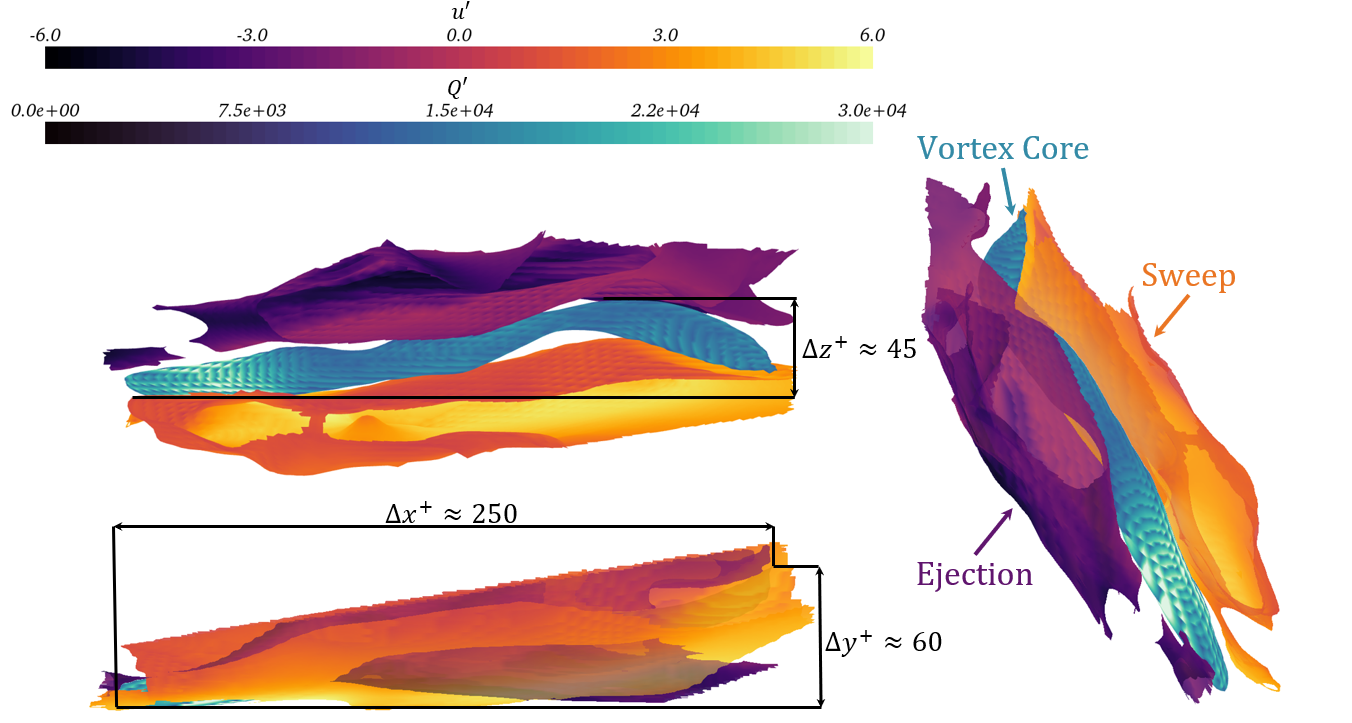
Generating synthetic fluid velocity fields with PGGAN and StyleGAN networks 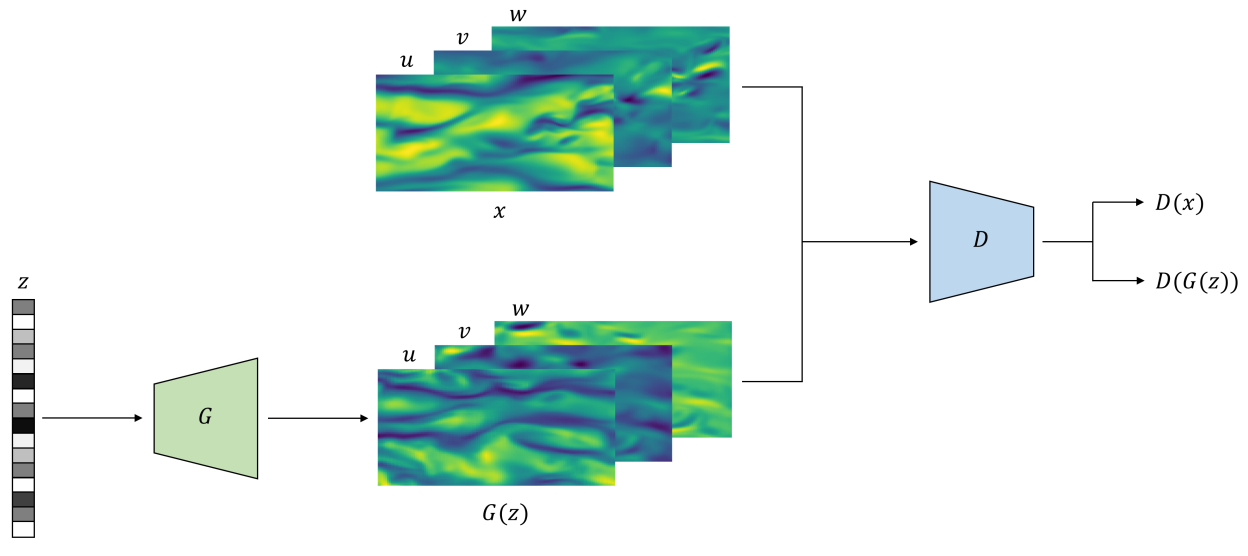
Three dimensional fluid velocity super-resolution 
Teaching Assistant, University of Waterloo, Systems Design Engineering Department, 2021
Identifying, understanding, and analyzing the interactions and impacts among technology, society and the environment for current and emerging technologies.
Teaching Assistant, University of Waterloo, Systems Design Engineering Department, 2021
Fundamental concepts in systems involving fluid flow. Basic treatment of statics, kinematics and dynamics of fluids. Conservation of mass, momentum and energy for a control volume. Dimensional analysis and similarity. Flow in pipes and channels. Brief introduction to boundary layers, lift and drag, ideal and compressible flow.
Teaching Assistant, University of Waterloo, Systems Design Engineering Department, 2021
Geometry and algebra: root-finding, vectors, coordinate systems, lines and planes, conic sections, complex numbers. Introduction to numerical computation. Floating point arithmetic, accuracy and sources of error. Matrix algebra, inverses. Analytical and numerical techniques for systems of linear equations.